
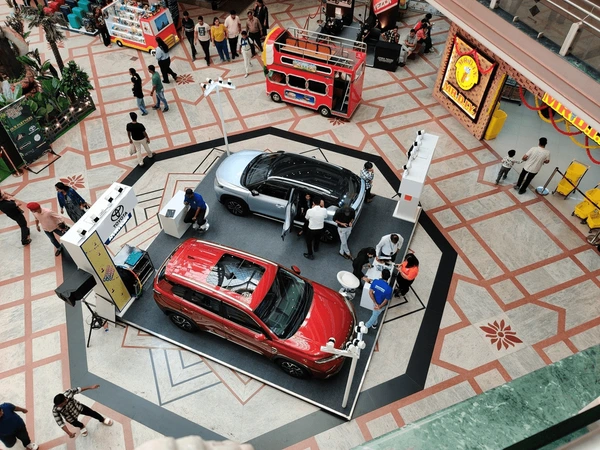
You are walking through your local shopping mall, maybe heading toward the food court or the electronics store, when you see it. A gleaming new SUV, parked right there in the middle of the concourse, roped off with stanchions and polished to a mirror shine. It looks like it belongs there. It does not smell of exhaust. There is no tire trail on the floor. It is as if the car materialized overnight. The question that crosses your mind almost immediately is a simple one: How did they get that car inside the mall?
This is not just idle curiosity. For anyone who has ever tried to maneuver a vehicle through a tight space, the idea of driving one into a climate-controlled, polished-floor, glass-door shopping center seems impossible. Yet car displays in malls are common. They sit in center court, near department store entrances, sometimes on the second floor. They arrive and depart without a scratch, and most shoppers never see the process. The truth is more interesting than you might think, and it involves a combination of clever architecture, careful logistics, and a willingness to do whatever it takes to put a product directly in front of potential buyers.
Foot traffic is the most valuable currency in retail. If you sell something, you need people to see it. But over the past decade, the way people shop for large purchases, especially cars, has changed dramatically. The days of customers spending their Saturday mornings driving from one dealership to the next are fading. Most buyers now spend weeks or even months researching online before they ever set foot on a lot. The average car buyer takes around ninety days from the first online search to the final purchase. That shift has forced dealers to rethink how they capture attention. If the customer will not come to the dealership, then the dealership must come to the customer. And where do you find the highest concentration of potential customers in one climate-controlled, well-lit, secure location? The mall.
Why Car Dealers Are Putting Vehicles Inside Shopping Centers
Placing a car in a mall is not a cheap undertaking. It requires coordination with mall management, payment of display fees, transportation logistics, insurance, and often the involvement of a specialized logistics company. So why do it? The answer lies in the unique advantages that a mall environment provides over every other form of advertising a car dealer can buy.
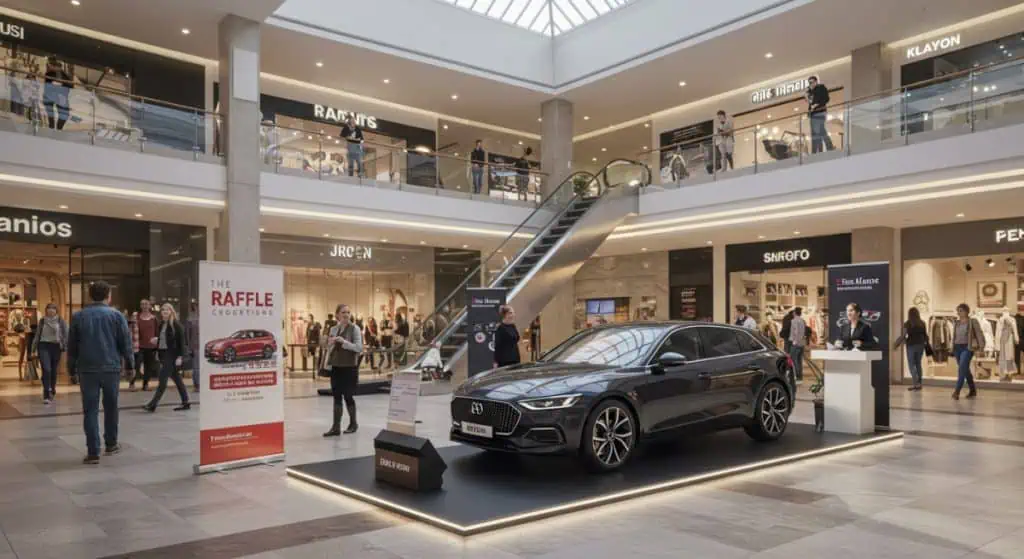
When a person sees a car in a television commercial or a social media advertisement, they are receiving a flat, two-dimensional impression. The image is curated. The angles are chosen. The lighting is perfect, but it is not real. When that same person walks past a physical car in a mall, they can see the actual color in natural light, or in the mall’s lighting, which is close to natural. They can look through the windows. In many cases, they can open the door, sit in the driver’s seat, touch the steering wheel, feel the upholstery, and smell the interior. That physical interaction creates a connection that no digital ad can replicate. The car stops being an abstract concept and becomes a real, tangible object that they can imagine owning.
That is not marketing theory. It is human psychology. We trust what we can touch. We remember experiences more vividly than images. A mall car display turns a passive advertisement into an active experience, and that experience plants a seed that often blooms into a dealership visit weeks later.
Getting Right Into the Heart of Your Primary Market
Every car dealership has a primary market area, a geographic radius from which the majority of its customers come. Typically, this is a ten to twenty mile circle around the dealership. Everyone inside that circle is a potential buyer. The problem is that most of them are not driving past the dealership every day. They are commuting on the highway, running errands, and going to the mall. The mall is the one place where a large percentage of that primary market area congregates regularly. By placing a vehicle inside that mall, the dealer positions its product directly in the path of the very people it wants to reach. It is the physical equivalent of targeted online advertising, except the click-through rate is a person physically touching a car.
Building Brand Recall That Lasts
A display in a high-traffic area builds brand recognition with a staying power that digital ads rarely achieve. A person scrolling through their phone might see dozens of car advertisements in a single hour. By the end of the day, they cannot recall a single one. But that person who walked past a gleaming red SUV in the center of the mall on a Saturday afternoon, who stopped to look through the window, who maybe even sat inside, will remember that vehicle a month later when they start thinking about buying a new car. The physical experience creates a memory anchor that digital impressions struggle to match.
Trackable Results That Other Advertising Cannot Match
One of the frustrations with traditional advertising is the difficulty of measuring return on investment. A billboard may be seen by thousands of drivers, but how many of them actually bought a car as a result? A radio ad plays to an audience, but the link between hearing it and visiting a dealership is murky at best. A mall car display, however, can be directly tracked. Promotional materials at the display can include a unique phone number or QR code. Salespeople can ask customers how they heard about the dealership. If a dealer tracks sales leads carefully, they can know exactly how many sales resulted from the mall display. That kind of measurable return makes the investment justifiable to even the most skeptical business owner.
Complete Creative Control Over the Display
Shopping centers are always looking for ways to enhance the shopper experience, and a well-executed car display accomplishes that. Mall management is often willing to work with dealers to create an attractive setup. Dealers can bring in custom flooring, backdrop displays, lighting, video screens, and even product specialists to answer questions. The display can be rotated with different models and colors to keep it fresh. This level of customization allows a dealer to present the vehicle exactly as they want it to be seen, in a setting that enhances the car’s appeal. The polished floors, the ambient lighting, the climate-controlled air, all of it makes the car look better than it ever does on a sun-baked asphalt lot.
Creating an Authentic Offline Connection
In an era where screens dominate our attention, a real-world interaction feels refreshing. People trust what they experience with their own senses. A car in a mall offers that genuine, unfiltered experience. There is no algorithm curating it. There is no pop-up ad blocking the view. It is just a person and a car, face to face. That authenticity resonates, and it builds a level of trust that digital marketing struggles to achieve.
The Hidden Logistics of Getting a Car Into a Shopping Mall
Now for the part most people find genuinely fascinating. The car is inside the mall, but the mall is not a parking garage. The corridors are not designed for vehicles. The doors are not drive-through bays. So how does a full-size SUV, or even a compact sedan, actually get from the loading dock to the center court without leaving a trail of destruction? The answer involves several cleverly designed infrastructure features that most shoppers never notice.
The Special Drive-In Entry Points Every Mall Has
Every major shopping mall is built with service access points that are hidden from the public. These are not the main entrances with their glass doors and welcome mats. They are large, industrial-grade bays located at the back of the building or on the lower level, accessible only to mall employees and authorized contractors. These loading bays are designed to accommodate delivery trucks, maintenance vehicles, forklifts, and, yes, cars. The openings are typically large enough for a box truck to back into, which means a passenger vehicle can drive through with room to spare. From the loading dock, service corridors lead directly into the back-of-house areas of the mall. These corridors are wide, high-ceilinged, and built to withstand the weight of heavy equipment. They are the highways that allow the mall to function without shoppers ever seeing a pallet of merchandise or a maintenance cart.
When a dealer arranges to display a car, the logistics team uses these service corridors to move the vehicle from the loading bay to the display location. The route is planned in advance. Floor load capacities are checked. Turns are measured. Columns and overhead obstacles are identified. The car is driven slowly, often with spotters walking alongside to ensure clearance. The tires are spotless. Any vehicle entering a mall’s public area is thoroughly cleaned, including the undercarriage, to prevent dirt, oil, or debris from marking the floor. In many cases, protective coverings are temporarily laid down on the corridor floors to prevent any chance of tire marks during the transit.
Revolving Doors That Are Secretly Much Larger Than They Appear
One of the most surprising facts about modern mall design is that many of the large revolving doors at main entrances are not fixed structures. They are engineered to disassemble or fold away. A typical mall entrance might feature a grand revolving door that looks like it is permanently installed, but in reality, the central panels can be removed, the frame can be collapsed, and the entire opening can expand to a width of three meters or more. This design feature is not widely advertised, and the average shopper would never know it exists. It is there specifically for occasions when the mall needs to bring in something large, a grand piano for a concert, a massive holiday decoration, or a car for a display. Maintenance staff can have the door disassembled in under an hour, the vehicle can be driven or pushed through, and the door can be reassembled without any visible trace of the operation.
In some older malls that lack these newer expandable doors, the answer is even more direct. Designers planned intentionally removable wall panels near certain entrances. From the outside, these panels look like part of the building facade. From the inside, they are held in place with bolts that can be removed. When a large object needs to enter, the panels are taken down, the vehicle is moved through, and the panels are reinstalled. The whole process happens after hours, in the dead of night when the mall is empty and the cleaning crews are the only witnesses.
Still other malls use temporary ramps and modified freight elevators. A vehicle can be transported to an upper level by driving it onto a designated freight elevator, one that is rated for the weight and has dimensions large enough to accommodate a car. The elevator descends to the loading dock level, the car is driven on, and it rises to the upper floor where it is driven off directly onto the concourse. These freight elevators are hidden behind unmarked doors in employee-only areas, invisible to shoppers.
The Nighttime Operation That Most People Never See
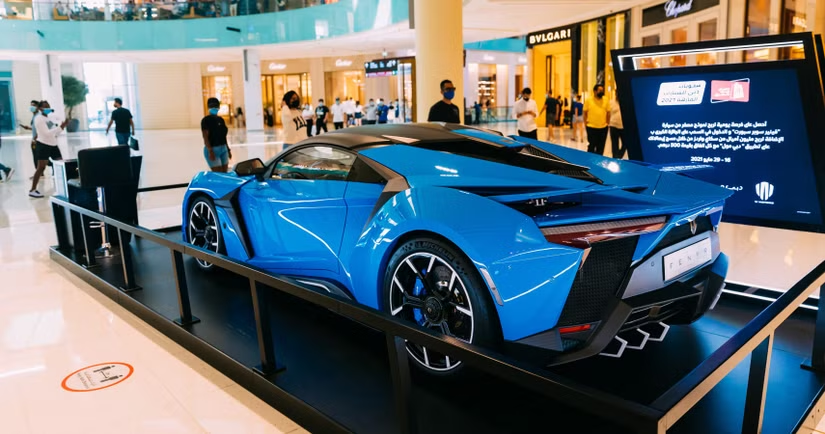
The process of moving a car into a mall display almost always happens after the shopping center closes. This is partly for practical reasons, empty corridors make navigation easier and safer, and partly for the theatrical effect. A car appearing overnight adds to the sense of magic. The logistics team typically arrives around midnight. The vehicle is transported to the mall on a flatbed truck or driven directly if the distance is short.
At the loading dock, the team checks the route one final time, lays down protective materials if needed, and begins the slow, careful drive through the service corridors. Spotters with radios walk ahead and behind, calling out clearances. The driver inches forward. When the vehicle finally reaches the display location, it is guided into its final position with inch-level precision. Chocks are placed behind the wheels. The battery is disconnected to prevent any accidental electrical drains or alarm triggers. Stanchions and ropes are set up. The display materials are arranged. By the time the first shoppers arrive the next morning, the car looks like it has been there forever.
Removal follows the same process in reverse. At the end of the display period, which can last anywhere from a weekend to several months, the team returns after closing. The stanchions are removed, the battery is reconnected, the tires are checked, and the car is started. It is driven back through the service corridors to the loading dock, loaded onto a truck if necessary, and transported away. Within hours, the space where the car sat is cleaned, and no evidence remains that a vehicle was ever there.
Planning a Mall Car Display: What Dealers Need to Consider
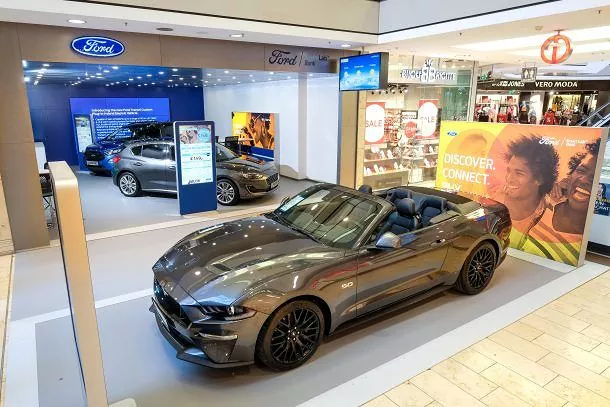
For a business considering a mall car display, the visible car is only the tip of the iceberg. The planning that goes into a successful display is extensive. The first step is negotiation with mall management. Malls charge a fee for the privilege of occupying retail space, even if that space is a concourse. The cost varies widely based on location, foot traffic, duration, and the size of the display. A prime center-court spot in a busy regional mall during the holiday shopping season can cost thousands of dollars per week. A smaller display in a less trafficked area might be significantly cheaper. The fee often includes access to electricity for lighting and video displays, as well as security monitoring by the mall’s personnel.
Insurance is another major consideration. The dealership’s policy must cover the vehicle while it is inside the mall, and the mall’s management will require proof of coverage. Any damage to the mall’s property, a scratched floor, a bumped pillar, is the responsibility of the dealer. Reputable logistics companies carry their own insurance for the transport and placement process.
The vehicle itself must be prepared. It cannot leak any fluids, not a drop. Even a small oil drip will stain the mall floor and result in a significant cleaning charge. The vehicle is typically placed on a thin protective mat that is hidden under the car and extends a few inches beyond the tires. The fuel tank is kept nearly empty to reduce fire risk and odor. The battery is disconnected. The doors may be left unlocked so shoppers can sit inside, or they may be kept locked if the display is meant to be viewed from the outside only. The decision depends on the dealer’s goals and the mall’s rules.
Staffing the display is another variable. Some dealers choose to have a product specialist on hand during busy hours to answer questions and collect contact information from interested shoppers. Others opt for a passive display with brochures and a QR code that links to a dedicated landing page. The passive approach is less expensive but generates fewer direct leads. The staffed approach generates more leads but requires labor that could otherwise be used at the dealership.
The Evolution of Mall Car Displays and What They Tell Us About Retail
The car in the mall is more than a sales tactic. It is a sign of a broader shift in how companies think about physical space. As online shopping has grown, malls have lost some of their traditional retail tenants. Clothing stores, electronics retailers, and bookstores have all contracted or disappeared. In their place, experiential marketing has risen. Malls are becoming places where brands go not just to sell products, but to create experiences that build long-term customer relationships. A car display is a perfect example. It does not expect you to buy the car on the spot. It expects you to sit in the driver’s seat, imagine yourself owning it, and walk away with a positive memory that will influence your decision weeks or months later when you are actually ready to purchase.
This strategy works because it respects the modern buyer’s journey. Today’s car buyer does not want to be sold to. They want to discover, to research, to interact, and to decide on their own timeline. The mall car display is the discovery phase, made tangible. It puts the product in a low-pressure environment where the buyer can engage with it without a salesperson looking over their shoulder. That freedom to explore on their own terms is exactly what many consumers want.
The logistics of getting the car in and out of the mall, the loading docks, the hidden doorways, the overnight operations, are all in service of that one simple idea: meet the customer where they are. In a world where attention is fragmented across screens, the mall remains one of the few places where a large, diverse audience gathers in one physical location. Putting a car in the middle of that gathering is not just a clever marketing stunt. It is a calculated investment in brand presence that pays dividends for years.
So the next time you see a vehicle parked inside your favorite shopping center, take a moment to appreciate what went into getting it there. The late-night drive through hidden corridors, the specially designed doors that opened just wide enough, the tire marks that were never left, and the team that made it all look effortless. The car did not appear by magic. It appeared by careful planning, clever engineering, and a deep understanding of how to capture human attention in a world that is increasingly difficult to impress. And now you know how it all works. The question is not how they got that car in the mall. The question is what you will do with that knowledge the next time you sit behind the wheel of a display vehicle and imagine the possibilities.