

If your Mitsubishi has thrown a P1773 code (DTC definitions not found) and you are trying to make sense of it, you are in the right place. This code is one of those that can feel confusing at first because it sits at the intersection of two major systems: the transmission and the ABS. Understanding what it actually means, what causes it, and what needs to happen to fix it will save you time, money, and a lot of unnecessary stress.
Let us break it all down in plain language.
What Does the Mitsubishi P1773 Code Actually Mean?
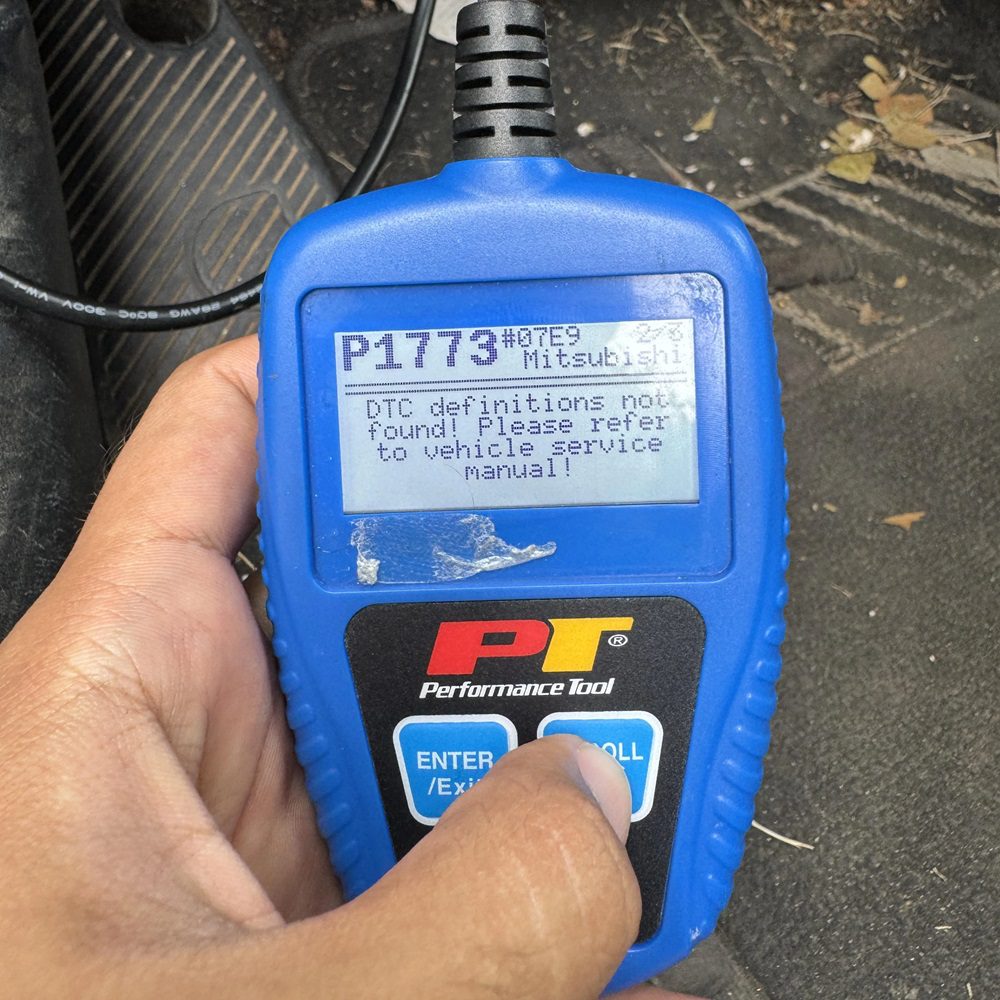
The P1773 is a manufacturer-specific diagnostic trouble code (DTC) that points to a malfunction in the clutch pressure control solenoid valve circuit, specifically within a Continuously Variable Transmission (CVT). On certain Mitsubishi models, including the Outlander, this code also has a relationship with ABS sensor data because the CVT uses wheel speed information from the ABS sensors to help manage transmission behavior.
Here is the short version: the code is telling you that the clutch pressure control solenoid valve, the component responsible for regulating hydraulic pressure inside the CVT, is either malfunctioning or not receiving the correct electrical signal. When hydraulic pressure is not controlled properly inside a CVT, the transmission cannot manage gear ratios smoothly. That leads to rough performance, potential transmission damage over time, and that check engine light staring at you from the dash.
On top of that, because the CVT communicates with the ABS system for wheel speed data, a faulty ABS sensor, particularly the right rear or left front sensors on Mitsubishi Outlander models, can also trigger or contribute to this code appearing. So you are potentially dealing with one problem or two, depending on what the full diagnostic reveals.
What the CVT and ABS Have to Do With Each Other
This connection confuses a lot of people because the transmission and the braking system seem like completely separate concerns. But in modern vehicles, these systems share data. The ABS wheel speed sensors do more than just help with braking. They feed real-time wheel speed data to multiple systems across the vehicle, including the CVT control module, the stability control system, and the traction control system.
The CVT uses that wheel speed data to determine how aggressively it should modulate the drive belt and pulley system when you accelerate or decelerate. If one of the ABS sensors is sending bad data, corrupted data, or no data at all, the CVT control module may not be receiving accurate wheel speed information. That disrupts its ability to manage the transmission correctly, which can trigger fault codes like P1773 in addition to ABS-specific codes.
So when you see P1773, the cause might be purely inside the transmission (a bad solenoid), purely in the ABS system (a bad wheel speed sensor), or a combination of both. That is exactly why a proper diagnostic scan is so important before any parts are ordered or replaced.
Symptoms You Might Notice When P1773 Is Active
Not every P1773 code produces obvious drivability symptoms right away. In some cases, the only indication is the warning light. But as the underlying problem progresses, you may notice more. Here is what to watch for:
Check Engine Light or Service Engine Soon Warning
This is almost always the first sign. The ECU detects the fault in the solenoid circuit or the ABS sensor signal and logs the P1773 code, which illuminates the check engine light. Seeing this light does not tell you how serious the problem is on its own, which is why reading the actual codes with a scanner is always the right first move rather than guessing.
ABS Warning Light

If the P1773 code is being triggered or accompanied by an ABS sensor fault, you may see the ABS warning light illuminate alongside the check engine light. This confirms that the ABS system is involved in the fault, which shifts part of the diagnostic focus toward the wheel speed sensors rather than exclusively the transmission solenoid.
Rough or Hesitant Transmission Behavior
A CVT that is not receiving correct hydraulic pressure from a malfunctioning solenoid can exhibit sluggish acceleration, hesitation during gear ratio changes, a shuddering sensation under load, or a feeling that the transmission is slipping. These symptoms may be subtle at first and worsen as the fault progresses.
Reduced Braking Confidence or ABS Activation at Unexpected Times
If a faulty ABS sensor is contributing to the P1773 code, the ABS system itself may behave erratically. This can include the ABS activating during normal braking on a dry road, which is a clear sign that wheel speed sensor data is corrupted. While your standard brakes will still work, the ABS protection layer becomes unreliable.
Stability or Traction Control Warnings
Because the ABS wheel speed sensors feed data to the stability and traction control systems as well, a faulty sensor can knock those systems offline too. You may see additional warning lights for these systems appearing alongside the P1773 code if an ABS sensor is the root cause.
What Causes the Mitsubishi P1773 Code?
There are three main failure areas that trigger this code. In some cases it is one of them. In others, it is a combination. Here is each one explained in detail.
1. Faulty Clutch Pressure Control Solenoid Valve
This is the most direct cause of the P1773 code. The clutch pressure control solenoid valve sits inside the CVT valve body and is responsible for regulating the hydraulic pressure applied to the transmission’s clutch packs. In a CVT, precise hydraulic pressure control is what allows the transmission to vary its gear ratio smoothly across a continuous range rather than in fixed steps like a conventional automatic.
When this solenoid fails, whether from internal wear, contamination from degraded transmission fluid, or electrical failure of the solenoid coil itself, the hydraulic pressure it controls becomes either too high, too low, or erratic. The CVT control module monitors the pressure output and compares it against expected values. When the actual output falls outside the acceptable range, it logs the P1773 fault code.
Solenoid failures on CVT-equipped vehicles are often accelerated by infrequent CVT fluid changes. Old, degraded CVT fluid carries contaminants and varnish deposits that can clog solenoid passages and cause them to stick open or closed. This is one of the main reasons CVT fluid changes are more important than many owners realize.
2. Wiring and Harness Problems
The clutch pressure control solenoid valve is an electrically operated component. It receives control signals from the CVT control module through a wiring harness. If that wiring is damaged, the solenoid cannot receive the correct commands regardless of whether the solenoid itself is functioning.
Wiring issues that can cause P1773 include:
- An open circuit in the solenoid wiring, meaning the wire is broken or disconnected somewhere along its path
- A short circuit where the wire is contacting a ground or another circuit, sending incorrect voltage signals
- Physical damage to the wiring harness from heat, abrasion, or rodent activity
- Corrosion or damage at the connector that plugs into the solenoid valve
Wiring faults are sometimes intermittent, which makes them particularly frustrating to diagnose. The fault code may clear after a reset and return after driving for a while, which is a characteristic pattern of a wiring issue that only shows up under the heat and vibration of normal driving.
3. Poor Electrical Connections
Even if the wiring itself is intact, a corroded, loose, or contaminated electrical connection at any point in the solenoid circuit can disrupt the signal enough to trigger the fault. Corrosion at the solenoid connector or at the CVT control module connector is a relatively common cause, particularly on older vehicles or those operated in environments with high humidity or road salt exposure.
A connection that looks visually fine can still be causing problems if there is internal pin corrosion or if the connection has developed increased resistance. High resistance in a control circuit can cause the solenoid to receive insufficient current to operate correctly, which the module interprets as a circuit fault.
4. Faulty ABS Wheel Speed Sensor
On Mitsubishi Outlander models specifically, faulty ABS wheel speed sensors, particularly the right rear and left front sensors, are a known contributor to the P1773 code. As explained earlier, the CVT relies on wheel speed data from the ABS sensors. When that data is corrupted or missing, the CVT control module may log a fault code because it cannot correctly interpret vehicle behavior.
A damaged ABS sensor, corroded sensor wiring, or a contaminated reluctor ring at the wheel hub can all produce corrupted wheel speed signals. If P1773 appears alongside ABS fault codes, the ABS sensor should be considered a primary suspect rather than an afterthought.
How to Diagnose and Fix the P1773 Code
Here is the practical step-by-step approach to identifying and resolving this fault correctly.
Step 1: Scan for All Stored Fault Codes
Before anything else, connect a scan tool capable of reading both transmission-specific and ABS-specific codes. A basic OBD-II scanner may only show powertrain codes and miss the ABS and transmission module codes that give you the full picture. Write down every code that is present, not just the P1773. The other codes will tell you whether the ABS sensors are involved, whether there are additional transmission faults, and whether any other systems have been affected.
Also note whether the codes are stored as current (active right now) or pending (detected recently but not confirmed as permanent). That distinction helps you understand whether you are chasing an intermittent fault or a permanent failure.
Step 2: Perform a Visual Inspection
Start with the things you can see before reaching for testing equipment. Here is what to check:
- ABS wheel speed sensors: Inspect the sensor bodies at each wheel hub for cracks, physical damage, or excessive buildup of metallic debris on the sensor tip. Check the wiring from each sensor for fraying, cuts, or corrosion at the connector. Pay particular attention to the right rear and left front sensors on Outlander models.
- CVT solenoid wiring: Trace the wiring harness from the transmission to the CVT control module. Look for sections where the harness is in contact with hot exhaust components, sharp edges, or areas of known abrasion. Check the solenoid connector at the transmission for corrosion or damage.
- CVT fluid condition: Pull the CVT fluid dipstick if your model has one accessible, or check with a shop if it is a sealed unit. Dark brown, burnt-smelling CVT fluid with a gritty texture indicates degraded fluid that may have contributed to solenoid contamination.
Step 3: Test the Electrical Connections
Disconnect the battery before inspecting any electrical connectors in the ABS or transmission circuits. Here is the process for checking connections:
- Disconnect the connector at the clutch pressure control solenoid valve.
- Inspect the connector pins for green or white corrosion deposits, bent pins, or signs of moisture intrusion.
- Clean any corrosion with electrical contact cleaner and a small brush. Allow the connector to dry completely before reconnecting.
- Reconnect the battery and rescan to check whether the fault returns immediately or clears.
If the fault clears after cleaning the connection and does not return, a corroded connector was the root cause. If it returns within a short drive, the problem is either in the solenoid itself or deeper in the wiring.
Step 4: Test the Wiring Circuit
Using a digital multimeter and the vehicle’s wiring diagram for your specific Mitsubishi model and year, check for the following:
- Continuity in the solenoid circuit wires: Each wire in the circuit should show continuity end to end with no breaks.
- No unwanted ground (short to ground): A wire shorted to ground will show near-zero resistance between the wire and the vehicle’s chassis. The resistance should be very high, effectively infinite, on a properly insulated wire.
- Correct voltage at the solenoid connector: With the ignition on and the engine running, the solenoid connector should receive the reference voltage specified in the service manual, typically around 12 volts on the power supply wire.
If the wiring tests reveal a break or short, the damaged section of the harness needs to be repaired or replaced. This is a job that requires careful attention to match wire gauge and connector specifications precisely.
Step 5: Inspect and Replace Faulty ABS Sensors if Applicable
If ABS fault codes are present alongside P1773, test the wheel speed sensors using a scan tool’s live data function. With the vehicle rolling slowly (on a lift with the wheels spinning, or during a slow drive on private property), each wheel speed sensor should show a consistent, proportional speed reading. A sensor showing zero output, erratic spikes, or readings that do not match the other sensors is the faulty one.
Replacing an ABS wheel speed sensor is generally straightforward: raise the vehicle, remove the wheel for better access, unbolt the sensor from the hub, unplug its connector, and install the new sensor. The key is using a quality sensor that meets Mitsubishi’s specifications for signal output. After installation, clear all fault codes and confirm the sensor is reading correctly in live data before considering the repair complete.
Fix 3: Replace the Clutch Pressure Control Solenoid Valve
If the wiring and connections check out and the fault code points firmly at the solenoid itself, replacement is the correct repair. The clutch pressure control solenoid valve is located inside the CVT valve body. On most Mitsubishi CVT applications, the solenoid can be accessed by removing the CVT oil pan and valve body without removing the entire transmission from the vehicle, but this is still a specialized job that requires draining the CVT fluid, working in a clean environment to prevent contamination of the transmission internals, and refilling with the correct Mitsubishi-specified CVT fluid after the repair.
This is not a job for a basic garage with general tools. CVT internals are precision components with very tight tolerances. Contamination of the valve body during solenoid replacement can cause additional problems. This repair is best handled by a shop that has experience with Mitsubishi CVT units specifically.
After replacing the solenoid, the CVT fluid should be replaced with fresh fluid that meets Mitsubishi’s specification, not a generic ATF. Using the wrong fluid in a Mitsubishi CVT is a common mistake that causes premature wear and additional fault codes. Always use the fluid specified in your owner’s manual or by a Mitsubishi technician.

Estimated Cost of Fixing the P1773 Code
Knowing what this repair might cost helps you plan and evaluate quotes from shops. Here is a realistic breakdown:
| Repair Type | Approximate Parts Cost | Approximate Total Cost (with labor) |
|---|---|---|
| Diagnostic scan and assessment | N/A | $75 to $150 (often applied toward repair) |
| ABS wheel speed sensor replacement | $20 to $100 per sensor | $100 to $300 per sensor |
| Wiring harness repair | $20 to $80 (materials) | $150 to $400 depending on damage location |
| Connector cleaning and repair | Minimal (supplies only) | $50 to $150 in labor |
| Clutch pressure control solenoid replacement | $80 to $250 for the solenoid | $400 to $900+ including fluid and labor |
| CVT fluid change (alongside solenoid repair) | $30 to $80 for fluid | Included in solenoid job or $100 to $200 standalone |
Most shops charge between $75 and $150 per hour for labor. A straightforward ABS sensor replacement takes about one hour. A CVT solenoid replacement is a more involved job, typically two to four hours of labor depending on the model and how accessible the valve body is. Always get the diagnostic done first so the repair quote is based on actual identified components rather than assumptions.
Why CVT Fluid Maintenance Matters for Preventing P1773
This is worth its own section because it is genuinely one of the most important things Mitsubishi CVT owners can do to protect their transmission and prevent codes like P1773 from appearing in the first place.
CVT fluid degrades over time from heat and the mechanical stress of operating the belt and pulley system. As it degrades, it breaks down into varnish deposits and fine metallic particles that contaminate the solenoids in the valve body. Solenoids have very small internal passages that can be partially or fully blocked by these deposits, which causes them to operate erratically or fail entirely.
Mitsubishi does not always publish a CVT fluid change interval in older owner’s manuals, and some manuals describe the fluid as lifetime fill. In real-world operation, CVT fluid should be changed every 40,000 to 60,000 miles to maintain optimal solenoid function and extend the life of the transmission. On vehicles used for towing, frequent short trips, or driving in extreme temperatures, more frequent changes are advisable.
When having CVT fluid changed, always confirm the shop is using Mitsubishi-approved CVT fluid. The fluid specification for Mitsubishi CVTs is different from standard automatic transmission fluid and from other manufacturers’ CVT fluids. Using the wrong type accelerates wear rather than preventing it.
Which Mitsubishi Models Are Most Commonly Affected?
The P1773 code is most frequently reported on CVT-equipped Mitsubishi models. The Outlander is probably the most commonly discussed, particularly the 2007 to 2013 model years, but the code can appear on any Mitsubishi vehicle with a CVT and clutch pressure control solenoid monitoring. This includes:
- Mitsubishi Outlander (2003 to present CVT models)
- Mitsubishi Outlander Sport / ASX (CVT variants)
- Mitsubishi Eclipse Cross (CVT variants)
- Mitsubishi Galant (CVT variants)
If you drive any of these models and have not had the CVT fluid changed in over 50,000 miles, that service should be on your near-term maintenance list even if you are not currently seeing any fault codes. Prevention is significantly cheaper than a solenoid replacement or a transmission rebuild.
Should You Drive With the P1773 Code Active?
This depends on the symptoms you are experiencing alongside the code. If the check engine light is on but the vehicle is driving normally with no transmission slipping or ABS irregularities, you can drive carefully to a shop for diagnosis. But do not put it off for weeks or months.
If you are experiencing any of the following alongside the P1773 code, treat it as more urgent:
- Transmission slipping, shuddering, or hesitating during acceleration
- ABS activating on dry pavement during normal braking
- Multiple warning lights on simultaneously
- Any unusual noises from the transmission area
A CVT operating with incorrect hydraulic pressure is under additional internal stress. The longer it runs in that condition, the higher the risk of more expensive internal damage beyond just the solenoid. Getting this addressed promptly protects your transmission from compounding damage.
Final Thought
The P1773 code is your Mitsubishi telling you that something in the clutch pressure control circuit or the wheel speed sensor data feeding your CVT is not right. Start with a full diagnostic scan, check the ABS sensors if related codes are present, inspect the wiring and connections before ordering any parts, and if the solenoid itself needs replacement, make sure the job is done with fresh Mitsubishi-spec CVT fluid by a shop that knows this transmission. Getting this right the first time is far less expensive than returning with a bigger transmission problem a few months down the road.