
Your brakes are the single most important safety system on your vehicle. Everything else, the engine, the transmission, the suspension, none of it matters if you cannot stop when you need to. So when a warning message pops up on your dashboard specifically about your braking system, that is not something to glance at and forget about.
The “Service Antilock Brake System” message is your vehicle’s way of telling you that something has gone wrong with the ABS, and it needs attention. This warning is especially common in Jeep and Dodge vehicles, though the underlying issues it points to are universal across most modern cars and trucks.
In this guide, we are going to walk through what the ABS actually does, why this warning appears, what causes it, and exactly how to fix it. No technical jargon overload. Just clear, practical information you can actually use.
What Is the Antilock Brake System and Why Does It Matter?
Before we get into causes and fixes, let us make sure we are clear on what the ABS actually does and why losing it is a problem worth taking seriously.
The Antilock Brake System is a safety feature built into most modern vehicles that prevents the wheels from locking up during hard braking. Think about what happens when wheels lock: the tires stop rotating but the car keeps moving. You lose steering control entirely. The vehicle slides in whatever direction physics decides to take it, not necessarily the direction you want to go.
The ABS prevents that from happening. When you stomp on the brakes in an emergency, the system rapidly pulses the brake pressure, applying and releasing it multiple times per second, sometimes as fast as 15 to 20 times per second depending on the system. This keeps the wheels rotating just enough to maintain traction with the road surface, which means you can still steer while braking hard. That ability to steer while stopping is what lets you swerve around an obstacle during a panic stop rather than simply sliding straight into it.
For drivers in snowy, icy, muddy, or wet conditions, the ABS is not just helpful. It is genuinely lifesaving. Those are exactly the conditions where wheels are most likely to lock up, and where maintaining steering control is most critical.
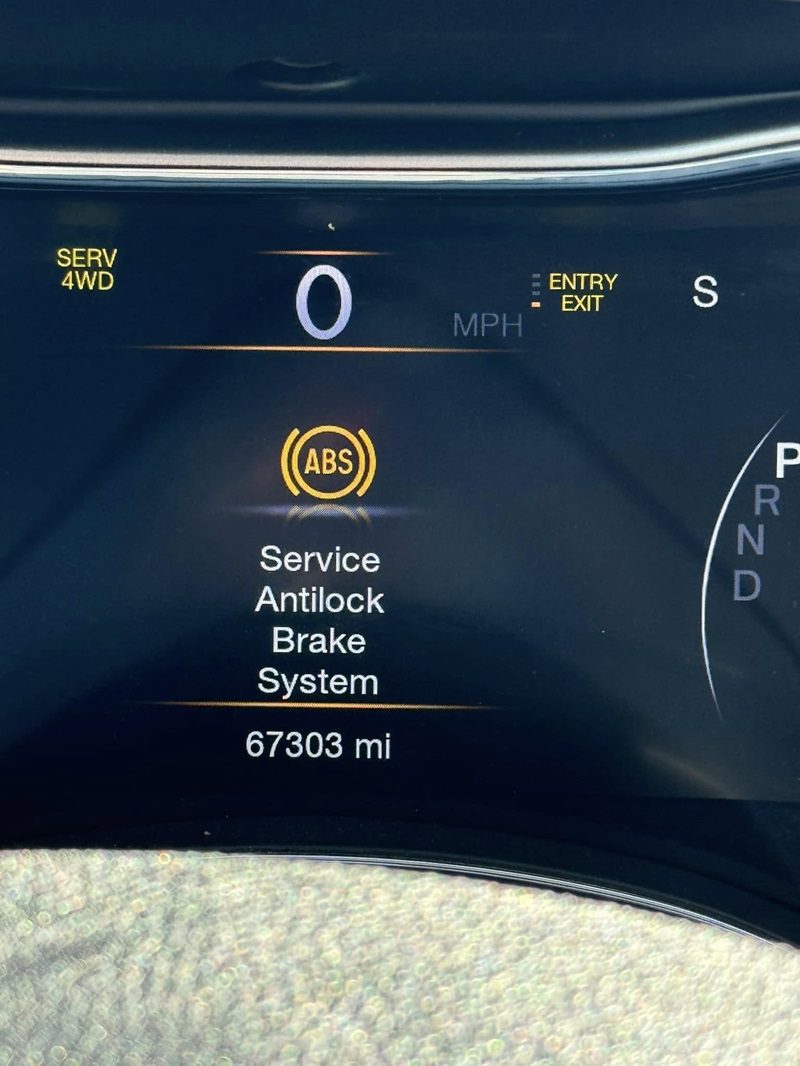
When the “Service Antilock Brake System” warning appears, the ABS has gone offline. Your standard brakes still work. You can still stop the car. But that automatic anti-lock protection is gone, and in an emergency braking situation, especially on a low-traction surface, the difference is significant.
The Four Core Components of the ABS
The ABS is not a single part you can swap out. It is a system of interconnected components that all have to work together. Understanding what each one does helps you understand why a failure in any one of them can bring the whole system down.
1. The Wheel Speed Sensor
Also called the ABS sensor, this is the component that watches how fast each wheel is spinning. There is one at every wheel, and they send continuous speed data to the ABS module. The moment the sensor detects that one wheel is slowing down dramatically faster than the others, a sign that it is about to lock up, it triggers the ABS to intervene.
These sensors are exposed to everything the road throws at them: water, mud, road salt, heat, vibration. They live a hard life, and they are one of the most common failure points in the ABS.
2. The ABS Control Module
Think of this as the brain of the operation. The ABS module receives the speed data from all four wheel sensors, processes it in real time, and makes the decision to activate the ABS when needed. It then sends commands to the hydraulic control unit to modulate brake pressure accordingly.
The module also communicates with your vehicle’s main ECU. When it detects a fault, either in its own function or in one of the components it monitors, it logs a diagnostic trouble code and triggers the warning message on your dashboard.
3. The Hydraulic Valve
The ABS valve sits inside the hydraulic control unit and manages the brake fluid pressure going to each brake caliper. When the ABS activates, the valve rapidly opens and closes to pulse the pressure up and down, which is what creates that familiar pulsing sensation in the brake pedal during a hard stop. There is typically one valve per brake circuit, and they need to be precise in their operation to maintain the right pressure at the right time.
4. The Hydraulic Pump
When the valve releases pressure during ABS activation, that pressure needs to be restored quickly so the brakes can engage again on the next pulse cycle. That is the pump’s job. It works in rapid succession with the valve to maintain the pressure modulation that makes ABS effective. A failing pump means the pressure restoration side of that cycle breaks down, and the system cannot function as designed.
All four of these components work as a unit. If any one of them fails, the ABS module detects the problem and shuts the system down. It would rather go offline completely than try to operate with bad data or compromised hardware. And when it goes offline, the “Service Antilock Brake System” warning appears on your dash.
What Causes the Service Antilock Brake System Warning?
There are several different failure points that can trigger this warning. Let us go through each one in detail so you understand not just what failed, but why it fails and what it looks like in practice.
1. A Broken or Failing Wheel Speed Sensor
This is the number one cause of ABS warning messages across virtually every vehicle brand and model. Wheel speed sensors sit right at the wheel hub, which means they are constantly exposed to the harshest conditions under your vehicle. Road debris, water, brake dust, heat cycles, and the physical vibration of driving all take a toll on these sensors over time.
A sensor can fail in several ways. The sensor body itself can crack or break from physical impact. The wiring that connects the sensor to the ABS module can fray, corrode, or get cut by road debris. The connector can loosen or corrode at the terminal. The reluctor ring, the toothed ring the sensor reads, can accumulate metal shavings or debris that interfere with accurate readings.
In any of these cases, the ABS module stops receiving accurate speed data from that wheel. Without reliable data, it cannot make safe braking decisions, so it shuts down and throws the warning.
Here is a real-world scenario to illustrate this: imagine you drive through a deep puddle at highway speed. A stone kicked up by the tire impact cracks the sensor housing at the rear left wheel. The sensor is still physically there, but it is damaged and sending corrupted data. The ABS module immediately detects the inconsistency and flags the fault. Next time you start the car, the warning is on your dashboard.
2. A Malfunctioning ABS Control Module
The ABS module is more durable than a wheel speed sensor, but it is not immune to failure. Minor electronic glitches can cause the module to temporarily malfunction, displaying the warning even when nothing is physically wrong with the system. These kinds of soft errors can sometimes be cleared with a simple reset.
But modules can also fail in more serious ways. Corrosion inside the module housing, damage from a voltage spike, water intrusion, or just general aging can cause the module to malfunction permanently. When the module itself is the problem, a reset will not hold. The warning will come back, and the ABS will remain non-functional until the module is repaired or replaced.
Module failures can be tricky to diagnose because the module is also the component doing the self-diagnosis. A failing module may report inaccurate fault codes or struggle to communicate with a scan tool. This is one situation where having a professional with proper diagnostic equipment is genuinely important rather than just convenient.
3. A Damaged ABS Valve
The hydraulic valves inside the ABS unit are precision components that operate under high pressure. They can fail in two main ways: stuck open or stuck closed. Both are bad, but for different reasons.
A valve stuck open means brake fluid pressure is constantly bleeding off to that circuit, which can cause a soft or spongy brake pedal and reduced braking force. A valve stuck closed means no pressure modulation is possible to that wheel, which eliminates ABS function at that corner.
The most common cause of valve failure is contaminated brake fluid. Brake fluid naturally absorbs moisture over time, and as it does, it can cause internal corrosion throughout the hydraulic system. Dirty or degraded brake fluid carries contaminants that can clog the small passages in the ABS valves and interfere with their precise operation. This is one more reason why flushing your brake fluid on schedule matters.

4. A Failing ABS Pump
The hydraulic pump has to work hard every time the ABS activates. Over tens of thousands of activation cycles over the life of the vehicle, the pump motor and internal components wear down. The pump can also become clogged with debris from degraded brake fluid, restricting fluid flow and reducing its ability to maintain proper pressure.
When the pump fails or becomes restricted, the ABS cannot complete its pressure modulation cycle properly. The system detects the discrepancy between commanded and actual pressure, logs the fault, and shuts down with the warning light active.
In practice, a failing pump often gives you some warning signs before the system shuts down entirely. You might notice the ABS activating more aggressively or at unexpected times, or the brake pedal behavior might feel slightly different under hard braking. Pay attention to those early signs. Catching a pump problem before it causes a full system shutdown is always preferable.
5. Electrical Problems
The ABS is entirely dependent on a healthy electrical system to function. It needs stable power from the battery, clean ground connections, intact wiring between all its components, and functioning fuses and relays in the ABS circuit.
Any break in that electrical chain can take the ABS offline. Common electrical culprits include:
- Corroded or loose wiring connectors at the wheel speed sensors or ABS module
- Damaged or frayed wiring in the harness running to wheel sensors (particularly at the flex point near the wheel hub)
- Blown ABS fuse in the fuse box
- Failing ABS relay
- A weak or failing battery that cannot supply stable voltage to the electronic systems
Battery issues deserve special mention here. A battery that is marginal or on its way out can cause all sorts of electronic warning messages to appear, including ABS warnings. If your battery is more than four years old and you are seeing multiple electronic warnings appearing at once, or warnings that come and go with no clear pattern, the battery should be your first suspect.
How to Fix the Service Antilock Brake System Warning
Now for the part you actually came here for. Here is how to approach fixing this warning, step by step, starting with the simplest and working toward the more involved repairs.
Step 1: Start With a Proper Diagnostic Scan
Do not start replacing parts based on guesswork. The ABS system stores specific diagnostic trouble codes (DTCs) that tell you exactly where the fault is. Before spending a dollar on parts, connect a scan tool that can read ABS codes (note: not all basic OBD-II readers can access ABS-specific codes; you may need a more capable scanner or a professional scan) and pull the stored codes.
Common ABS fault codes and what they typically indicate:
| Fault Code | What It Typically Means |
|---|---|
| C0035, C0040, C0045, C0050 | Wheel speed sensor circuit fault (specific to each wheel) |
| C0110 | ABS pump motor circuit fault |
| C0121 | ABS valve relay circuit fault |
| C0265, C0266 | ABS relay circuit open or shorted |
| U0121 | Lost communication with ABS control module |
| C0200 | Right front wheel speed sensor circuit fault |
These codes narrow down your diagnosis significantly. A code pointing to the left rear wheel speed sensor means you focus your inspection on that corner of the vehicle, not on the hydraulic pump. That specificity saves you time and money.
Step 2: Inspect and Replace the Wheel Speed Sensor if Needed
If your scan points to a wheel speed sensor fault, start with a physical inspection before ordering a replacement part. Here is the process:
- Raise the vehicle safely and secure it on jack stands at the affected wheel.
- Locate the ABS sensor at the wheel hub. It will have a wire running from it toward the vehicle’s body.
- Inspect the sensor body for visible cracks, corrosion, or physical damage.
- Trace the wiring from the sensor toward the connector. Look for fraying, cuts, or areas where the insulation has worn through from rubbing against the suspension or brake components.
- Check the electrical connector for corrosion at the terminals. Corroded terminals can often be cleaned with electrical contact cleaner, but if the corrosion is severe, the connector or wiring pigtail may need replacement.
- Check the reluctor ring (the toothed ring the sensor reads) for metal shaving buildup, cracks, or missing teeth. A damaged reluctor ring requires replacement of the hub bearing assembly in most cases.
If the sensor itself is damaged, replacement is straightforward on most vehicles. The sensor is typically held in by a single bolt and unplugs from the wiring harness. Replacement sensors are generally not expensive, usually ranging from $20 to $100 depending on the vehicle. Labor adds to that if you have a shop do the work, but it is a relatively quick job on most models.
After replacing the sensor, clear the fault codes with your scan tool and take the vehicle for a test drive. The ABS warning should clear once the module receives consistent, accurate data from the new sensor.
Step 3: Reset or Replace the ABS Module
If the diagnostic points to the ABS module itself, start with a reset rather than immediately jumping to replacement. A reset clears any stored soft errors and allows the module to reinitialize. You can do this with a capable scan tool by clearing the stored fault codes and then cycling the ignition.
After the reset, take the vehicle for a test drive that includes a few instances of moderate to firm braking to allow the ABS module to run through its self-check cycle. If the warning stays off and does not return, the reset solved the problem.
If the warning returns quickly, particularly if it returns with the same fault code pointing to the module itself, replacement is likely necessary. ABS module replacement is a more involved job with a higher parts cost, typically $300 to $800 or more for the module itself depending on the vehicle. On some vehicles, a replacement module also needs to be programmed to match the vehicle’s VIN, which requires dealer-level equipment.
Before committing to a new module, it is worth getting a second opinion from a qualified technician. Module failures can sometimes be misdiagnosed when the actual fault is in the wiring or connectors communicating with the module rather than the module itself.
Step 4: Inspect and Replace the ABS Valve
ABS valves are part of the hydraulic control unit (HCU), which is a combined assembly that houses both the pump and the valves. In most cases, individual valves cannot be replaced separately. If a valve is confirmed faulty, the repair usually involves replacing the entire HCU assembly.
Before condemning the HCU, make sure you have verified the following:
- The brake fluid is clean and at the correct level. Dirty fluid is the most common cause of valve contamination and sticking.
- The fault code specifically points to a valve circuit fault rather than a sensor or module issue.
- The wiring to the HCU has been inspected and is intact.
If the HCU does need replacement, this is a job for a professional. The hydraulic brake system needs to be opened and refilled, which requires proper bleeding procedure to remove all air from the brake lines. Air in the brake lines equals a spongy pedal and compromised braking performance. This is not a job to cut corners on.
Step 5: Address Any Electrical Issues
Electrical faults require a systematic approach. Guessing at electrical problems usually just results in wasted time and unnecessary parts purchases. Here is how to work through it methodically:
- Check the ABS fuse. Find the ABS fuse in your fuse box (check the owner’s manual for its location) and visually inspect it. A blown fuse has a clearly broken element inside. Replace a blown fuse with one of the exact same amperage rating.
- Test the battery. Have the battery load-tested at an auto parts store or with a proper battery tester. A resting voltage above 12.4 volts does not necessarily mean the battery is healthy. Load testing reveals whether it can maintain voltage under the electrical demand of starting and operating the vehicle.
- Inspect the ground connections. ABS systems are sensitive to poor grounds. Check the main ground connection from the battery to the chassis and any ABS-specific ground points referenced in your vehicle’s wiring diagram.
- Inspect the wiring harness. Pay particular attention to the sections near wheel sensors, where the harness flexes constantly with suspension movement. Look for spots where the outer insulation has worn through from contact with suspension or brake components.
- Check the ABS relay. If your vehicle has a separate ABS relay, test it by swapping it with an identical relay from another circuit to see if the fault changes.
If the electrical diagnosis is beyond your comfort level, take it to a professional. Electrical faults in safety systems are not an area to guess your way through.

What Happens to Your Brakes When the ABS Is Offline?
This is something a lot of drivers wonder about when the ABS warning first comes on. Can I still brake normally? Will my brakes still work?
The short answer is yes, your brakes still work. The ABS is a supplemental system that operates on top of your conventional braking system. When the ABS goes offline, you revert to braking the way vehicles worked before ABS was invented. Your calipers still clamp the rotors, friction still slows the wheels, and the vehicle still stops.
But here is the difference in a panic stop on a slippery surface: without ABS, if you brake hard enough to lock the wheels, they will lock. And locked wheels mean no steering control and often a longer stopping distance on low-traction surfaces. The vehicle goes where momentum and physics decide to take it, not where you steer it.
Experienced drivers can mimic a basic form of threshold braking by modulating the brake pedal manually during a hard stop, but this is extremely difficult to do precisely in an actual emergency situation where reaction time and adrenaline are factors.
In addition, some vehicles also disable the Electronic Stability Control (ESC) and traction control systems when the ABS goes offline, because both of those systems rely on the same wheel speed sensor data and ABS hardware to function. If your ABS warning is accompanied by a traction control or ESC warning, that is likely what has happened.
How to Keep Your ABS Healthy and Prevent Future Failures
Reactive repairs are always more expensive than preventive maintenance. Here are some practical habits that protect your ABS and reduce the chances of seeing that warning message in the first place.
Flush Your Brake Fluid on Schedule
This is the single most overlooked piece of brake system maintenance. Brake fluid absorbs moisture over time, which lowers its boiling point and promotes internal corrosion throughout the brake hydraulic system. That corrosion is what leads to stuck ABS valves and degraded pump performance.
Most manufacturers recommend a brake fluid flush every two years or so, though some modern vehicles with longer-life fluids can go longer. Check your owner’s manual for the specific interval. If you do not know when the brake fluid was last changed, have it tested. Shops can use a simple moisture tester on the fluid to determine if it needs changing.
Have Wheel Speed Sensors Inspected During Brake Jobs
Any time you have brake pads or rotors replaced, ask the technician to take a quick look at the wheel speed sensors and their wiring at each corner. The wheels are already off the car during a brake job, so there is no extra labor cost for this inspection. Catching a sensor with a cracked housing or corroded wiring before it fails completely can save you an unscheduled repair visit later.
Do Not Ignore Minor ABS Activations That Feel Wrong
The ABS activating briefly on a slippery road is normal. But if you notice the ABS activating when it should not, such as during normal braking on a dry road, or activating more aggressively than usual, that is an early warning sign that something is starting to fail. Get it checked before the system shuts down completely.
Keep the Battery in Good Shape
A healthy battery is the foundation of every electronic system in your vehicle. Have it tested annually once it is more than three years old. Replace it proactively when it shows signs of weakness rather than waiting for it to leave you stranded or cause a cascade of electronic warning messages including ABS faults.
Protect Your Wiring From Road Debris and Wear
If you frequently drive on rough roads, gravel, or unpaved surfaces, the wiring near your wheel speed sensors is taking more abuse than average. Consider having an inspection of the sensor wiring done more frequently. Some technicians recommend applying a wiring protection loom or conduit over particularly vulnerable sections of the harness to extend its life.
Approximate Repair Costs for Common ABS Failures
Having a rough idea of what repairs cost helps you know whether you are being quoted fairly and plan accordingly. These are general estimates and will vary by vehicle make, model, and location.
| Repair | Approximate Parts Cost | Approximate Total Cost (with labor) |
|---|---|---|
| Wheel speed sensor replacement | $20 to $100 per sensor | $100 to $300 per sensor |
| ABS control module replacement | $300 to $800+ | $500 to $1,200+ |
| ABS hydraulic control unit (HCU) replacement | $400 to $1,000+ | $700 to $1,500+ |
| Brake fluid flush | $15 to $30 (fluid) | $80 to $150 |
| Wiring repair (minor) | $20 to $50 (materials) | $100 to $300 depending on complexity |
| Battery replacement | $100 to $250 | $150 to $350 |
| ABS fuse replacement | Under $5 | Under $30 |
Always get a diagnostic scan done before authorizing any ABS repair. Knowing the exact fault code before spending money on parts is the difference between a targeted repair and an expensive guessing game.
Should You Drive to the Shop or Call a Tow?
This is a practical question that comes up every time a warning light appears. For the ABS warning specifically, here is how to think about it.
If the only warning on your dash is the ABS light and your brakes feel completely normal, you can drive to a shop. Your standard braking is still intact. Just be aware that you are without the antilock protection, so drive with extra following distance and more caution in poor weather conditions.
If the ABS warning is accompanied by a red brake warning light, that is a different situation entirely. A red brake light can indicate low brake fluid, a brake system pressure problem, or brake failure. Do not drive a vehicle with a red brake warning light without first checking the brake fluid level and testing the brakes in a safe environment. If the pedal feels soft, spongy, or goes to the floor, do not drive it. Call for a tow.
If the ABS warning comes on while you are driving and the brake pedal behavior changes, such as feeling softer than usual or requiring more effort than normal, pull over safely and call for assistance. Do not keep driving a vehicle that is showing signs of compromised braking performance.
Final Thought
Your regular brakes will still stop the car when the ABS warning is active. But the safety margin that the ABS provides in an emergency, on a wet road, on ice, in a sudden stop, is not something you want to be without longer than necessary. Get the diagnostic done, pinpoint the exact fault, and fix it properly. Brakes are the one system on your vehicle where cutting corners is never worth the risk.