
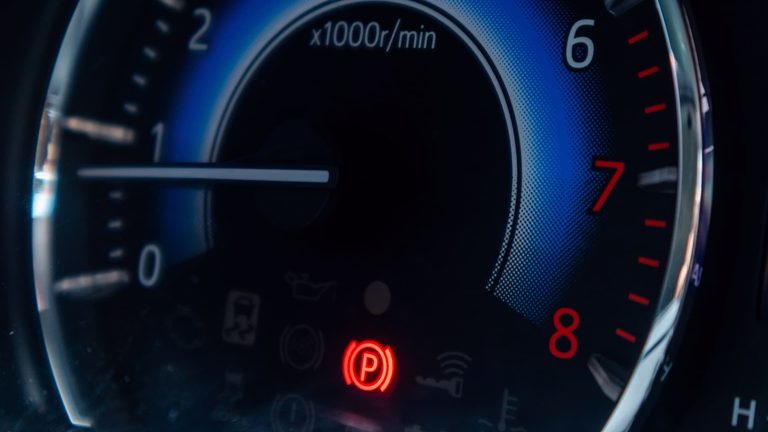
You pull away from the curb, hear a faint scraping sound, and notice the red brake warning light is still glowing on the dashboard. Or perhaps you only realize what happened when you smell hot brakes at the next intersection. Forgetting to release the emergency brake, also called the parking brake or handbrake, is common, especially when the lever was left only one or two clicks up.
A short drive with a lightly applied parking brake usually does not destroy the car. It can, however, create enough heat to damage brake parts if you travel far, drive quickly, carry a heavy load, climb a hill, or continue after the warning signs appear. The risk depends on how firmly the brake is applied, how well the brake is adjusted, whether the car uses rear disc or drum brakes, the road, and how long you keep driving.
The first thing to do is simple: release the brake, stop somewhere safe, and let the affected brakes cool. Do not pour water on them. After that, check for a burning smell, smoke, unusual noise, pulling, a soft pedal, poor acceleration, or a warning light that stays on. If any of those symptoms is severe, have the car inspected before driving normally again.
What happens when you drive with the emergency brake on?
The parking brake normally acts on the rear brakes. When it is applied, a cable, lever, electric motor, or mechanical actuator presses the rear brake shoes or pads against a drum or rotor. The friction keeps the parked vehicle from rolling, but it also creates heat as soon as the wheel tries to turn.
That heat has nowhere to go at first except into the brake pad or shoe, rotor or drum, caliper or wheel cylinder, hub, and surrounding air. A brake that is only slightly applied may produce a little extra drag. A fully applied brake can make the car struggle to move and can raise brake temperatures very quickly.
The engine and transmission do not automatically suffer major damage just because the parking brake was left on. The vehicle may work harder to overcome the drag, but the most direct risk is to the rear braking hardware. On an automatic transmission, continued driving can also create extra heat in the drivetrain because the engine is trying to move a car that is being held back.
The difference between a brief mistake and a damaging event is usually duration and heat. Moving a few feet to reposition the car is not the same as driving several miles through traffic with the brake dragging. A driver who notices the mistake quickly should not panic, but should not ignore the car either.
Why one or two clicks can still matter
A manual parking-brake lever often clicks as the cable ratchet engages. One or two clicks does not tell you exactly how much braking force is being applied. The cable may be adjusted tightly, the rear mechanism may be sticking, or the lever may be partly engaged while the warning switch has not behaved as expected.
Some vehicles have a warning light that comes on as soon as the lever moves from its fully released position. Others rely on a switch that may be worn, misadjusted, or delayed. An electronic parking brake may apply a calibrated amount of force rather than behaving like a simple hand lever. For that reason, do not judge the danger only by the number of clicks.
If the vehicle moved easily, made no unusual noise, and was driven only a short distance, permanent damage is less likely. If the car was difficult to accelerate, smelled hot, or continued to roll only after a lot of throttle, assume the brakes need a closer look.
Parking brake basics: what the system is designed to do
The parking brake is designed to hold a stationary vehicle after the driver parks. It is not normally intended to stop a moving car during everyday driving. On many vehicles it acts on the rear wheels, although the exact design varies. Some cars use a small drum brake inside the rear rotor, some use the regular rear caliper with a mechanical mechanism, and others use an electric motor integrated into the caliper.
The brake system also includes the service brake, which is the pedal-operated system used to slow the car while driving. The service brake and parking brake may share the rear pads, shoes, cables, drums, rotors, or calipers, but they do not always operate in exactly the same way. Knowing which design your car uses helps a technician identify what may have overheated.
In a conventional handbrake, pulling the lever tensions cables that move the rear brake mechanisms. In a foot-operated parking brake, pressing a pedal performs the same basic job. An electronic parking brake uses a switch and an electric actuator, and the vehicle may apply or release it automatically under certain conditions. The Mopar owner’s manual resource can help you find the correct application and release procedure for a Chrysler, Dodge, Jeep, or Ram vehicle. The owner’s manual for your specific car should still take priority over general advice.
The National Highway Traffic Safety Administration’s brake safety information is a useful general reference, but it cannot replace the vehicle owner’s manual or a brake inspection. Brake warning lights, automatic release behavior, and electronic parking-brake procedures differ between models.
Why a parking brake is still needed with an automatic transmission
Putting an automatic transmission in Park locks the transmission through a mechanical parking pawl. That pawl is not a substitute for the parking brake. On a slope, the vehicle can load the pawl heavily, which may make the shifter difficult to move later or place unnecessary force on a small transmission component.
A good parking routine is to stop with the foot brake applied, set the parking brake, and then select Park. On a steep incline, this allows the parking brake to carry the vehicle’s holding load before the transmission’s parking pawl engages. When leaving, apply the foot brake, shift out of Park, and then release the parking brake according to the vehicle’s instructions.
This does not mean every automatic transmission will be damaged if a driver selects Park first. It means using the parking brake properly can reduce the load placed on the pawl and make the car safer if the transmission lock does not hold as expected. If the car is parked on a slope, turn the wheels as recommended for the road position as an additional precaution.
Why a manual transmission should also use the parking brake
Leaving a manual transmission in gear can help prevent the car from rolling, but the gear is not a complete replacement for the parking brake. A manual transmission can resist movement through the engine and drivetrain, yet the car may still move if the clutch slips, the gear disengages, the drivetrain has a fault, or the slope is severe enough to overcome the available resistance.
In normal parking, set the parking brake and leave the transmission in an appropriate gear, following the owner’s manual. Many drivers use first gear when facing uphill and reverse when facing downhill, but the exact parking advice can vary by vehicle and local driving practice. The important point is to use both holding methods rather than trusting the transmission alone.
Leaving a manual car in gear does not normally damage the transmission. The transmission is designed to transmit engine torque through its gears. The parking brake should carry the static holding load, while the selected gear gives you a second layer of protection if the car tries to move.
Driving a manual transmission car with the parking brake on
A manual car can sometimes move with the parking brake partially engaged because the driver can slip the clutch and raise engine speed. That ability can hide the problem. The car may feel lazy, the clutch may smell hot, and the driver may continue giving it throttle without realizing that the rear brakes are fighting the engine.
The parking brake itself can overheat the rear pads or shoes. The clutch can also suffer if the driver uses clutch slip to overcome the resistance. A clutch that is already worn may begin to slip under this extra load, especially during a hill start or when the car is carrying passengers.
How the clutch gets involved
When you release the clutch in first gear, the engine has to move the car and overcome the brake drag at the same time. If the brake is firmly applied, the engine may stall. If the driver adds more throttle and holds the clutch halfway engaged, the clutch disc slips while converting engine power into heat.
That heat can glaze the clutch surfaces or accelerate wear in a clutch that was already near the end of its service life. You may notice a sharp friction smell, a higher-than-normal engagement point, or engine speed rising without a matching increase in road speed. Those signs do not prove the parking brake damaged the clutch, but they justify testing it.
Do not deliberately repeat the event to see whether the clutch slips. A shop can inspect clutch operation during a road test and check for other causes. If the clutch worked normally before the mistake and the car was driven only a short distance, it may be fine, but a strong burnt smell should not be dismissed.
What the driver may feel
- The car feels unusually heavy or reluctant to move.
- The engine needs more throttle than normal to start or climb a hill.
- The clutch engagement feels different or a friction smell enters the cabin.
- The vehicle pulls slightly if one rear brake is dragging more than the other.
- A rear wheel or brake area becomes much hotter than the opposite side.
On a rear-wheel-drive manual car, the parking brake is acting on the same general end of the car that receives engine torque. That can make the resistance more obvious. Still, the drivetrain layout does not make the situation harmless. A rear-wheel-drive vehicle can move with the brake applied if the brake is weak, partially engaged, or overcome by enough engine torque.
Driving an automatic transmission car with the parking brake on
An automatic car may hide the problem because the torque converter allows the engine to keep running while the vehicle creeps forward. The driver may feel a little resistance but assume the car is cold, loaded, or facing a slight incline. Pressing the accelerator can make the car move, but it also increases heat in the engine, transmission, and dragging brakes.
The most direct damage still occurs at the parking-brake assembly and rear brakes. The automatic transmission is not automatically ruined by a short drive with the brake on. If the car is forced to move for a long time, though, the transmission may run hotter because it is transmitting extra torque against the brake drag.
Automatic transmissions use fluid to lubricate and carry heat away from clutches, bearings, gears, and the torque converter. Many vehicles route that fluid through a cooler in the radiator or a separate heat exchanger. Extra load can raise fluid temperature, but the severity depends on speed, ambient temperature, vehicle weight, terrain, transmission condition, and how firmly the parking brake is applied.
A few minutes of slow driving does not justify replacing a transmission. A long trip with a dragging brake, especially uphill or in hot weather, deserves a fluid and brake inspection. If the transmission begins slipping, shifts harshly, refuses to select a gear, or produces a hot-fluid smell after the event, stop driving and have it checked.
Why an automatic may keep moving anyway
At idle, a healthy automatic transmission can deliver enough torque through the torque converter to move a car slowly. If the parking brake is lightly applied, the available engine torque may be greater than the braking resistance. This is why a driver can sometimes travel a surprising distance before noticing the problem.
The fact that the car moves does not mean the brake is fully released. A dragging brake can still produce damaging heat even when it does not stop the vehicle. Think of the brake as a clamp rubbing against a spinning part. The wheel can turn, but the rubbing energy is becoming heat instead of useful motion.
Rear-wheel drive versus front-wheel drive
Drive layout changes what the driver feels, but it does not eliminate the risk. On many rear-wheel-drive vehicles, the parking brake acts directly on the driven rear wheels. The engine has to overcome the brake drag through the driveshaft and differential, so the car may feel heavily restrained or refuse to move if the brake is firmly applied.
A front-wheel-drive car sends engine power to the front wheels while the parking brake usually acts on the rear wheels. The front tires can pull the vehicle forward while the rear brakes drag behind. That can make the mistake less obvious, particularly if the rear parking brake is weak or only partly engaged.
Neither layout makes wheel bearings automatically fail after a short mistake. Wheel bearings can be affected by excessive heat if a rear brake or hub becomes severely overheated, but a normal brief parking-brake error does not guarantee bearing damage. Listen for a new growl, rumble, or roughness after the brake cools, and have the hub checked if the noise remains.
What may happen on a rear-wheel-drive car
If the rear parking brake is firmly applied, the car may feel as though something is holding it back. The engine may load heavily, the automatic transmission may creep less than usual, or a manual car may stall when the clutch is released. A strong burning smell can appear near the rear wheels.
If the brake is worn, out of adjustment, or only partially engaged, the car may move normally enough for the driver to miss the warning. The rear pads or shoes can still overheat. A brake that is weak when parked may be unsafe on a slope, so the problem should be repaired rather than treated as a benefit because it allowed the car to drive.
What may happen on a front-wheel-drive car
The driven front tires can often pull the car forward even while the rear brakes drag. Acceleration may feel dull, and the engine may work harder, but the driver may not get the dramatic resistance experienced in a rear-wheel-drive vehicle.
The rear brake components can become hot without the steering wheel immediately giving a warning. If one rear brake is tighter than the other, the car may pull or feel unsettled during braking. A hot rear rotor or drum can also damage seals, grease, shoes, pads, and nearby rubber components.
Do not use the idea of a front-wheel-drive car pulling away as proof that everything is fine. It only means the engine’s torque is overcoming the resistance. The rear brakes may still be absorbing a large amount of energy.
What parts can be damaged?
Brake pads and shoes
Brake pads and drum-brake shoes are friction materials. Excessive heat can glaze the surface, making the brakes noisy or less effective. Severe heat can crack, crumble, or separate friction material, although the likelihood depends on the temperature and condition of the parts.
A glazed pad or shoe may still appear thick enough when viewed through a wheel. Thickness alone does not tell you whether the friction material has been overheated. A technician should inspect the surface, check the hardware, and compare the affected side with the opposite side.
Rotors and drums
A dragging pad can overheat a rear disc rotor. The rotor may develop a blue or dark heat mark, surface cracks, or thickness variation. A drum can also become distorted or develop heat spots. If the brake is applied unevenly, one side may be much hotter than the other.
Do not touch a rotor or drum to judge its temperature. Use your senses from a safe distance, or allow the vehicle to cool completely. A non-contact infrared thermometer can help a trained person compare temperatures, but the reading is affected by surface finish and measurement angle, so it should not replace a brake inspection.
Calipers and wheel cylinders
Rear disc brakes may use a caliper with a mechanical parking-brake lever or electric actuator. Rear drum brakes use wheel cylinders and springs for the service brake, with a separate mechanical shoe mechanism for parking. Excessive heat can damage seals, boots, lubricant, and hydraulic components.
A caliper piston that begins sticking may keep the pad against the rotor after the parking brake is released. A cable may also bind inside its sheath, leaving one side partly applied. If the brake stays hot after release, the original mistake may have exposed a pre-existing adjustment or hardware problem.
Cables and electronic actuators
A conventional parking-brake cable can corrode, stretch, kink, or seize. Releasing the lever inside the cabin may not fully release the brake at the wheel if the cable or pivot is stuck. An electronic parking brake can set a warning message or fault code if the actuator cannot reach its expected position.
Do not repeatedly cycle an electronic parking brake that is making grinding noises or showing a fault. Follow the owner’s manual and have the system scanned if the warning remains. Some systems require a service mode before rear pads can be removed, and forcing the mechanism can damage the actuator.
Wheel bearings and tires
A severely overheated brake can transfer heat into the hub and bearing. The grease may lose its properties, and seals can be affected. This is not the first part I would blame after a short parking-brake mistake, but a new growling noise, looseness, or rough wheel rotation deserves attention.
Tires can wear faster when the brakes drag, especially if the brake causes a wheel to scrub or if the car is driven under heavy load. Uneven tire wear may also come from alignment, suspension, inflation, or normal brake imbalance. Inspect rather than assuming every new tire mark came from the parking brake.
Warning signs after you release the parking brake
The following signs suggest that the brake did more than create a harmless momentary drag:
- A strong smell of hot friction material near a rear wheel or inside the cabin.
- Smoke coming from a wheel or from underneath the car.
- A wheel that remains hot after the brake has been released and the vehicle has cooled for a reasonable time.
- Grinding, scraping, squealing, clicking, or a rattle that was not present before.
- The car pulls to one side while driving or braking.
- The brake pedal feels soft, spongy, unusually low, or different from normal.
- The vehicle refuses to accelerate normally or feels as if it is being held back.
- New vibration through the steering wheel, seat, or brake pedal.
- A brake, ABS, electronic parking-brake, or traction-control warning remains illuminated.
- The parking-brake lever travels farther than before or will not hold the car when parked.
Smoke is a stop-driving symptom. Pull over away from traffic, switch off the engine, keep away from the hot wheel, and call for assistance if the smoke continues or a fire is possible. Do not put your hand near the brake to check it and do not pour water on a hot rotor or drum, because rapid cooling can distort components and steam can burn you.
What to do immediately after noticing the mistake
- Release the parking brake completely. For a manual lever, lower it fully. For a pedal, release it according to the manufacturer’s procedure. For an electronic system, confirm that the dashboard indicator goes out and that the system reports released.
- Find a safe place to stop. Avoid stopping on a blind corner or shoulder with fast traffic if the vehicle is still controllable. Use hazard lights when appropriate.
- Let the brakes cool naturally. Park safely, keep the transmission in the correct position, and do not hold the car with the accelerator. The cooling time varies with the heat generated and the weather.
- Look and listen from a distance. Check for smoke, fluid leaks, a missing cable, damaged wiring, or obvious fresh damage. Do not touch the wheel or brake hardware.
- Decide whether it is safe to continue. A normal pedal, no smell, no smoke, no noise, and a short low-speed drive are reassuring. A warning light, strong smell, smoke, pulling, soft pedal, or severe noise calls for an inspection or tow.
Do not pump the brake pedal repeatedly to cool the brakes. Pumping the pedal will not remove heat from the pads, shoes, rotor, or drum. If the pedal feels soft after the event, do not keep driving in the hope that it will recover.
How to check whether the brake is still dragging
A simple road test can reveal a problem, but it should be done only when the car has no dangerous symptoms. With the brake fully released and the area clear, drive a short distance at low speed without heavy braking. Notice whether the car rolls freely, tracks straight, and accelerates normally.
After stopping, compare the smell and apparent heat at the rear wheels without touching them. A brake that is much hotter than its opposite number may still be dragging. Wheel temperature comparisons are more useful when taken under similar conditions, and they should be interpreted by someone who understands that the front brakes often run hotter during ordinary stops.
A shop can safely raise the vehicle, verify that the wheels rotate, inspect cable travel, check caliper or drum operation, and measure brake temperature. It can also inspect the hydraulic system and scan electronic parking-brake modules. Do not lift a car with an unstable jack for the purpose of spinning the wheels.
How a technician confirms a dragging brake
The technician may compare wheel rotation, inspect the parking-brake lever at each rear wheel, and check whether the cable returns fully. On a disc-brake system, the caliper piston and slide pins are inspected. On a drum system, the shoes, springs, adjuster, and wheel cylinder are checked.
If the brake released but the wheel remains tight, the cause may be a seized caliper, a blocked flexible brake hose, a stuck drum mechanism, a frozen cable, or an electronic actuator problem. Adjusting the cable without finding the cause can hide the fault and leave the brake unsafe.
The brake fluid may also be checked if the brakes became extremely hot or the pedal changed. A parking-brake mistake does not normally boil the entire hydraulic system, but a severely overheated rear brake can affect nearby components. The correct repair follows the inspection rather than a guess.
Can driving with the emergency brake on damage the transmission?
It can add load and heat to the drivetrain, but transmission damage is not the automatic result. The brakes are the first place to investigate. If the car was driven a short distance at low speed and shifts normally afterward, there is no reason to assume the transmission needs replacement.
The risk rises when the driver continues for a long distance, uses heavy throttle, climbs hills, carries a large load, or drives in hot conditions. An automatic transmission may transmit more torque through the torque converter while the car is held back. A manual transmission may suffer clutch heat if the driver slips the clutch to keep moving.
Watch for delayed engagement, slipping, harsh shifts, a new hot-fluid smell, or a transmission warning message after the incident. Those symptoms should be diagnosed, but they can have causes unrelated to the parking brake. A fluid check and scan are more useful than replacing parts based on fear.
Can it damage the engine?
The engine may work harder and run at a higher load, especially at low speed or on a hill. That does not mean the engine has been damaged. A healthy engine can tolerate a brief increase in load, and the driver often releases the parking brake before temperatures become extreme.
Continued high load can contribute to overheating if the cooling system is already weak. Watch the temperature gauge and stop if it rises above normal. Do not keep pressing the accelerator to force the car forward against a brake that is clearly applied.
Reduced engine power after the event may be the computer protecting the vehicle, a transmission response, or simply the result of brake drag. It may also indicate an unrelated engine problem. Scan the car if a warning light appears or if power does not return after the brake issue is corrected.
Why the brake warning light may not save you
Many cars illuminate a red brake warning light when the parking brake is applied. This is helpful, but drivers may miss it because they are watching traffic, the light may be small, or the instrument cluster may be bright during the day. Some vehicles use the same warning light for low brake fluid or another brake-system issue, so it should not be ignored.
A faulty parking-brake switch can prevent the light from operating. A switch that is misadjusted may stay off even though the lever is slightly raised. Electronic systems may show a separate message or warning symbol. Check the light during the normal dashboard self-test and repair it if it never illuminates or never goes out.
In rain, snow, loud traffic, or a vehicle with good sound insulation, the driver may not hear the brake drag. Wet conditions can also change brake noise and make visual clues less obvious. Make a habit of checking the parking-brake indicator before selecting Drive or moving away.
Common mistakes to avoid
Do not assume no smoke means no damage
Brake components can be overheated without producing visible smoke. A burnt smell, unusual wheel heat, or new noise can be an earlier warning. Smoke means the situation is severe, but the absence of smoke does not prove the parts are unaffected.
Do not touch the wheel to test the temperature
A hot rotor, drum, caliper, or wheel can burn you instantly. Even the wheel center or lug nuts may be too hot to touch after a brake has dragged. Let the vehicle cool and use a qualified inspection or suitable non-contact test instead.
Do not pour water on the brakes
Water can shock hot brake components, distort metal, create steam, and spread dirt into areas that need to remain dry. If the brakes are smoking, move away from the vehicle and call for help. Natural cooling is safer.
Do not tighten the parking-brake cable as a quick fix
A loose lever can result from stretched cable, worn friction material, seized hardware, or incorrect adjustment. Tightening the cable without inspecting the rear brakes can leave the brake dragging all the time or prevent it from releasing fully. Adjustment must follow the manufacturer’s procedure.
Do not keep driving because the car still accelerates
Engine torque can overcome a dragging rear brake, especially on a front-wheel-drive car. The fact that the car moves only tells you that the resistance is not greater than the available drive force. Heat is still building at the brake.
How much might the repair cost?
The cost cannot be stated accurately without knowing the vehicle, brake design, part condition, local labor rate, and damage. A brief mistake may require no repair beyond confirming that the brake is operating normally. A badly overheated system may need pads or shoes, rotors or drums, caliper or drum hardware, cables, sensors, or an electronic actuator.
Ask the repair shop to separate inspection, parts, labor, and any electronic calibration. If a brake is replaced, the shop should explain whether the opposite side also needs service. Brakes are normally serviced in axle pairs so that braking remains balanced, but the exact recommendation depends on the parts and vehicle condition.
Do not approve a complete brake overhaul simply because you smelled something once. Do not reject a needed repair because the car still stops. Ask to see the heat damage, uneven wear, cracked friction material, stuck mechanism, or failed test that supports the estimate.
How to prevent the mistake from happening again
- Look at the parking-brake indicator before moving. Make sure the lever is fully down or the electronic system shows released.
- Use the same parking sequence every time so the action becomes automatic.
- Do not place bags, coats, or accessories where they hide the lever or instrument warning.
- If the warning light does not operate correctly, repair it rather than relying on memory.
- Have a loose lever, stiff pedal, or electronic parking-brake warning diagnosed promptly.
- When borrowing a vehicle, ask how its parking brake works. A pedal, lever, and electronic switch do not all release in the same way.
For an automatic car, my preferred habit is foot on the service brake, apply the parking brake, select Park, then release the service brake. For a manual car, apply the parking brake, select the appropriate gear, and release the clutch only after the car is secured. Follow the vehicle manual if it gives a different procedure.
When the parking brake itself is the real problem
If the vehicle moves freely after you release the brake but will not hold on a slope, the mistake may have exposed a weak parking-brake system. Worn shoes, stretched cables, seized pivots, a damaged ratchet, incorrect adjustment, or an electronic actuator fault can all reduce holding ability.
A parking brake that does not hold is a safety issue even if the service brake works perfectly. The car can roll after you leave it, especially if it is parked on an incline. Use the service brake to stop the vehicle, but have the parking-brake system repaired rather than depending on the transmission or a wheel turned against the curb.
If the brake will not release, do not force the car forward. A frozen cable, seized mechanism, or electronic fault may keep the rear brake clamped. Repeated throttle can turn a repairable release problem into overheated friction material and damaged hardware.
When to DIY and when to call a mechanic
A driver can safely release the brake, read the warning light, observe symptoms, and arrange an inspection. A basic visual check is reasonable if the car is parked safely and the exhaust and brakes are cool. You can also record how far you drove, the speed, the road grade, the warning lights, and any smell or noise.
Brake inspection and repair require more caution. Use jack stands and proper wheel chocks if the vehicle must be lifted, and never work under a car supported only by a jack. Rear drum brakes contain springs under tension, and electronic parking brakes may require service mode and a scan tool.
Call a mechanic or roadside service if there is smoke, a soft pedal, a strong continuing smell, a wheel that locks, severe pulling, a warning message, or any uncertainty about whether the brake released. The cost of an inspection is small compared with the cost of losing braking control or damaging several components.
The bottom line for a forgotten parking brake
Driving a short distance with the emergency brake or parking brake slightly raised often has minimal consequences, especially if the car moved normally and no heat or warning signs appeared. A longer drive can overheat the rear pads or shoes, rotors or drums, calipers, cables, and nearby parts. A manual car may also overheat its clutch if the driver used clutch slip to overcome the resistance, while an automatic car may place extra load and heat into the drivetrain.
Front-wheel-drive and rear-wheel-drive cars behave differently, but neither is protected from damage. A car that keeps moving may still be dragging a brake. The safest response is to release the brake, stop when practical, let the system cool naturally, and check for smell, smoke, noise, pulling, poor acceleration, warning lights, and a changed pedal.
If everything feels normal after a very short drive, monitor the car and mention the event at the next service visit. If a symptom remains, have the brakes inspected before normal driving. My mechanic’s verdict is straightforward: forgetting the parking brake once is usually recoverable, but continuing to drive after the car tells you something is hot or wrong is where a small mistake becomes an expensive repair.