
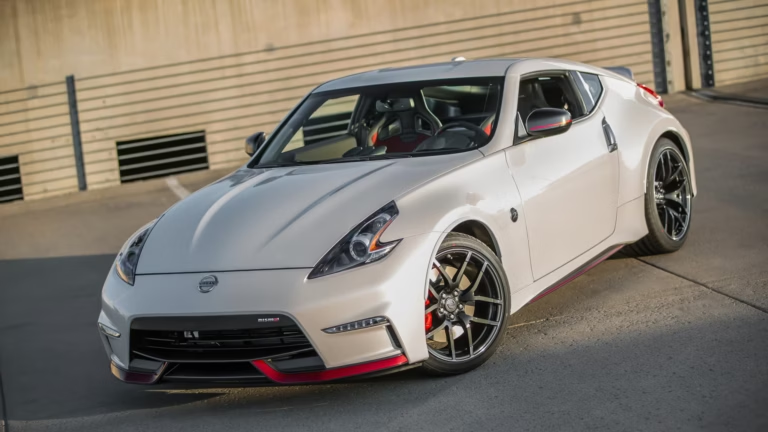
The Nissan 370Z is one of those cars that occupies a unique space in the sports car world. It is not trying to be a luxury grand tourer or a stripped-out track weapon. It is a pure-blooded, rear-wheel-drive, naturally aspirated sports coupe that rewards drivers who know how to work with it rather than relying on technology to smooth over their mistakes. Since its introduction as the successor to the 350Z, it has carried the Z-car philosophy forward with an honesty that many more expensive performance cars have abandoned.
If you are considering buying one, already own one, or simply curious about what this car is genuinely capable of, the numbers and facts around its top speed, power output, modification potential, and ownership costs deserve a clear-eyed look. The 370Z generates strong opinions in the enthusiast community. Some dismiss it as dated. Others call it one of the last affordable, uncompromised sports cars built for driving purists. Both camps have a point, and the truth about what this car is sits somewhere between the marketing sheet and the arguments online.
What the 370Z Is and Where It Sits in Nissan’s Z-Car Lineage
The Nissan Z-car series has been running since the original S30 240Z arrived in 1969 and immediately set the benchmark for affordable sports car performance. Each generation refined the formula without abandoning it. The 370Z represents the sixth generation of that lineage, introduced for the 2009 model year and running through 2020 when it was finally replaced by the Z (RZ34). That eleven-year production run is remarkable for a performance vehicle and speaks to how right the 370Z got its core proposition from the start.
At the heart of the car is the VQ37VHR, a 3.7-liter naturally aspirated V6 that produces 332 horsepower and 270 pound-feet of torque in standard form. The VQ family of engines has one of the longest continuous award records in the automotive industry, named to the Ward’s 10 Best Engines list multiple years running. The VQ37VHR specifically features Variable Valve Event and Lift (VVEL) technology, which continuously adjusts both the timing and the lift of the intake valves to optimize the power curve across the entire RPM range. This is what gives the engine a broad, usable torque curve rather than a peaky powerband that only comes alive near the redline. The practical result is an engine that feels alive whether you are threading through city traffic or stretching it toward its 7,500 RPM redline on a track.
Transmission choices include a six-speed manual with Nissan’s SynchroRev Match system, which automatically blips the throttle to match engine speed on downshifts, a feature previously found only in much more expensive sports cars. The automatic option is a seven-speed paddle-shift unit with a manual mode. Neither choice is wrong, but the manual remains the transmission that most driving enthusiasts choose because it keeps the driver actively engaged in the mechanical conversation the Z-car has always been about.
Top Speed: What the 370Z Can Actually Do
The Nissan 370Z has an electronically limited top speed of 155 mph (249 km/h). This is a common threshold among performance vehicles across multiple manufacturers, implemented through the ECU’s speed limiter programming. The limiter is not a physical restriction of the drivetrain or aerodynamics. It is a software instruction that cuts fuel delivery when the vehicle exceeds the programmed threshold.
Without the electronic limiter operating, the 370Z is capable of reaching approximately 171 mph (275 km/h). This figure comes from the combination of the engine’s peak power output, the gearing of the six-speed manual or the automatic transmission’s final drive ratio, and the aerodynamic drag characteristics of the body. At higher speeds, aerodynamic resistance increases exponentially, and eventually the engine’s available power at the wheels is equaled by the drag force resisting forward motion. That equilibrium point, where available thrust and aerodynamic drag are balanced, is the vehicle’s true maximum velocity.
The 0 to 60 mph sprint happens in approximately 5 seconds in standard form. This places the 370Z solidly in sports car territory without reaching the supercar bracket. It is quick enough to leave most ordinary traffic decisively behind, fast enough to be genuinely engaging on back roads and track days, and controlled enough to be manageable for experienced drivers without requiring constant intervention.
For context on where the 370Z sits among its contemporaries:
| Vehicle | 0-60 mph | Top Speed (Limited) | Engine |
|---|---|---|---|
| Nissan 370Z | ~5.0 seconds | 155 mph | 3.7L V6, 332 hp |
| Porsche Cayman (base) | ~4.7 seconds | 170 mph | 2.0L Turbo 4, 300 hp |
| Ford Mustang GT | ~4.3 seconds | 155 mph | 5.0L V8, 450 hp |
| Chevrolet Camaro SS | ~4.0 seconds | 165 mph | 6.2L V8, 455 hp |
| BMW M2 | ~4.2 seconds | 155 mph | 3.0L Turbo 6, 405 hp |
The 370Z is not the fastest car in its segment, but raw numbers miss the character of what this car is. The VQ37VHR engine has a naturally aspirated delivery that turbocharged engines cannot quite replicate. There is no lag, no sudden torque surge, just a linear build of power from idle to redline that drivers who understand the difference tend to find deeply satisfying. That character is what the Z-car has always sold, and the 370Z delivers it with a purity that many more powerful modern alternatives have traded away for outright performance metrics.
Speed Limiter: What It Is and What You Should Know Before Removing It
The 155 mph electronic speed limiter in the 370Z is a factory ECU setting. Several methods exist for disabling or raising this limit, ranging from ECU tune flashing by a professional tuner to specific ignition cycling procedures that some owners have reported with varying results. Some aftermarket ECU tuning solutions entirely remove the limiter as part of a broader tune package that also adjusts fuel maps, ignition timing, and VVEL calibration for improved overall performance.
Before pursuing speed limiter removal, several practical considerations deserve clear attention. The 155 mph factory limit is not arbitrary. It corresponds to speeds where the factory tires and suspension geometry are operating within their tested parameters. The original equipment tires on a 370Z may or may not be speed-rated to safely operate at 171 mph for sustained periods. Sustained high-speed operation increases heat buildup in the tires, brakes, and drivetrain components in ways that brief acceleration runs do not. Aerodynamic stability at those speeds is also outside the envelope most drivers have experience managing.
Any limiter removal or significant ECU modification also carries implications for emissions compliance, warranty coverage, and street legality. On public roads, speeds above the limit by any significant margin are both illegal and genuinely dangerous regardless of the vehicle’s mechanical capability. Track environments with proper safety infrastructure and appropriate speed classes are the only places where exploring the true top speed capability of any vehicle makes sense.
How Much Power Can You Actually Get From the 370Z
The 370Z makes 332 horsepower and 270 pound-feet of torque in stock form. Those are measured at the crankshaft by Nissan. Dynamometer testing at the wheels, which subtracts drivetrain losses, typically shows around 280 to 300 wheel horsepower depending on testing conditions and the specific car. The discrepancy between crankshaft and wheel numbers is normal for any rear-wheel-drive car with a conventional gearbox and differential setup.
The VQ37VHR responds well to modifications, and the enthusiast community around these cars has developed a comprehensive body of knowledge about which modifications deliver real results versus which ones are marketing hype. The most common entry-level modification is an intake and exhaust combination. A cold-air intake that brings denser air to the throttle body and a free-flowing exhaust that reduces backpressure can free up 15 to 25 additional wheel horsepower depending on the specific components chosen. More importantly, they transform the sound character of the car, with the VQ engine producing a genuinely aggressive intake roar and exhaust note that the factory setup deliberately mutes.
An ECU tune combined with intake and exhaust is the next step and typically pushes the car to 320 to 350 wheel horsepower while also improving throttle response and sharpening the power delivery curve. This combination represents the point at which most naturally aspirated 370Z builds stop, as the return on investment begins to decline steeply beyond this level with a stock rotating assembly and fuel system.
For owners who want to go further, forced induction is the path. Both supercharger and turbocharger kits are available for the 370Z from several established suppliers. A supercharger maintains the linear, lag-free power delivery characteristic of the naturally aspirated VQ while adding significant boost, typically pushing output to 450 to 550 wheel horsepower depending on boost pressure and supporting modifications. Turbocharger setups can push even further, but they change the character of the engine considerably and require significant supporting work including upgraded fuel injectors, a fuel pump, and reinforced internals on high-output builds. At these power levels, the stock transmission, differential, and half-shafts become limiting factors that also need attention.
What It Costs to Own and Maintain a 370Z
This is where the 370Z makes its strongest practical argument. The average annual maintenance cost for a 370Z is approximately $504, according to ownership cost analysis data. The average annual maintenance cost across all vehicle segments is approximately $651. The 370Z is not just cheaper to maintain than other sports cars, it is cheaper to maintain than the average vehicle of any type.
Among 36 compact car models in reliability studies, the 370Z ranks 23rd, which is solidly mid-pack rather than class-leading. The reliability rating sits at 4.0 out of 5.0, which represents good but not exceptional dependability. What pushes the ownership costs down despite the mid-range reliability score is the relatively low cost of common repairs and maintenance items when they do come due. The VQ37VHR engine, while a high-performance unit, uses parts that are widely available, well-understood by independent shops, and not priced at the premium commanded by European performance car components.
Common maintenance items and their approximate costs give a clearer picture of what 370Z ownership actually looks like in practice:
- Oil changes with synthetic oil are needed every 5,000 to 7,500 miles and cost between $80 and $120 at an independent shop
- Brake pad replacement front and rear runs approximately $200 to $400 depending on pad quality and whether rotors need replacement
- Spark plugs require replacement around every 30,000 miles and cost roughly $150 to $200 in parts and labor for all six cylinders
- Tires are a significant ongoing cost given the 370Z’s rear-wheel-drive performance setup, with a set of four quality performance tires typically running $600 to $1,000 depending on brand and size
- The clutch on manual transmission cars typically lasts 60,000 to 100,000 miles under normal use, with replacement costs around $800 to $1,200 at an independent shop
Insurance costs deserve mention as an ownership expense that varies significantly by driver age, location, and driving history. The 370Z’s sports car classification typically means higher premiums than an equivalent sedan, but it is generally less expensive to insure than European sports cars of comparable performance because the 370Z has a strong parts availability record and repair costs that do not escalate the way German performance car components tend to.
Is the 370Z Actually Reliable Enough to Drive Daily?
Many 370Z owners do exactly this, and the car generally holds up well to daily driving duties. The VQ37VHR engine has proven itself to be a robust unit when maintained properly. Oil changes with quality synthetic lubricant on schedule are the single most important maintenance practice for preserving engine health. The VQ engine family is known for reliable service well past 150,000 miles on cars that receive consistent care.
Known weak points worth understanding before purchase include the differential on certain models, which can develop whine and wear on higher-mileage examples that have been driven hard. The clutch on manual cars is a consumable component whose lifespan depends heavily on how the previous owner drove. Pre-purchase inspection by a mechanic familiar with Z-cars is a worthwhile investment on any used example, as it reveals developing issues before they become expensive surprises.
The 370Z’s cabin is not spacious. It is a two-seat sports car with minimal storage and a firm ride quality calibrated for handling rather than comfort. Long highway drives are manageable but not as relaxed as a larger vehicle. The entry and exit from the low-slung seats take some adjustment for taller drivers. These are known characteristics of the car’s character rather than reliability concerns, and they are worth considering honestly against how the car would actually be used day to day.
The real ownership risk with any performance car is finding an example that has been driven hard without corresponding maintenance, modified without proper supporting work, or run at a track without the wear items being addressed afterward. The 370Z used market has plenty of well-cared-for examples at reasonable prices, but it also has its share of cars that look clean and have hidden issues from aggressive ownership. Service history, a compression test on the engine, and a lift inspection of the undercarriage are worth more than any cosmetic condition assessment when buying a used 370Z.
Who the 370Z Is Really For
The 370Z was not designed to be the fastest car in every stoplight confrontation or the most impressive vehicle on a specification sheet comparison. It was designed around the idea that driving a properly sorted rear-wheel-drive sports car should be engaging, tactile, and rewarding in ways that go beyond outright acceleration numbers. The steering communicates what the front tires are doing. The engine pulls cleanly and responds immediately without the artificial throttle remapping that some modern performance cars use to make outputs feel stronger than they are. The manual transmission version specifically rewards smooth, practiced inputs and punishes sloppiness in ways that make a skilled driver better over time.
For a driver who wants a sports car that is affordable to buy in the used market, honest about what it is, mechanically accessible for maintenance, and genuinely enjoyable to drive on the right road, the 370Z makes a compelling case even years after its production ended. The new Z continues the lineage with more modern technology and a turbocharged powertrain, but the 370Z’s naturally aspirated character is a different kind of experience that its own audience will continue to value.
At 155 mph with the limiter, 171 mph without it, 332 horsepower stock, and annual maintenance costs below the industry average, the numbers tell part of the story. The rest of it belongs to the driver’s seat on a good road with the right amount of traffic clearance and a driver who knows how to use what the car is offering.