
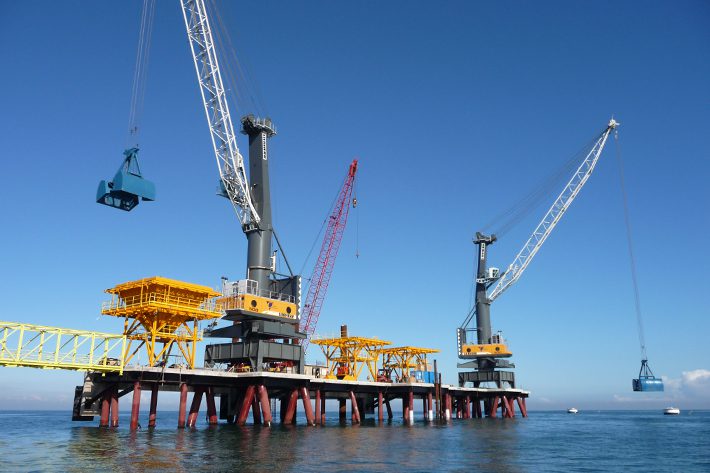
Walk past any major construction site and you will almost certainly see at least one crane towering above everything else. They are so common in urban landscapes that most people stop noticing them. But look a little closer and you will realize that not all cranes are the same. The machine lifting steel beams onto a skyscraper is fundamentally different from the one loading cargo onto a ship, which is different again from the one working a remote offshore platform.
Cranes are, at their core, machines that use cables, pulleys, and structural arms to lift, lower, and move heavy loads that would be impossible to handle by any other means. But within that basic definition lives an enormous variety of designs, each one engineered to solve a specific problem in a specific environment.
Before cranes, construction and heavy industry were limited by what human muscle and basic pulley systems could manage. The moment cranes entered the picture, the scale of what was buildable changed permanently. High-rise buildings, offshore oil platforms, suspension bridges, and modern port infrastructure all depend on cranes in ways that are easy to take for granted until you actually understand what each type is doing and why it was designed the way it was.
This guide covers 17 different types of cranes, what makes each one distinct, and where each one actually gets used in the real world.
1. Truck-Mounted Crane
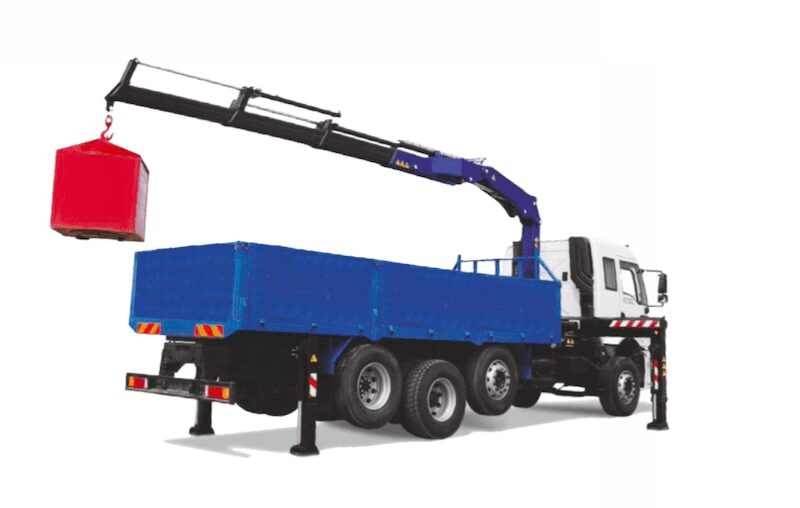
The name tells you most of what you need to know. A truck-mounted crane is exactly what it sounds like: a crane assembly mounted directly onto a truck carrier, making the entire unit self-propelled and road-legal without requiring a separate transport vehicle.
The setup consists of two main components: the carrier, which is the truck itself, and the boom, which is the lifting arm. When a job site needs the crane, it drives there under its own power, deploys its outriggers to stabilize the platform, and gets to work. When the job is done, the outriggers retract, the boom folds down, and the whole unit drives away.
That mobility is the defining advantage. Truck-mounted cranes do not need to be disassembled, loaded onto flatbeds, and reassembled at each location. For projects that involve multiple sites or short-duration lifts, that saves significant time and cost.
The outriggers deserve specific mention because they are not optional. Without them, the crane’s lifting capacity is dramatically reduced and the risk of tipping is real. Proper outrigger placement on solid, stable ground is one of the most important steps before any lift begins. You will commonly see truck-mounted cranes working on bridge inspection and maintenance, utility work, and short-term construction tasks where getting the equipment on and off site quickly matters.
2. Floating Crane
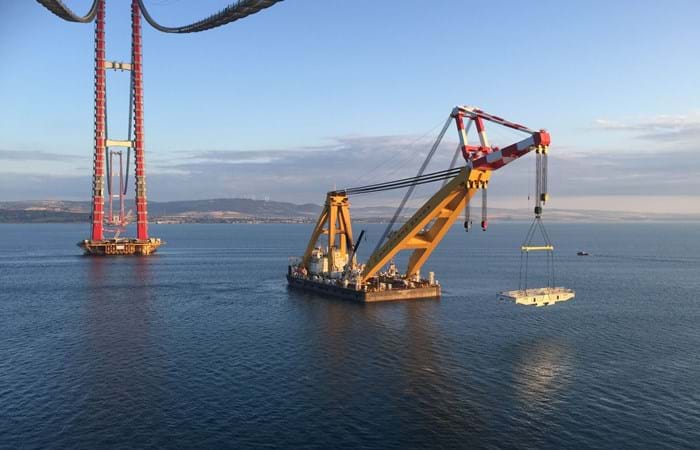
If you need to lift something extremely heavy in, on, or over water, this is the machine for the job. Floating cranes, also called crane ships or crane vessels, are essentially cranes mounted on large barges or ships, purpose-built for offshore and marine construction work.
The lifting capacities on floating cranes are in a different league from most land-based machines. Some of the largest floating cranes in the world can handle loads upward of 9,000 tons. To put that in perspective, that is heavier than most naval destroyers. These are not construction tools in the traditional sense. They are maritime engineering platforms.
Floating cranes are used to install offshore oil and gas infrastructure, assemble sections of bridges over water, load and unload massive cargo from ships, and in some cases, raise sunken vessels from the seabed. The last application is a genuinely specialized operation that involves stabilizing the crane vessel, attaching lift points to the sunken object, and managing the enormous and unpredictable forces involved in pulling something up from underwater.
One key limitation worth knowing: many fixed floating cranes cannot rotate. The vessel itself must be repositioned to change the lifting angle, which requires careful tugboat coordination and tidal planning.
3. Telescopic Crane
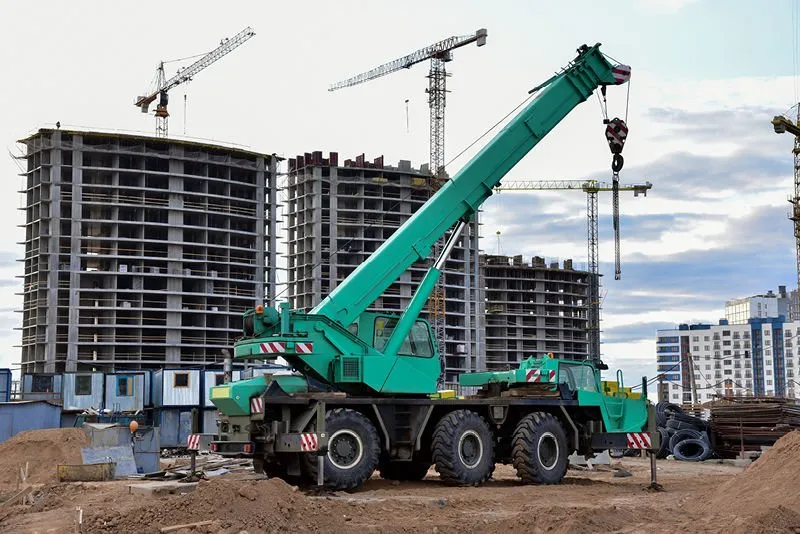
The telescopic crane gets its name from the way its boom extends, the same way a telescope does. The main boom contains a series of tubes nested inside each other. Hydraulic cylinders push these tubes outward or pull them inward, allowing the operator to adjust the boom’s length on the fly without changing any physical components.
That adjustability is what makes telescopic cranes so widely used. A single crane can work in a tight urban space with the boom fully retracted, then extend to full height when the lift demands it. The operator adjusts reach and height based on what the job actually requires rather than being locked into a fixed configuration.
Telescopic cranes show up in a wide range of applications: moving equipment from ground level to rooftops, placing HVAC units on commercial buildings, emergency rescue operations where extending a boom into a difficult-to-reach area could save a life, and general material handling on construction sites where flexibility matters. They are also commonly used as the crane component in truck-mounted configurations, since the extending boom works well with a mobile carrier.
4. Crawler Crane
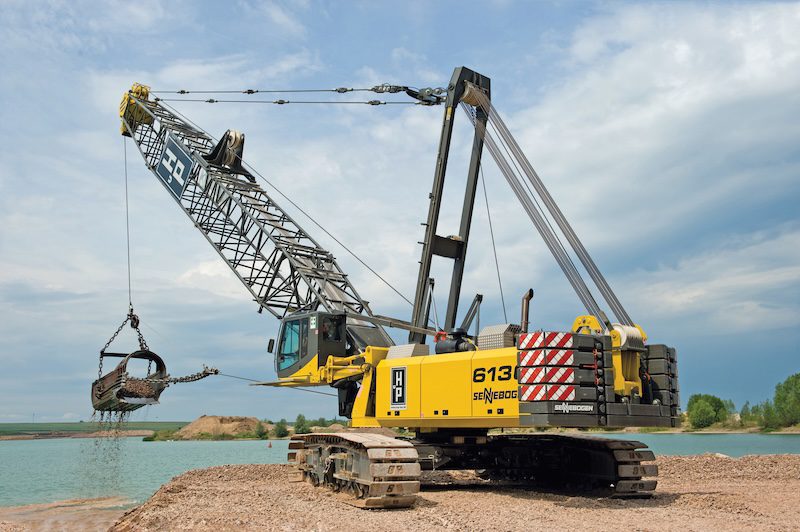
If you have ever seen a massive crane moving slowly but steadily across a muddy or uneven construction site without sinking into the ground, you were probably looking at a crawler crane. Instead of wheels, crawler cranes move on rubber or steel tracks, similar to a tank. Those tracks spread the machine’s enormous weight over a much larger surface area, which is what allows them to operate on soft, wet, or unstable ground that would swallow a wheeled machine entirely.
The trade-off is mobility. Crawler cranes are slow. They cannot drive on public roads, which means they need to be transported to the job site on low-bed trailers, then reassembled on arrival. For short-term projects, that is an inconvenient overhead cost. But for long-term, large-scale projects where the crane will stay in one place for months, the setup cost becomes irrelevant compared to the operational benefits.
Crawler cranes carry some of the largest loads in the construction industry. Many are equipped with telescoping or lattice booms that can reach extraordinary heights, and some configurations allow them to work in conjunction with other cranes on heavy tandem lifts. Power plant construction, large bridge projects, and industrial plant installations are all typical crawler crane territory.
5. Harbour Crane
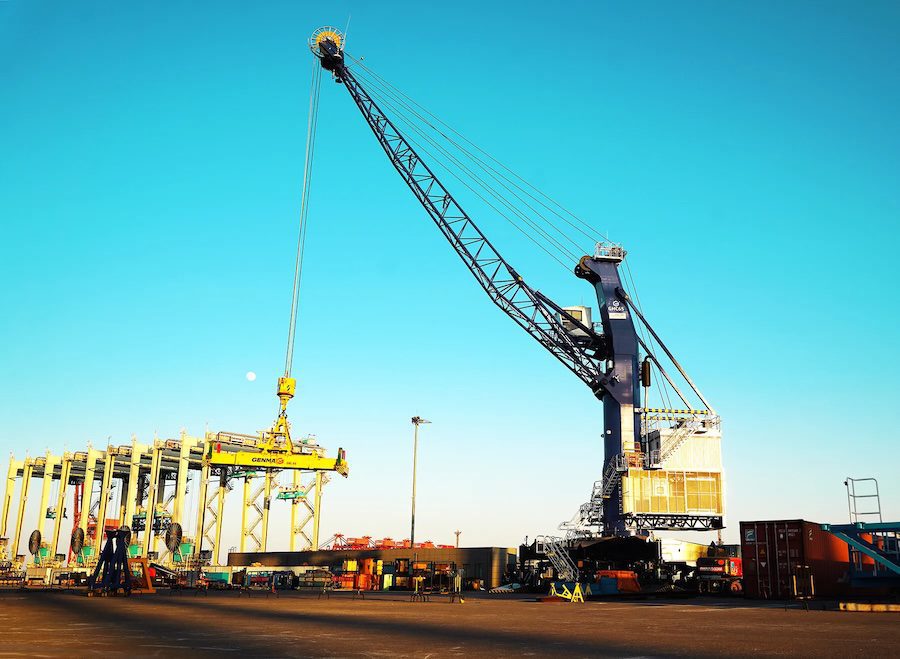
Seaports run on cranes. The harbour crane, sometimes called a port crane or movable harbour crane, is specifically designed for the loading and unloading of ships in port environments. Without these machines, modern international trade at the scale we depend on would simply not be possible.
Harbour cranes are built for both strength and versatility. Port operations involve handling an enormous variety of cargo types, from standard shipping containers to bulk materials to heavy project cargo, and the harbour crane needs to handle all of it efficiently. The ability to move along rails or rubber-tired tracks within the port facility means a single crane can serve multiple berths and handle different vessels without complex repositioning.
What makes harbour cranes particularly valuable is their combination of high lifting capacity and precise control. Placing cargo accurately onto a ship or lifting it off without damaging the vessel, the dock, or the goods themselves requires both power and finesse. Modern harbour cranes are often equipped with advanced control systems that allow operators to manage load sway and positioning with a level of precision that earlier generations of port equipment could never achieve.
6. Mobile Crane
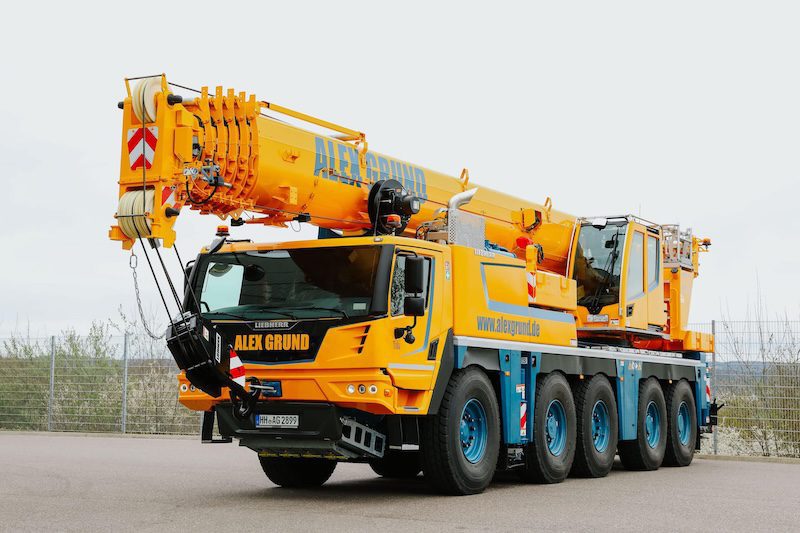
Mobile cranes are the generalists of the crane world. They are designed to be transported to a job site, set up relatively quickly, perform the required lifts, and then move on to the next location. The term covers a broad category that includes truck-mounted cranes, rough terrain cranes, and all-terrain cranes, though in common usage it often refers specifically to cranes mounted on wheeled carriers that can travel between sites without dedicated transport vehicles.
The lifting arm on a mobile crane is typically articulated, meaning it can be raised or lowered as needed, usually through a combination of hydraulic cylinders and cables. That articulation is what allows the crane to reach different heights and angles depending on what the lift demands.
One application that often surprises people is the use of mobile cranes on barges for waterway construction. When a project involves building a bridge or installing infrastructure over a river or canal, mounting a mobile crane onto a barge platform gives it the reach and positioning needed to work mid-water without a floating crane vessel. It is a practical, cost-effective solution for mid-scale water-adjacent projects.
7. All-Terrain Crane
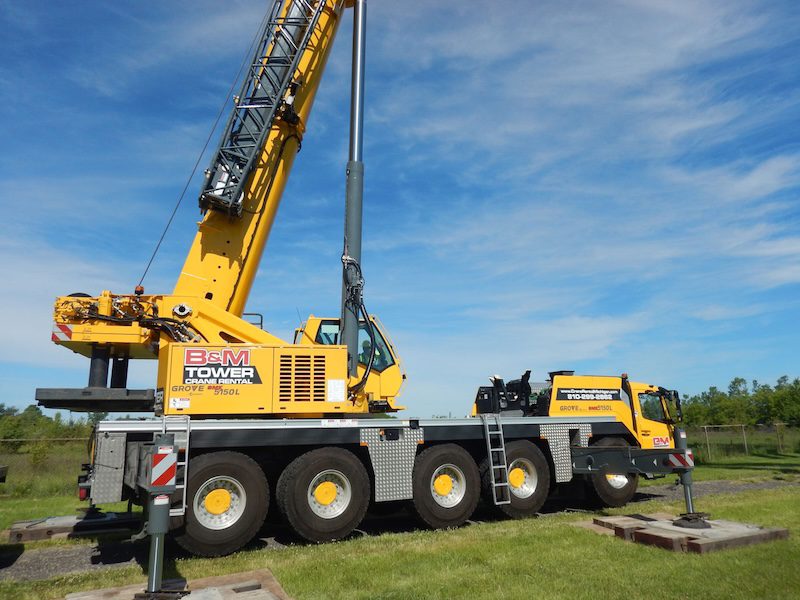
The all-terrain crane exists because real-world job sites rarely fit neatly into either the “smooth paved road” or “rough off-road” category. Construction projects often require a crane to drive on public highways to reach a site, then immediately work on unpaved, uneven ground once it gets there. An all-terrain crane is built to handle both without compromise.
These machines typically run on multiple axles with all-wheel drive and all-wheel steering, giving them the road handling capability needed for highway travel at reasonable speeds and the ground clearance and traction needed for rough site conditions. They are also designed with stability in mind, carrying more axles and a wider stance than a standard vehicle-mounted crane to reduce the risk of tipping when working on uneven ground.
In practice, all-terrain cranes have largely replaced both rough terrain cranes and vehicle-mounted cranes on many job sites, simply because doing both jobs with one machine is more economical than maintaining two specialized units. They are the Swiss Army knife of mobile cranes: not the absolute best at any single application, but capable enough at all of them to be genuinely useful across a wide range of project types.
8. Rough Terrain Crane
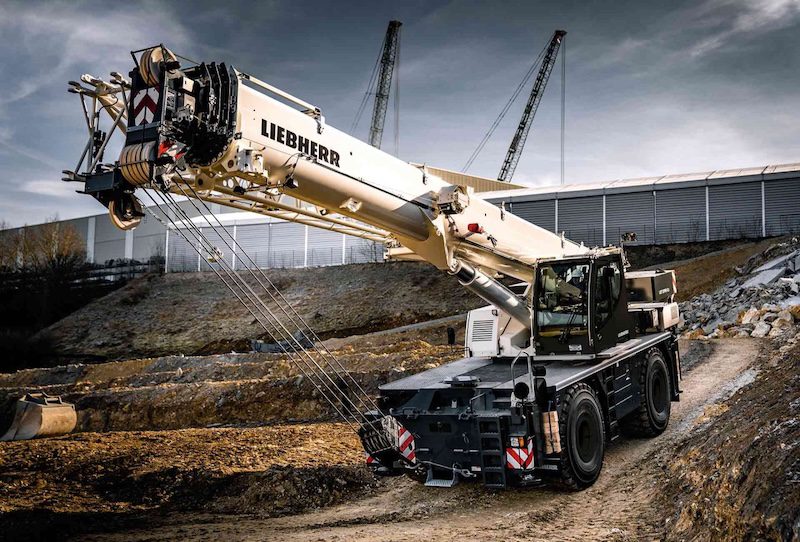
Where the all-terrain crane is built to handle both road and off-road conditions, the rough terrain crane is optimized specifically for off-road work and is not designed for highway travel at all. It sits on four large rubber tires with significant ground clearance and is built to handle the kind of unpaved, unstable, or sloped surfaces that would stop a standard crane dead.
One of the more interesting design features is that rough terrain cranes use a single engine for both the undercarriage drive system and the crane’s lifting functions. That simplicity reduces mechanical complexity and maintenance requirements, which matters when the crane is working in remote locations where specialized maintenance support may not be nearby.
Outriggers are deployed during lifting operations to provide the stability that the four tires alone cannot guarantee. Without outriggers on level ground, the machine’s rated lifting capacity drops significantly, and on truly uneven terrain, lifting without outriggers is an unacceptable risk.
Rough terrain cranes are commonly found on oil field construction sites, pipeline projects in remote areas, and any construction work happening where the ground has not been prepared and graded for conventional equipment access.
9. Tower Crane
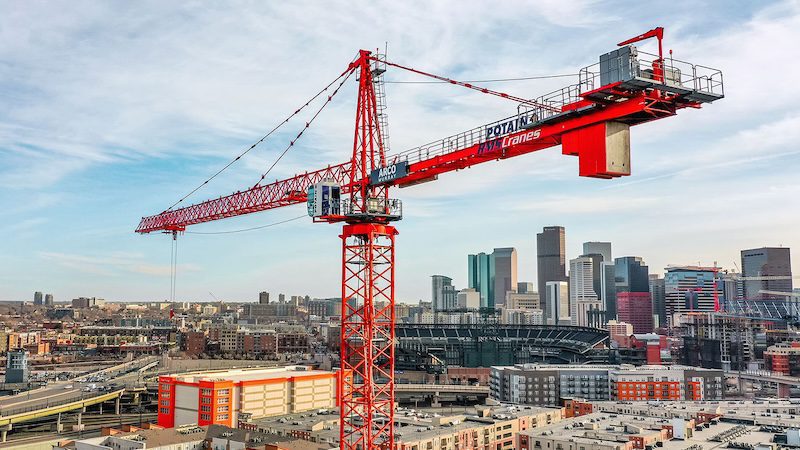
The tower crane is the most visually iconic type of construction crane. If you have ever watched a skyscraper going up in a city center, the crane standing tall at the top of the structure, rotating slowly as it moves materials into position, is a tower crane.
The design is built around a vertical mast anchored to a concrete foundation. Extending horizontally from the top of the mast is the jib, which is the working arm that carries the hook and load. On the opposite side sits a counter-jib loaded with concrete counterweights that balance the load and prevent the crane from tipping. The slewing unit, which is essentially the crane’s rotational drive system, sits at the top of the mast and allows the entire jib assembly to rotate 360 degrees around the mast.
There are two main jib configurations. The fixed jib type uses a trolley that travels horizontally along the jib to position loads at different distances from the mast. The luffing jib type allows the entire jib to move up and down in angle, which is particularly useful in dense urban areas where neighboring buildings restrict horizontal swing.
What makes tower cranes genuinely remarkable from an engineering standpoint is how they grow with the building. As the structure rises floor by floor, the crane is climbed upward using a hydraulic climbing system that inserts new mast sections from the inside. The crane essentially extends itself from within the building as the building gets taller. Once construction is complete, the process runs in reverse, with the crane dismantling itself section by section from the top down.
10. Carry Deck Crane
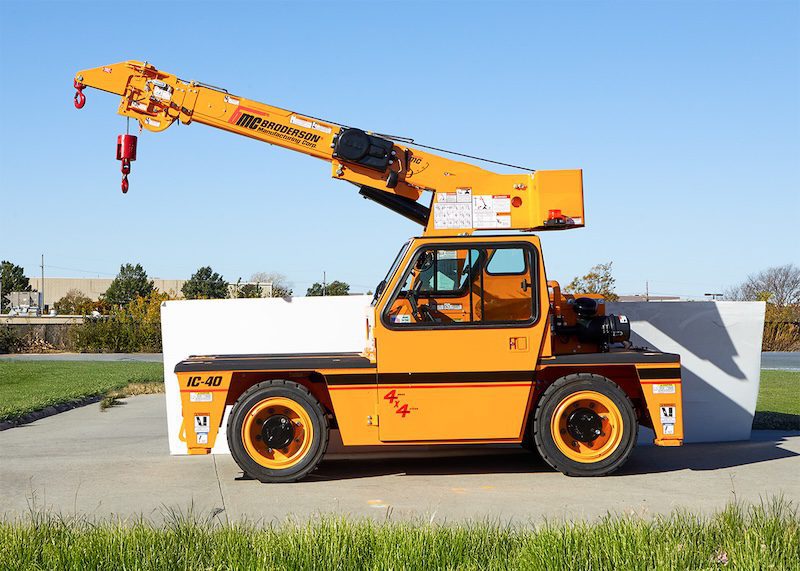
The carry deck crane is built for confined spaces. It is a compact, four-wheeled machine with a rotating boom and a flat deck between the operator’s cab and the rear of the machine. That deck is what gives it the name: it can carry a load on the deck while moving, which is not a capability most crane types have.
Carry deck cranes evolved from the pick-and-carry cranes that first appeared in the 1980s. The modern version adds a 360-degree rotation capability, which means the operator can pick up a load, rotate to face the direction of travel, drive to the destination, rotate back to the drop point, and place the load, all without repositioning the machine itself. In a cramped indoor environment like a factory, warehouse, or industrial plant, that maneuverability is extremely valuable.
These cranes are particularly suited to situations where overhead clearance is limited and larger cranes simply will not fit. They are small enough to pass through standard industrial doorways and navigate warehouse aisles while still being capable of meaningful lift capacities. For plant maintenance, equipment installation in industrial facilities, and similar work in tight quarters, the carry deck crane does what no other type can.
11. Level Luffing Crane
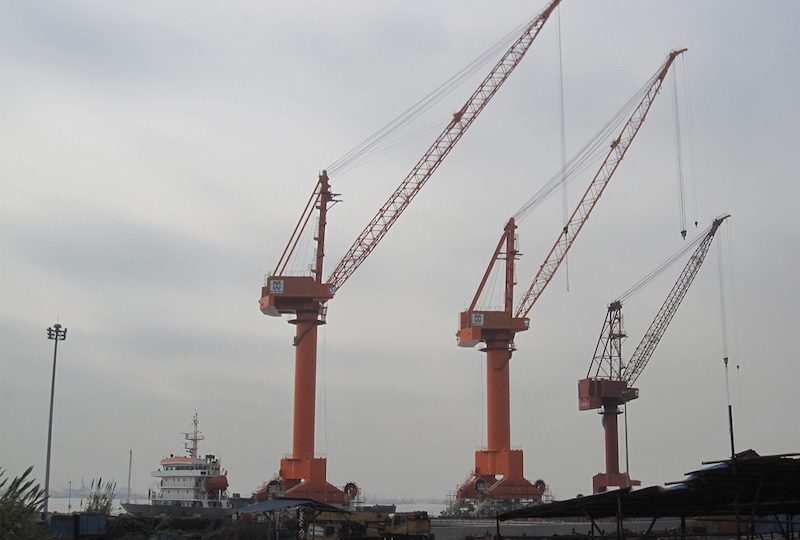
The level luffing crane solves a specific problem that matters a great deal in port and shipyard environments: keeping a suspended load at a constant height while the jib angle changes.
On most luffing cranes, when the jib is raised or lowered, the hook follows a curved arc rather than staying at the same elevation. That means a load being moved horizontally by changing the jib angle will also rise or fall as the angle changes, which creates complications when precise horizontal positioning at a consistent height is required. The level luffing crane uses a mechanical linkage system that compensates for jib angle changes, keeping the hook at a consistent elevation regardless of where the jib is pointed.
This is particularly useful when loading and unloading containers or cargo onto ships, where the load needs to travel horizontally from the dock to the hold without unintended vertical movement that could swing the load into the vessel’s structure or the dock edge. Moving the jib toward ground level requires careful, deliberate operation, and the level luffing mechanism makes that process significantly more controllable.
12. Overhead Crane
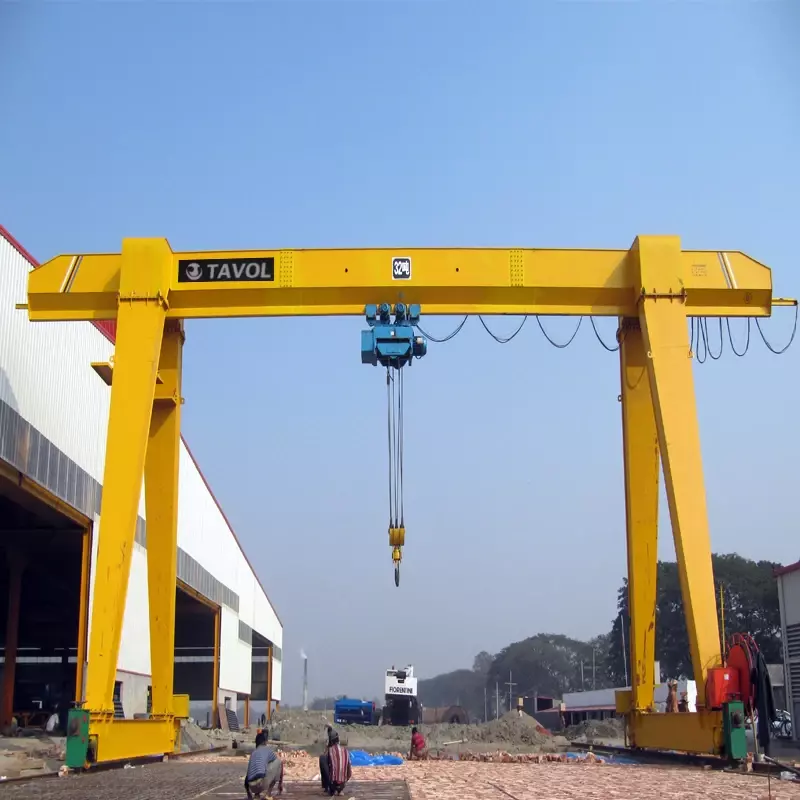
Overhead cranes, also called bridge cranes or suspended cranes, are fixtures in heavy manufacturing and industrial environments. Walk into a steel mill, a large machine shop, a shipbuilding facility, or a heavy fabrication plant and you will almost certainly see one running along rails mounted near the ceiling.
The design consists of a bridge beam spanning the width of the work area, supported at each end by end trucks that run along elevated rails attached to the building’s structural columns. A hoist and trolley assembly rides along the bridge beam, allowing loads to be moved in three axes: side to side along the bridge beam, forward and backward as the bridge travels along the rails, and up and down as the hoist raises or lowers.
Overhead cranes are designed to handle loads ranging from a few hundred pounds all the way to several hundred tons, depending on the facility’s needs. In a steel mill, an overhead crane might be lifting ladles of molten metal. In a manufacturing plant, it might be moving large machine components from one workstation to the next. The key advantage is that the crane operates above the work area without taking up any floor space, leaving the entire floor available for production activity.
13. Aerial Crane
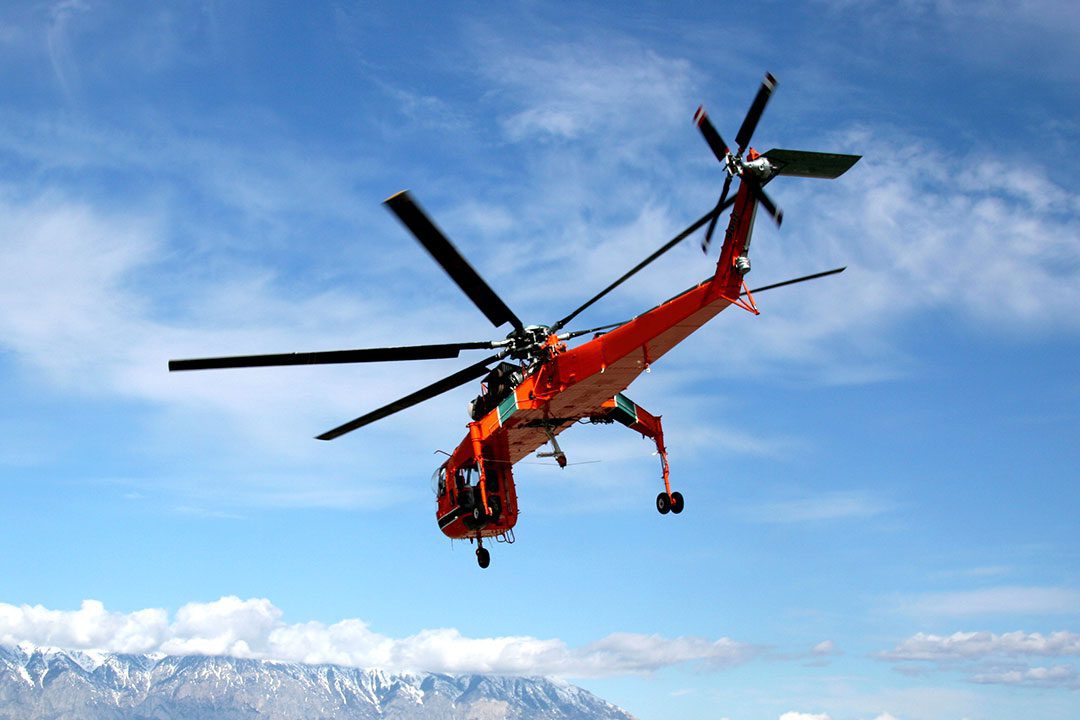
Aerial cranes take the concept of lifting in a fundamentally different direction. Instead of a fixed or mobile ground-based structure, an aerial crane is a helicopter specifically modified and equipped to lift and position loads in locations that no ground-based crane could physically reach.
The principle is straightforward: heavy loads are attached to long cables or slings suspended from the helicopter, and the aircraft positions the load by flying it to the required location. In practice, this is an extremely demanding operation requiring highly skilled pilots, precise communication between the flight crew and ground personnel, and careful load management to control swing and oscillation during flight.
Aerial cranes became commercially viable in the late 1950s and saw significant expansion in the 1960s following the introduction of more powerful helicopter platforms, including the Sikorsky S-58, which could handle heavier loads than the earlier Bell 47 machines that had first demonstrated the concept.
The applications are genuinely unique. Aerial cranes place HVAC equipment on skyscraper rooftops where a conventional crane cannot reach. They carry construction materials to remote mountain locations where no road exists. They lift sections of transmission towers in terrain that would take weeks to access by ground. They are also used in firefighting, disaster response, and military logistics. No other crane type can operate in the spaces an aerial crane can reach.
14. Hydraulic Crane
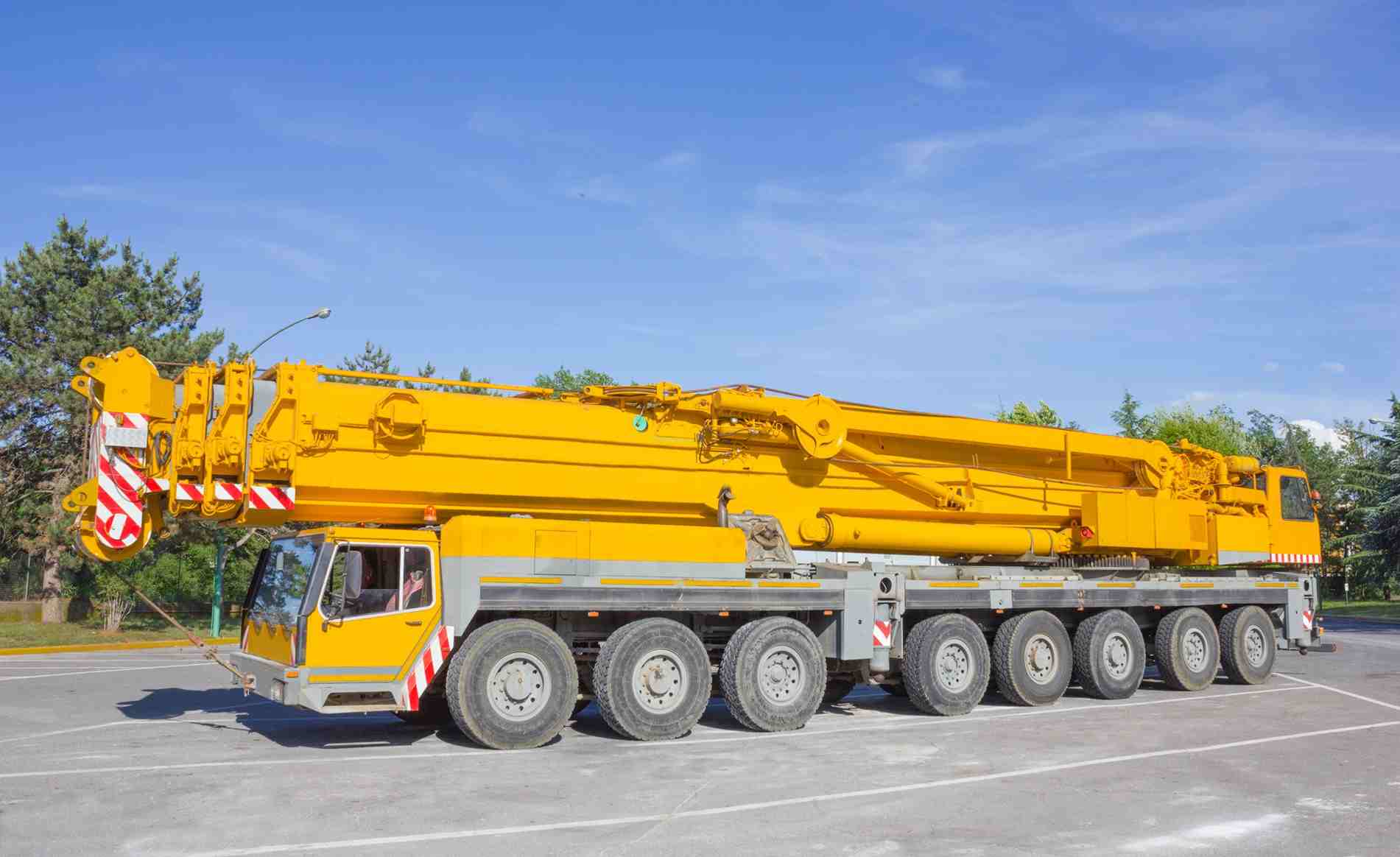
Hydraulic cranes use pressurized fluid to generate the force needed to lift, extend, and rotate their components. Most modern cranes incorporate hydraulic systems to some degree, but hydraulic cranes as a specific category refers to machines where hydraulics are the primary operating mechanism rather than a supplementary system.
The physics behind hydraulics make them well-suited to crane applications. Hydraulic cylinders can generate enormous force from a relatively compact package, they provide smooth and precise control, and they can hold a load stationary under pressure without continuous power input. That last characteristic is important for safety: if power is lost during a lift, a hydraulic system holds the load in place rather than allowing it to drop suddenly.
In practical terms, hydraulic cranes are used across an enormous range of applications. Installing steel beams during highway overpass construction, positioning heavy machinery within industrial plants, setting precast concrete elements during building construction, and countless other tasks where controlled lifting force is needed. The category spans from small knuckle boom cranes mounted on service trucks all the way to massive hydraulic crawler cranes used in power plant construction.
15. Hammerhead Crane
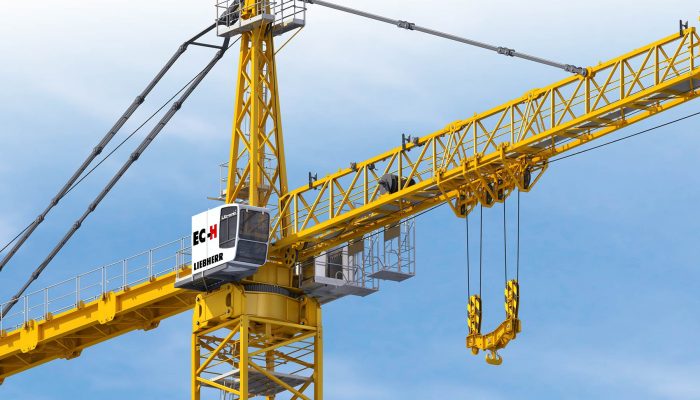
The hammerhead crane is a type of tower crane distinguished by its characteristic horizontal jib that extends equally in both directions from the top of the mast, giving it a T-shaped profile when viewed from the side. The name comes from the visual similarity to a hammerhead shark’s distinctive head shape.
The working end of the jib carries a trolley that runs horizontally along the arm, positioning loads at different distances from the mast. The rear section of the jib carries counterweights that balance the load being lifted on the front section. A racking mechanism drives the trolley forward and backward along the jib without changing the jib’s angle, which means loads can be moved horizontally at a constant elevation throughout the working radius.
Hammerhead cranes are among the most commonly used cranes on large building construction projects. They are assembled on the job site and are built to be both extremely heavy and highly stable, which allows them to handle the demanding and repetitive lift cycles that major construction projects require. On major infrastructure projects like large bridges or dam construction, multiple hammerhead cranes often work simultaneously, each handling a different section of the structure.
16. Bulk-Handling Crane
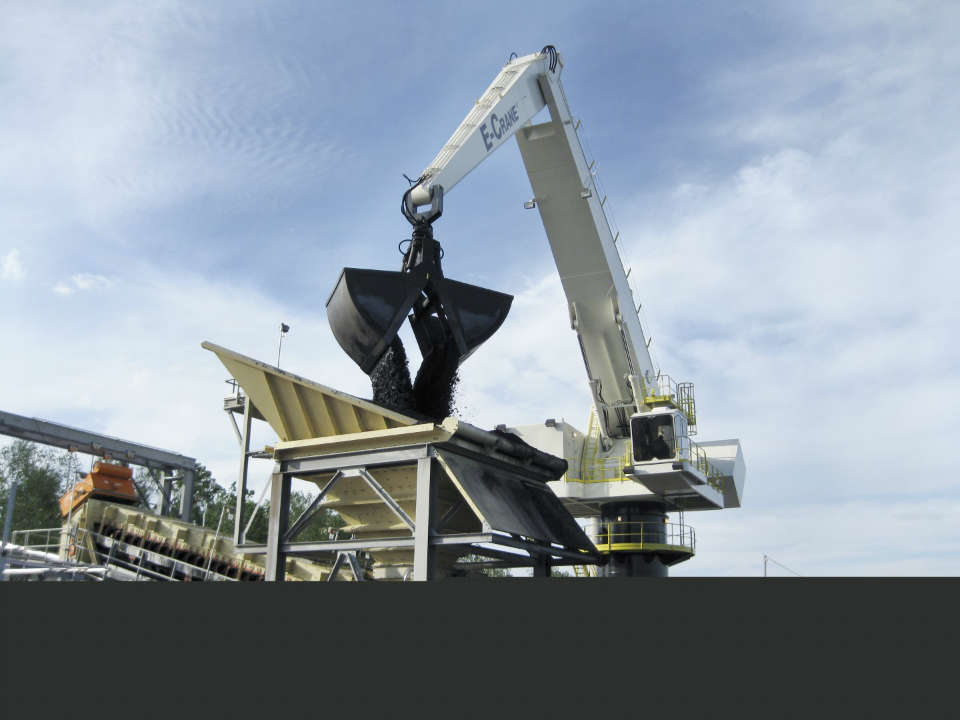
Bulk-handling cranes are purpose-built for one specific type of work: moving very large quantities of loose, granular, or chunky material such as coal, iron ore, grain, gravel, sand, or similar bulk commodities. They are not lifting individual objects with a hook. They are scooping, grabbing, and moving enormous volumes of material as efficiently as possible.
Instead of a standard hook, bulk-handling cranes are equipped with specialized attachments. The most common is a clamshell bucket, which consists of two curved bucket halves hinged at the top. The bucket is lowered open into the material, then the two halves close around it, grabbing a large bite of the material. The crane then lifts the loaded bucket and swings it to the discharge point, where the bucket opens and drops the material.
Some configurations use a grab bucket with multiple segments that close from multiple sides rather than just two halves, which can be more effective for certain material types or tighter discharge requirements. These cranes are fixtures at coal-fired power plants, iron ore processing facilities, grain terminals, and aggregate handling yards. The volumes they move in a single working day would be impossible to match with any other material handling method at a comparable cost.
17. Stacker Crane
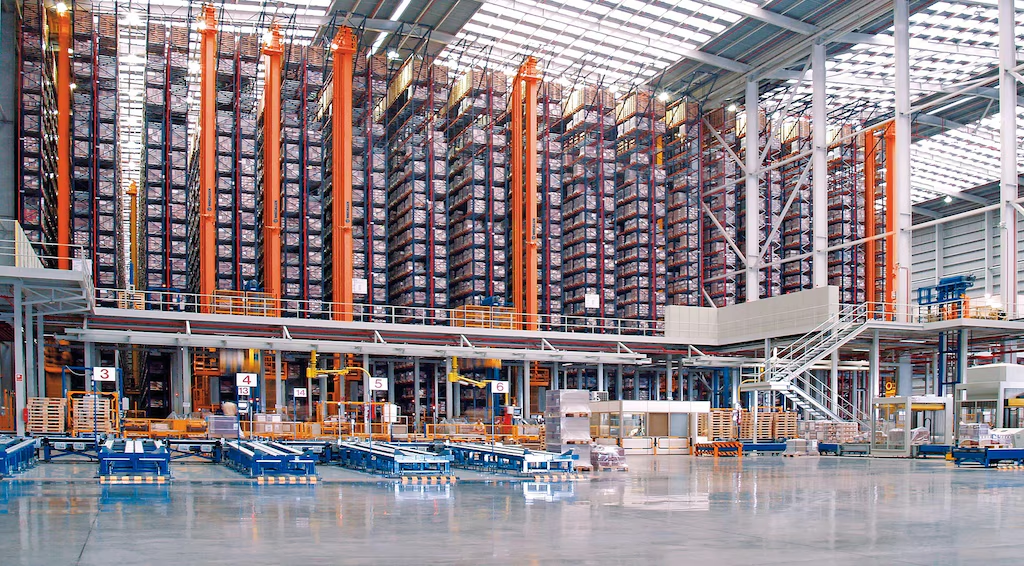
The stacker crane operates on a principle that is closer to an automated storage system than a traditional construction crane. Stacker cranes are used in automated warehouses and distribution centers, moving vertically and horizontally along narrow aisles between tall storage racks to retrieve or store pallets, bins, or other unit loads with precision and speed.
The machine travels along floor rails and ceiling guide rails within a dedicated aisle, with a lifting platform or fork mechanism that raises and lowers to access storage locations at different heights. In modern automated facilities, stacker cranes operate entirely under computer control, with no human operator in the machine. The warehouse management system directs each stacker crane to retrieve specific items or store incoming goods at designated locations, and the machine executes those instructions continuously.
The efficiency gains from stacker cranes in high-volume warehousing are significant. They can operate in aisles narrow enough that no forklift could navigate them, store goods at heights that no manual system could safely reach, and work continuously around the clock without the fatigue and error rates that human operators experience over a shift. For large e-commerce fulfillment operations, cold storage facilities, and high-density parts storage in manufacturing, stacker cranes are an essential part of the infrastructure.
Quick Reference: 17 Types of Cranes at a Glance
| Crane Type | Primary Use | Key Feature |
|---|---|---|
| Truck-Mounted | Bridge work, utilities, short-term construction | Self-propelled, road-legal, quick deployment |
| Floating | Offshore construction, ship loading, salvage | Marine platform, up to 9,000-ton capacity |
| Telescopic | Rooftop placements, rescue operations, general construction | Adjustable boom length via hydraulic extension |
| Crawler | Large-scale construction, soft ground sites | Rubber tracks, massive lift capacity, long-term deployment |
| Harbour | Port loading and unloading | Rail or rubber-tired mobility within port facilities |
| Mobile | Multi-site projects, waterway construction | Articulated arm, barge-mountable |
| All-Terrain | Mixed road and off-road projects | All-wheel drive and steering, highway-capable |
| Rough Terrain | Remote and off-road construction sites | Single engine, large tires, outrigger-stabilized |
| Tower | High-rise building construction | Self-climbing with building, 360-degree rotation |
| Carry Deck | Indoor industrial work, confined spaces | Compact, 360-degree rotation, load-carrying deck |
| Level Luffing | Port container handling, shipyards | Maintains constant hook height during jib movement |
| Overhead | Factories, steel mills, fabrication plants | Ceiling-mounted, leaves full floor space available |
| Aerial | Remote locations, rooftops, firefighting | Helicopter-based, reaches inaccessible locations |
| Hydraulic | General construction, industrial installation | Pressurized fluid system, precise load control |
| Hammerhead | Large building and infrastructure projects | T-shaped jib, horizontal trolley movement |
| Bulk-Handling | Coal, ore, grain, aggregate terminals | Clamshell or grab bucket instead of hook |
| Stacker | Automated warehouses, distribution centers | Computer-controlled, narrow aisle operation |
Every crane on this list exists because someone identified a specific problem that no existing machine could solve well enough. The floating crane exists because offshore construction would otherwise be nearly impossible. The carry deck crane exists because factories need lifting capability in spaces too tight for anything larger. The aerial crane exists because some locations simply have no ground access at all.
Understanding which crane fits which situation is not just interesting engineering knowledge. For anyone involved in construction, logistics, project planning, or heavy industry, it is practical information that directly affects how projects get done, how safely they are executed, and how much they cost. The right crane for the job is not always the biggest or the most powerful. It is the one engineered for the exact conditions and demands of the work at hand.