
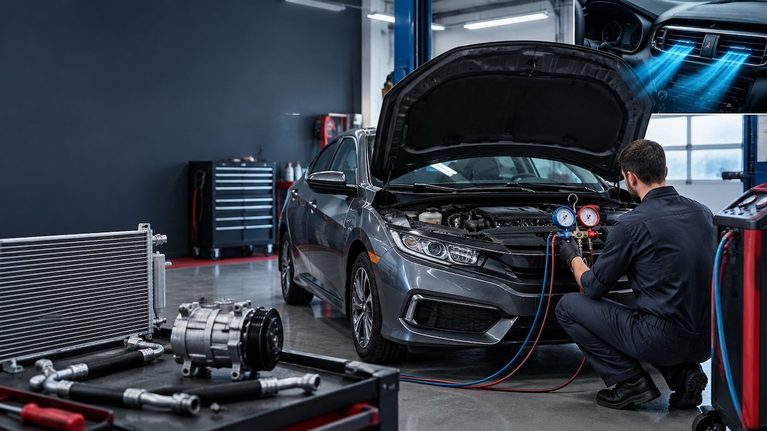
A Civic that blows warm air on a hot afternoon is a miserable car to sit in, and the cause isn’t always obvious. Sometimes it’s a ten-minute fix like a dirty cabin filter or a blown fuse. Other times it’s a leaking condenser or a compressor that’s finished.
The good news is that most Civic AC complaints trace back to a short list of causes. Low refrigerant from a leak, a tired compressor, a clogged condenser, weak airflow and electrical faults cover the bulk of them. Some owners may also have warranty coverage that helps with the bill, so it’s worth asking before you pay.
This guide explains how the system works, what the common symptoms mean and how to do sensible checks before you spend money. It also covers upkeep that keeps the system healthy, mistakes I see people make, and when to hand the job to a shop. I’ll mention what I’d check first if your Civic rolled into my bay with the complaint.
The short answer
If your Civic’s AC blows hot air, start with the basics. Check that the blower works at every speed, look at the cabin air filter, and see whether the condenser at the front of the car is blocked with dirt or leaves. Listen for the compressor engaging when you switch the AC on, and look for oily residue around hoses and fittings that might point to a refrigerant leak.
Weak airflow usually comes from a clogged filter, blocked vents or a blower motor problem. Strange noises can come from debris in the fan or a worn compressor. Bad smells usually come from mold or mildew growing where moisture collects, often around the evaporator.
A refrigerant leak is the most common reason a system stops cooling, and topping it up without finding the leak only buys time. If the system needs repeated recharges, a professional leak test is the right next step.
How the Civic’s AC system works
The air conditioning system in your Civic moves heat out of the cabin and releases it outside. It does that by circulating refrigerant through a closed loop of connected parts. When one part fails or the refrigerant level drops, the whole loop stops working properly.
The main components
The compressor is the heart of the system. It circulates the refrigerant and raises its pressure so that it can carry heat. The condenser sits at the front of the car, where it releases the heat the refrigerant has picked up from the cabin.
The evaporator sits inside the dash. As refrigerant passes through it, the evaporator cools and dehumidifies the air headed for the cabin. The expansion valve controls how much refrigerant flows into the evaporator, which helps regulate temperature.
The receiver-drier filters moisture and debris out of the refrigerant, which protects the rest of the system. The blower fan pushes air across the evaporator and into the cabin through the vents. If any of these parts misbehave, you’ll feel it as warm air, weak airflow or noise.
What the refrigerant does
Refrigerant moves between the compressor and evaporator, changing from gas to liquid and back again. That change is what absorbs heat from the cabin and carries it outside. Without enough refrigerant, the system simply can’t move enough heat.
A sealed AC system shouldn’t use up refrigerant. If the level is low, it escaped somewhere, and finding that leak matters more than topping it up. Low refrigerant also puts strain on the compressor, so ignoring it can turn a modest repair into a bigger one.
Why airflow matters
Even a healthy system feels weak if air can’t move through it. The blower pushes air over the evaporator, so a weak fan or a clogged cabin filter reduces how much cool air reaches you. Blocked vents have the same effect.
Airflow problems are easy to mistake for cooling problems. If the air coming out is cold but there isn’t much of it, you’re looking at the blower, the filter or the ducts. If plenty of air comes out and it’s warm, the fault is in the cooling side of the system.
Common Honda Civic AC problems
Most owners notice one of four things: hot air, weak flow, noise or a bad smell. Each one points toward a different part of the system. Here’s how I read them.
AC blowing hot air
When the AC blows warm air, the usual suspect is low refrigerant, and a leaking condenser is a common source. Without enough refrigerant, the system can’t cool the air, no matter how well everything else works. The condenser sits at the front of the car, so road debris and corrosion can damage it over time.
The compressor is the other big possibility. If it isn’t compressing refrigerant properly, or it isn’t engaging at all, warm air will circulate through the cabin. Electrical faults such as a blown fuse or a bad relay can stop the compressor from switching on even when the compressor itself is fine.
In the shop, I listen for the compressor clutch engaging when the AC is switched on. A click and a slight change in engine sound is a good sign. Silence suggests I should look at the electrical side and the refrigerant pressure before condemning the compressor.
Weak airflow from the vents
Weak airflow is frustrating, because the AC may be making cold air that just doesn’t reach you. The most common cause is a clogged cabin air filter or blocked vents. Dust and debris build up gradually, so the loss of airflow can creep up on you.
A dirty or failing blower motor can cause the same complaint. If the airflow is weak at every setting, suspect the filter or the ducts first. If the fan works only on some speeds or makes noise, the blower motor or its resistor may be the culprit.
Unusual noises when the AC is on
Clicking, buzzing or rattling when you turn on the AC can point to several things. Loose parts or debris stuck in the fan are common, and they’re often cheap to fix. A leaf that has made its way into the blower housing can make quite a racket.
A noisy compressor is a more serious sign. If the noise comes from the engine bay and changes when you switch the AC on and off, a worn compressor is possible. Don’t keep running a system that’s grinding, because a failing compressor can send debris through the rest of the system.
Foul smells from the vents
A musty or sour smell usually means mold or mildew is growing in the evaporator area or the ducts. The evaporator gets cold and wet, and that damp, dark space is ideal for growth. The smell is often strongest when you first switch the fan on.
Cleaning the system and using a suitable disinfectant made for AC systems can help. A fresh cabin air filter also makes a difference. If the smell keeps returning, a professional cleaning may be necessary, and the shop should check that the evaporator drain isn’t blocked.
Symptoms and likely causes at a glance
| What you notice | Likely causes | First thing to check |
|---|---|---|
| Warm air from the vents, strong airflow | Low refrigerant, leaking condenser, compressor not engaging | Listen for the compressor clutch, look for oily residue on lines and fittings |
| Weak airflow at all fan speeds | Clogged cabin filter, blocked vents or ducts | Inspect and replace the cabin air filter |
| No airflow at all | Blown fuse, failed blower motor or electrical fault | Check the blower fuse, then the blower motor |
| Clicking or rattling when AC is on | Debris in the fan, loose parts | Inspect the blower housing and fan area |
| Grinding or squealing from the engine bay | Worn compressor or related components | Stop using the AC and have it inspected |
| Musty or sour smell | Mold or mildew on the evaporator or in the ducts | Replace the cabin filter, then arrange an AC cleaning |
| Cooling fades after a short time | Low refrigerant, blocked condenser, electrical fault | Clear debris from the condenser and have the pressures checked |
Symptoms overlap, and more than one thing can be wrong at the same time. Treat the table as a starting point for your checks, not a final diagnosis.
How to troubleshoot your Civic’s AC step by step
Work through these checks in order, from the cheapest and simplest to the ones that need more equipment. Many AC problems turn out to be simple, so there’s no sense jumping straight to the compressor. Keep notes as you go, because they help a technician if you do end up at a shop.
- Check the airflow first. Run the fan on each speed and feel how much air comes out of the vents. Weak flow at all speeds points toward the filter or the ducts, while a fan that only works on some speeds points toward the blower motor or its controls. No air at all suggests a fuse or an electrical fault.
- Inspect the cabin air filter. Pull it out and look at it. If it’s packed with dust, leaves and debris, replace it. A clogged filter strains the system and cuts airflow, and it’s one of the cheapest fixes you can make.
- Look at the condenser. With the engine off and cool, look through the grille at the front of the car. Leaves, bugs and road grime can block the condenser fins and stop it from shedding heat. If it’s dirty, clean it gently (more on that below).
- Listen for the compressor engaging. Start the engine, switch the AC on and listen. You should hear a click as the compressor clutch engages, and the engine note may dip slightly. If nothing happens, the problem may be electrical or refrigerant-related.
- Check the fuses and relays. Look up the AC and blower fuses in your owner’s manual and inspect them. A blown fuse is cheap to replace, but a fuse that keeps blowing means there’s a fault that needs finding. Relays can fail too, and a mechanic can test them quickly.
- Look for signs of a refrigerant leak. Inspect hoses, fittings, the compressor and the condenser for oily residue. Refrigerant oil travels with the refrigerant, so an oily patch often marks the leak. If you find one, the system will need repair, not just a top-up.
- Have the pressures checked. If the earlier checks don’t explain the problem, the next step is measuring the system’s refrigerant pressure with proper gauges. The readings tell a technician whether the charge is low and whether the compressor is doing its job. This is where a professional usually earns their fee.
Checking the refrigerant level
Low refrigerant causes warm air, and measuring the system pressure is the way to confirm it. A pressure gauge shows whether the pressure is low, and low pressure is a strong hint that refrigerant has leaked out. The correct reading depends on conditions like outside temperature, so a technician interprets it rather than relying on one number.
Recharging should be done carefully, following your owner’s manual and the specifications for your car. The right refrigerant type and amount vary by model year, and a label under the hood usually lists them. Overcharging or undercharging can damage the system or leave it blowing warm, so if you’re not comfortable with it, let a shop handle the job.
Finding refrigerant leaks
Look for oily residue around the hoses, connectors and the compressor. That film is often the first visible sign of a leak. To pinpoint the source, a leak detection kit with UV dye can help, since the dye shows up under a UV light and marks where refrigerant is escaping.
Once you know where the leak is, you can decide how to fix it. Sometimes it’s a worn seal or a loose fitting, which is a modest repair. A leaking condenser or evaporator usually means replacing the part.
I’m wary of stop-leak sealants. Many shops dislike them because they can contaminate recovery equipment and may clog small passages inside the system. If you’re considering one, ask a technician first, and be honest that you’ve used it if you later take the car to a shop.
Testing the blower motor
If you aren’t getting air, start with the fuse for the blower motor. A burned-out fuse is easy to replace and sometimes solves the problem straight away. If the fuse is fine, listen to the blower as it runs.
Grinding or squealing sounds can mean the motor is wearing out, and a replacement may be needed. A blower that works only on high speed often points to a failed resistor or control part rather than the motor itself. Getting the diagnosis right avoids buying the wrong part.
Checking the electrical side
Electrical faults can stop an otherwise healthy AC system from working. Look at the wiring for frayed or disconnected wires, and make sure connectors are secure. Corroded or loose connections can interrupt power to the compressor clutch or blower.
Relays and switches can fail too, and replacing a faulty one often restores the AC. If you aren’t sure how to test them safely, a technician with a wiring diagram can do it quickly. Don’t poke around electrical parts with the battery connected if you’re unsure what you’re doing.
Warranty and recall checks before you pay
Depending on your car’s age and mileage, some AC repairs may be covered by a warranty. An extended warranty or service plan might help too, but coverage varies, so don’t assume anything. Read the terms, since AC components are sometimes treated differently from the rest of the car.
Before you pay for a major repair, contact a Honda dealer with your VIN and ask whether any warranty coverage, recalls or service campaigns apply. If you bought a third-party extended warranty, check what it covers and whether you need approval before repairs start. Many plans require authorization first, and doing the work without it can leave you paying yourself.
Keep your service records, because some warranty claims depend on proof of maintenance. A short phone call can save you a lot of money, and it costs nothing to ask.
Costs and time
I won’t quote prices for Civic AC repairs, because they depend on the model year, the failed part and local labor rates. A cabin filter swap is cheap and quick, while a compressor or condenser replacement is a much bigger job. Refrigerant leaks add to the cost because the leak has to be found, repaired and the system evacuated and recharged properly.
Ask for an itemized estimate that separates diagnosis, parts, refrigerant and labor. Ask what tests led to the recommendation, and whether a compressor replacement includes other parts, such as the receiver-drier. When a compressor fails internally, a good shop will also check or replace related parts, because debris can circulate through the system.
Repair time varies with how accessible the parts are. A shop can give you a realistic timeframe once they’ve diagnosed the problem. If someone quotes a big repair without testing, get a second opinion.
Preventive maintenance for your AC system
A little regular care keeps the system cooling and can head off bigger repairs. The goal is to keep air moving, keep the condenser clean and catch small problems early. None of this takes much time.
Replace the cabin air filter
The cabin air filter keeps dust and debris out of the air you breathe. Over time it clogs, which strains the system and cuts cooling efficiency. A fresh filter also helps with odors.
Replace it every 15,000 to 20,000 miles, or sooner if it looks dirty. If you drive on dusty roads or in heavy traffic, check it more often. Your owner’s manual shows where the filter is and how to get at it, and on many cars it’s a quick job.
Keep the condenser clean
The condenser at the front of the car collects dirt, bugs and leaves. A clogged condenser can’t release heat efficiently, so the system cools poorly. Checking it every few months is a good habit.
To clean it, use a garden hose with gentle pressure to rinse away the buildup. A pressure washer can work, but the fins bend easily, so keep the pressure low and stay back. Bent fins restrict airflow, so be patient and don’t force anything.
Get regular AC check-ups
Have a professional inspect the system at least once a year. They can check the compressor, refrigerant level, seals and hoses for wear or leaks. Early detection can turn an expensive repair into a small one.
If you rarely use your AC in winter, run it for a few minutes every so often anyway. That keeps the seals lubricated and helps you spot problems before summer arrives. It’s a habit that costs almost nothing.
Use the system sensibly
Switching to fresh-air mode now and then helps dry the system out and can reduce musty smells. If you notice the smell building, replace the filter and ask about a cleaning. Parking in the shade also takes a load off the system on very hot days.
Mistakes to avoid
- Topping up refrigerant without finding the leak. The cooling returns for a while, then fades again, and you’ve spent money for nothing.
- Ignoring noises from the compressor. A grinding compressor can damage the rest of the system, so stop using the AC and get it checked.
- Skipping the cabin filter. It’s the cheapest part in the system, and it affects airflow and odors.
- Blasting the condenser with a pressure washer. You can bend the fins and make cooling worse.
- Buying parts before diagnosing. A new compressor won’t help if the real problem is a fuse or a blocked condenser.
- Using the wrong refrigerant or amount. Check the label under the hood and your manual before adding anything.
- Assuming warranty doesn’t apply. Ask the dealer with your VIN before paying out of pocket.
DIY or see a mechanic?
Plenty of Civic AC jobs are reasonable for a careful DIYer. Replacing the cabin air filter, cleaning leaves from the condenser, checking fuses and listening for the compressor all need little more than basic tools. Replacing a blower motor can be straightforward on many cars too, if you can reach it.
Refrigerant work is a different story. Handling it requires the right equipment, and in many places releasing it into the air is illegal. Leak repairs, compressor swaps and evacuating and recharging the system are jobs for a shop with the proper gear.
See a mechanic if the system loses cooling repeatedly, the compressor makes grinding noises, you find oily residue, or the electrical checks don’t turn anything up. I’d also bring it in if you’ve tried the simple fixes and the AC still isn’t right. Guessing at AC repairs can burn through money fast.
Common questions about Honda Civic AC problems
Why is my Honda Civic AC blowing warm air?
Low refrigerant from a leak is the most common reason, and a leaking condenser is one possible source. A compressor that isn’t working, or an electrical fault that keeps it from engaging, can also cause warm air. A technician can measure the pressures and test the electrical side to find which it is.
Why is the airflow from my vents so weak?
A clogged cabin air filter is the first thing to check, followed by blocked vents and a weak blower motor. Weak flow at every fan speed usually points to the filter or ducts. If the fan only works on some speeds, suspect the blower motor or its controls.
What does it mean if my AC makes noise?
Clicking, buzzing or rattling can come from debris in the fan or loose parts. A grinding or squealing sound from the engine bay may point to a worn compressor. If the noise changes when you switch the AC on and off, stop using it until it’s inspected.
Why does my AC smell bad?
Mold and mildew growing on the evaporator or in the ducts is the usual cause. Replace the cabin filter and have the system cleaned with a product made for AC systems. If the smell returns, ask the shop to check the evaporator drain.
How often should I replace the cabin air filter?
Every 15,000 to 20,000 miles is a sensible interval, or sooner if it looks dirty. Dusty roads and heavy traffic mean you should check it more often. Your owner’s manual shows where it sits.
Can I recharge the AC myself?
You can, but it’s easy to get wrong. The correct refrigerant and amount depend on your car, and overcharging can damage the system. If the system keeps losing refrigerant, there’s a leak, and a recharge won’t fix it.
Is my Civic’s AC repair covered by warranty?
It may be, depending on the age and mileage of the car and any extended coverage you hold. Contact a Honda dealer with your VIN, and check the terms of any extended warranty before you pay. Ask about recalls and service campaigns while you’re at it.
The expert verdict
Most Civic air conditioning problems come down to a handful of causes: low refrigerant from a leak, a failing compressor, a blocked condenser, weak airflow and electrical faults. Start with the simple checks, which are airflow, the cabin filter, the condenser, the compressor click and the fuses. If those don’t explain it, get the pressures measured and the system leak-tested rather than guessing.
Your next step is to run through the troubleshooting list, then check warranty coverage with a Honda dealer if the repair looks significant. Keep up with the cabin filter, keep the condenser clean and get the system inspected once a year. Small habits like those prevent a lot of misery in July.
DIY is reasonable for filters, cleaning the condenser, fuses and basic inspection. Leave refrigerant work, leak repairs and compressor replacement to a shop with the right equipment.
One clear takeaway: find out why your Civic’s AC stopped cooling before you spend money on parts or refrigerant, because a recharge without a leak repair is only a short-term fix.