
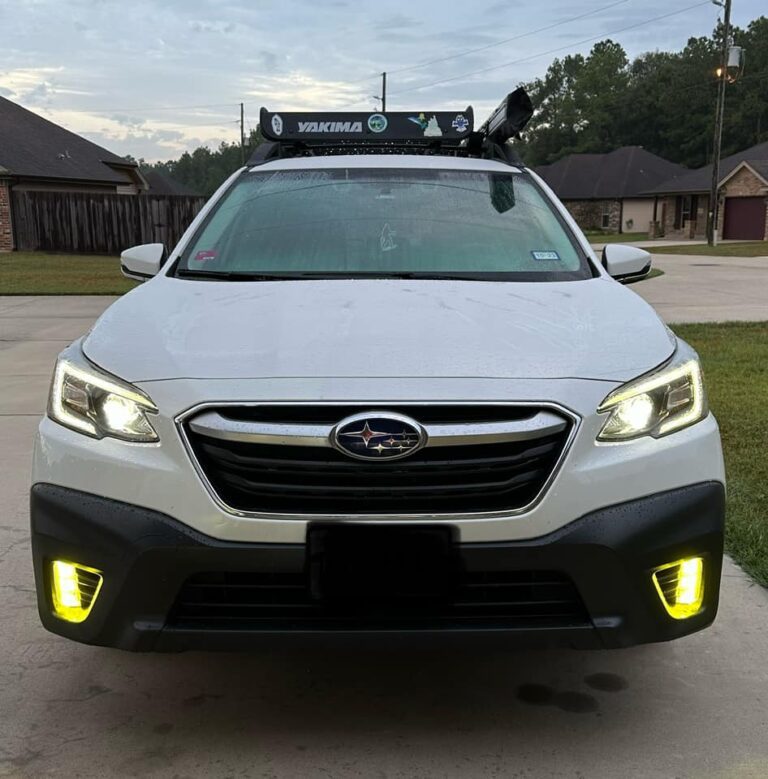
If you have been staring at the letters “SRF” in your Subaru’s manual or on the dashboard and wondering what they actually mean, you are in the right place. It is not the most talked-about feature, but once you understand what it does, you will start to appreciate just how much thought Subaru put into it.
SRF stands for Steering Responsive Fog Lights. And yes, it is exactly what it sounds like. These are fog lights that actually move with your steering input rather than staying fixed in one direction. It is a small but genuinely useful piece of engineering that makes a real difference in specific driving conditions.
Let’s get into everything worth knowing about it.
What Does SRF Actually Mean on a Subaru?
SRF stands for Steering Responsive Fog Lights. These are auxiliary lights positioned on each side of the vehicle, typically mounted low on the front bumper, below the main headlights. They are not your standard headlights. They serve a completely different purpose and behave differently depending on how you are driving.
Here is the key distinction. Your main headlights sit above the bumper and cast a long beam far down the road ahead. The SRF lights sit lower and cast a wide, shorter beam that is angled closer to the ground. That lower angle is intentional. In foggy conditions, light that travels too high reflects straight back at you off the fog layer, making visibility worse instead of better. A wide, low beam cuts underneath the fog rather than into it, which is why fog lights work so much better in those conditions than high beams do.
Now here is what separates Subaru’s SRF from ordinary fog lights. When you turn the steering wheel, the SRF lights pivot in that direction automatically. Turn right, the fog lights swing right. Turn left, they swing left. When you straighten the wheel back to center, the lights return to their forward-facing position on their own. You do not have to think about it. The system handles it.
In terms of range, halogen SRF lights project approximately 200 feet, while LED SRF lights push that out to around 300 feet. The LED version gives you noticeably more visibility around corners, which matters when you are navigating a dark, winding road at night.
Your Subaru dashboard has an indicator light that tells you whether the SRF is on or off. The control button or indicator stalk, depending on your specific model, is typically found on the left side of the steering wheel. If you are not sure whether your Subaru has this feature, start the car and look at the dashboard symbols. If you see the fog light indicator, it is equipped. If you do not see it, your trim level may not include SRF.
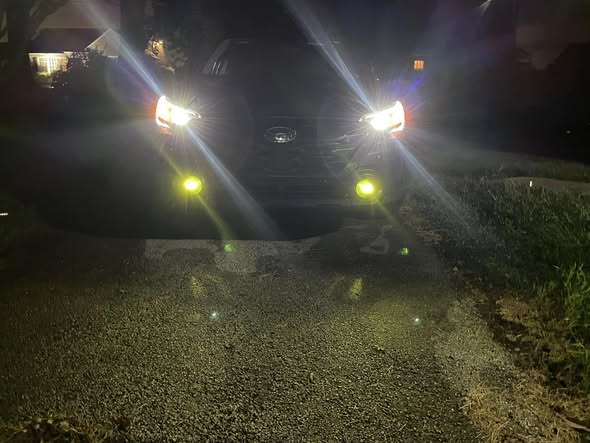
One more thing on bulb color. Yellow-tinted fog light bulbs, whether halogen or LED, have long been the preferred choice among manufacturers, and there is a solid reason for that. Yellow light operates at a longer wavelength than standard white light. That longer wavelength scatters less in fog, rain, and mist, which means it actually penetrates those conditions more effectively. It is not just an aesthetic preference. The physics back it up.
Why Steering Responsive Fog Lights Are More Useful Than They Might Seem
At first glance, you might think fog lights are just fog lights. They turn on when conditions get rough and help you see a bit better. But SRF goes beyond that because of the steering-responsive element, and that specific behavior addresses a real problem that drivers face regularly.
When you approach a corner or a bend in the road, your headlights are pointing straight ahead. They are illuminating the space in front of where the car currently is, not where it is about to go. So for a brief but meaningful moment, you are steering into a section of road that your lights have not reached yet. On a familiar road in daylight, that is not a big deal. On an unfamiliar road at night in the rain, that gap in visibility is exactly where accidents happen.
The SRF system fills that gap. By pivoting up to 15 degrees in the direction of your steering input, the fog lights illuminate the corner ahead of you before your headlights have rotated around to reach it. That early look around the bend gives you more time to spot a hazard and react. It sounds like a small advantage, but at night on a winding road, it genuinely matters.
Here is a breakdown of what the SRF system actually does for you:
It Extends Your Effective Vision Around Corners
The pivot motion of the SRF lights means you are not waiting for the car’s body to rotate before the road ahead gets illuminated. The lights lead the turn rather than following it. On a road that meanders through hills or through a forest, that difference in timing can be enough to spot an animal crossing the road, a cyclist without reflective gear, or a stopped vehicle before you are already committed to the turn.
It Works Particularly Well in Foggy and Low-Visibility Conditions
Fog is one of the more dangerous driving conditions precisely because it tricks you. You feel like you can see far enough ahead, but fog compresses your actual reaction distance. High beams make this worse by bouncing light back off the fog layer directly into your eyes. The wide, low beam of the SRF cuts under the fog layer instead of reflecting off it, giving you actual usable visibility rather than a wall of reflected light.
Pair that with the steering-responsive pivot, and you have a fog light system that not only works better in fog than standard lights but also adjusts dynamically as you navigate corners in those reduced-visibility conditions.
It Makes Your Presence Known to Other Road Users
The rear fog lights that come on in poor visibility conditions serve a different but equally important function. They make your vehicle more visible to drivers approaching from behind. In heavy fog or driving rain, the difference between a vehicle with rear fog lights on and one without them can be the difference between being seen in time and not being seen at all. That visibility works both ways. You see better ahead, and the driver behind you sees you more clearly.
It Can Affect Your Insurance Situation
This one surprises some drivers, but it is worth knowing. If you are involved in an accident during conditions where fog lights should have been in use, and you were not using them, that failure to use appropriate vehicle lighting can be used to reduce or in some cases complicate your insurance claim. Using your SRF when conditions call for it is not just a safety habit. It is also a record of responsible driving behavior.
When Should You Actually Use the SRF?
Not every drive calls for fog lights, and using them unnecessarily can actually be annoying to other drivers because of the wide beam spread. So knowing when to use them and when to leave them off is part of using the system correctly.
Here are the situations where SRF genuinely earns its keep:
1. Foggy or Misty Conditions
This is the most obvious use case and the one the lights are literally named for. Mist, fog, and heavy water vapor in the air all scatter high-beam light back toward you. The low, wide beam of a fog light is designed specifically to work in these conditions without the reflection problem. Turn on the SRF when visibility drops and fog starts closing in. Turn them off once conditions improve. Simple as that.
Using high beams in fog is one of the most common mistakes drivers make. It feels like more light should help, but it actively makes things worse by creating a wall of reflected glare. The SRF is the right tool for that specific job.
2. When Navigating Bends and Turns
Even on a clear night, the steering-responsive function of the SRF is useful when you are navigating tight or unfamiliar curves. The lights will automatically pivot as you turn the wheel, illuminating the corner before your headlights rotate around to reach it. This is the feature that separates Subaru’s SRF from a standard fog light setup.
You do not have to manually activate this function. The system reads your steering input and responds on its own. Once you straighten the wheel, the lights return to center. It is seamless in practice.
3. When Visibility Drops Below a Safe Threshold
In the UK, the legal guideline is that fog lights should be used when you cannot see more than 100 meters ahead. This rule exists to prevent the misuse of fog lights in conditions where they are not actually needed, because unnecessary fog lights can dazzle oncoming drivers. Whether or not your country has a specific law like this, the principle is sound. If your effective visibility has dropped to the point where you need additional light to see the road safely, that is when the SRF comes into play.
Driving at night in areas with no street lighting, heavy rain that is reducing visibility, or dusty rural roads can all be situations where the SRF adds meaningful value even outside of actual fog.
How SRF Compares to Standard Fog Lights
To appreciate what SRF brings to the table, it helps to understand what you are comparing it against.
| Feature | Standard Fog Lights | Subaru SRF |
|---|---|---|
| Beam direction | Fixed, always pointing straight ahead | Pivots up to 15 degrees with steering input |
| Activation | Manual switch only | Automatic response to steering, plus manual control |
| Corner visibility | Limited until car has completed the turn | Illuminates the corner before the car turns into it |
| Halogen range | Varies, typically 150 to 200 feet | Approximately 200 feet |
| LED range | Varies by vehicle | Up to 300 feet |
| Returns to center | Not applicable, light is fixed | Automatically returns to forward position when wheel straightens |
The pivot function is really what defines SRF as a distinct system rather than just a branded name for ordinary fog lights. Without that pivot, it would just be fog lights with a fancy label. With it, the system actively adapts to how you are driving in real time.
Frequently Asked Questions About Subaru SRF
How Do You Turn Off the Steering Responsive Fog Lights on a Subaru?
On models like the Subaru Outback, you can turn off the SRF by pressing the lower right button on the right side of the steering wheel. The specific button location can vary between models, so check your owner’s manual if you are not sure which button controls it.
That said, turning the SRF off is generally not recommended unless you have a specific reason to do so. The system is designed to improve your safety in low-visibility and cornering situations. Disabling it removes that layer of assistance without offering any real benefit in return. Most drivers who understand what the feature does choose to leave it enabled.
How Do Cornering Fog Lights Work Exactly?
When you turn the steering wheel or activate your turn signal while making a turn, the cornering fog light on the corresponding side of the vehicle activates and pivots in the direction of the turn. This gives you improved illumination on the section of road you are about to enter, rather than waiting for your main headlights to rotate around to cover that area.
The light activates automatically based on steering angle input and returns to its resting position when the wheel is straightened. You do not manually aim or adjust it. The system reads your steering and responds accordingly, which is what makes it a genuinely practical feature rather than a gimmick.
Can SRF Replace Regular Headlights?
No, and this point is worth being clear about. The SRF is a supplemental system. It works alongside your main headlights, not instead of them. The wide, low beam that makes fog lights effective in poor conditions also means they do not illuminate a long distance down the road the way headlights do. They are not designed to. Using fog lights as a substitute for headlights would leave you severely under-lit on any road where distance visibility matters.
Think of the SRF as a specialist tool that does one specific job very well. Use it in the conditions it was built for, alongside your regular headlights, and it performs exactly as intended. Try to use it as a replacement for your primary lighting and you are working against its design.
Does Every Subaru Come With SRF?
No. Steering Responsive Fog Lights are available on select Subaru models and trim levels, not across the entire lineup. Whether your specific vehicle has SRF depends on the model, the year, and the trim package you purchased or are considering. The easiest way to check is to look at your dashboard after starting the car. If you see a fog light indicator symbol, your vehicle is equipped. If you do not see it, check your window sticker or owner’s manual for confirmation.
Should You Slow Down When Using Fog Lights?
Yes, and this is a point that does not get mentioned often enough. Fog lights improve your visibility in poor conditions, but they do not change the physical reality of those conditions. Fog, rain, and mist reduce your effective stopping distance and reaction time regardless of what lighting you are using. The SRF gives you a better look at what is ahead, but you still need to reduce your speed to match the conditions. Driving at normal speed in heavy fog with your SRF on is still dangerous. Slow down, increase your following distance, and use the improved visibility the SRF provides to supplement your caution, not replace it.
How SRF Fits Into Subaru’s Broader Safety Philosophy
Subaru has built a strong reputation around safety, and the SRF is a good example of how the brand approaches it. Rather than adding a feature just to put it on a spec sheet, Subaru designed SRF to address a specific, real-world visibility problem that drivers encounter regularly: the gap in illumination during cornering and the reduced penetration of standard lights in fog and mist.
SRF sits alongside other Subaru safety features like Steering Responsive Headlights (SRH), High Beam Assist (HBA), and Reverse Auto Braking (RAB) as part of a layered approach to keeping the driver informed and protected. Each of these features handles a different scenario. Together, they cover a broad range of the situations where driver visibility and reaction time are most at risk.
The SRH handles adaptive beam direction for the main headlights. The HBA manages the switch between high and low beams automatically. The RAB catches obstacles behind you when reversing. And the SRF handles low-level, wide-beam visibility in fog and during cornering. They are distinct systems covering distinct problems, and that is exactly how a well-designed safety ecosystem should work.
Quick Reference: Everything You Need to Know About Subaru SRF
- SRF stands for Steering Responsive Fog Lights.
- The lights are mounted low on the front bumper, below the main headlights, and cast a wide, short-range beam close to the ground.
- They pivot up to 15 degrees in the direction of your steering input and automatically return to center when you straighten the wheel.
- Halogen SRF lights project approximately 200 feet. LED SRF lights project up to 300 feet.
- Yellow-tinted bulbs are common in fog lights because the longer wavelength penetrates fog and mist more effectively than standard white light.
- Use SRF in foggy conditions, during heavy rain or mist, and when navigating corners or bends at night.
- Do not use SRF as a substitute for your main headlights. It is a supplemental system, not a replacement.
- Avoid using high beams in fog. The reflection off the fog layer reduces visibility. Use SRF instead.
- The control button is typically on the left side of the steering wheel, but the exact location varies by model.
- Rear fog lights make your vehicle visible to drivers approaching from behind in poor conditions.
- Failing to use fog lights when conditions require them can complicate insurance claims in the event of an accident.
- Always reduce speed in fog and poor visibility conditions regardless of whether your SRF is active.
If your Subaru is equipped with SRF and you have never paid much attention to it, take a few minutes to locate the control and understand the indicator light on your dashboard. Knowing how the system works means you will use it at the right times and recognize immediately if something is not functioning as it should. A feature this well-designed deserves to be used correctly, and the conditions where it actually helps you are exactly the ones where having clear visibility around a corner could make all the difference.