
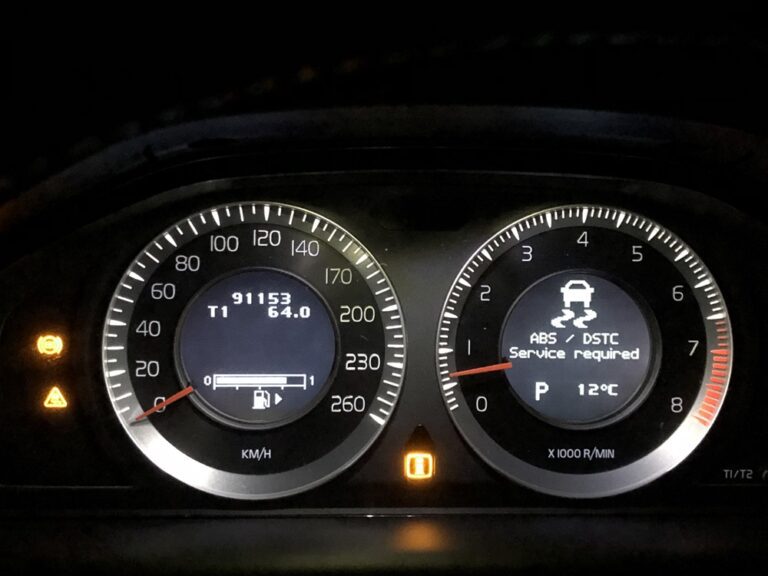
If you drive a Volvo and the “DSTC Service Required” message has appeared on your dashboard, you already know it is not a warning you can comfortably ignore. DSTC, which stands for Dynamic Stability and Traction Control, is one of the key safety systems keeping your Volvo planted and predictable on the road. When it goes offline or develops a fault, your vehicle loses a critical layer of protection that most drivers do not even think about until it is gone.
This guide covers everything you need to know: what DSTC actually does, what the warning means, what causes it, what symptoms to watch for, and exactly what needs to happen to fix it.
What Is DSTC and Why Does It Matter?
DSTC is Volvo’s integrated stability and traction management system. It monitors several things simultaneously while you drive: individual wheel speeds, the steering angle you are applying, lateral acceleration (how hard the vehicle is pushing sideways through a corner), and yaw rate (how quickly the vehicle is rotating around its vertical axis). It pulls all that data together in real time and compares it against what the vehicle should be doing based on your inputs.
When a discrepancy appears, such as the rear stepping out more than the steering angle would normally produce, or a wheel spinning faster than the others during acceleration, DSTC intervenes. It can selectively apply individual brakes, reduce engine torque, or both, all without the driver having to do anything. The goal is to bring the vehicle back into a controlled path before the situation becomes a problem.
This is not a luxury feature. In slippery conditions, during sudden evasive maneuvers, or when a corner tightens unexpectedly, DSTC is the system quietly working to prevent a loss of control from becoming something far more serious. When the “DSTC Service Required” message appears, that system is either offline or compromised, and the vehicle’s ability to manage those situations automatically is reduced or completely gone.
What Does “DSTC Service Required” Actually Mean?
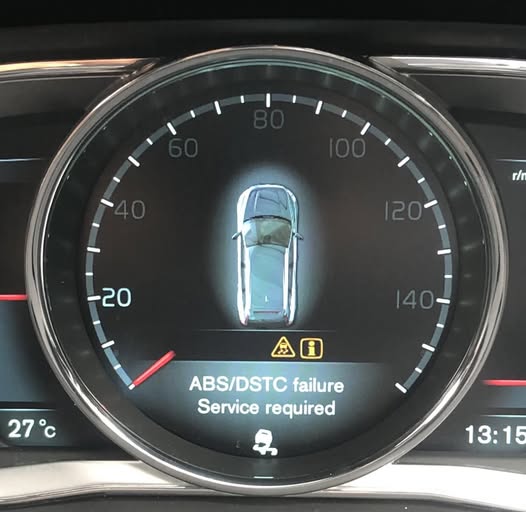
The warning tells you one of two things. Either the DSTC system has detected an internal fault that is preventing it from operating correctly, or the ECU has lost communication with a component the DSTC system relies on. In either case, the system cannot function as designed and has flagged the driver to get it looked at.
On some Volvo models, this warning appears alongside other messages or warning lights. That is actually helpful because additional warnings give you clues about where the fault originates. An ABS light alongside the DSTC message points toward the wheel speed sensor and braking hardware. A steering-related message alongside DSTC points toward the steering angle sensor. Seeing only the DSTC message on its own without other warnings is often a sign of a control module or communication fault.
The DSTC system is also integrated with the body sensor cluster, which is a module that measures the vehicle’s lateral acceleration and yaw rate. A fault in the body sensor cluster will produce this warning because DSTC cannot make accurate stability calculations without that data.
Symptoms That Come With the DSTC Service Required Warning
Sometimes the warning appears with no noticeable change in how the car drives. Other times, you will feel or notice something clearly wrong. Here is what to pay attention to.
Unexpected or Unexplained Traction Control Activation
Traction control activating on a dry road when you are not doing anything aggressive with the throttle is a red flag. The traction control function within DSTC works by detecting wheel spin and responding with brake application or power reduction. If a wheel speed sensor is sending bad data, the system may interpret normal driving as wheel spin and intervene unnecessarily. That unintended intervention feels like brief hesitation or a momentary loss of power during acceleration for no apparent reason.
Instability or Reduced Confidence During Cornering
If DSTC is offline, the vehicle will not actively correct oversteer or understeer. For most everyday driving situations, you probably will not notice the difference. But push the car harder through a wet corner, hit a patch of ice, or encounter an emergency maneuver situation, and the absence of DSTC becomes apparent very quickly. Some drivers describe it as the car feeling less planted or more nervous than usual through corners. That sensation is worth taking seriously.
ABS Warning Light Appearing Alongside DSTC Message
Because DSTC and ABS share wheel speed sensor data and hydraulic brake hardware, a fault in the ABS frequently triggers both the ABS warning light and the DSTC Service Required message at the same time. If you are seeing both, the investigation should start with the wheel speed sensors and ABS components rather than the DSTC control module specifically.
Steering Warning or Other System Messages
A malfunctioning steering angle sensor can produce the DSTC warning along with a steering-related message on some Volvo models. The steering angle sensor tells the DSTC system what direction the driver is trying to go. Without accurate data from that sensor, DSTC cannot correctly distinguish between an intentional maneuver and an unwanted loss of control.
What Causes the DSTC Service Required Warning?
Multiple failure points can trigger this warning. Here is a detailed look at each one.
1. Wheel Speed Sensor Problems
Wheel speed sensors are among the most common triggers for DSTC-related warnings, and for good reason. There is one at each wheel, each continuously transmitting speed data that the DSTC system uses to compare wheel rotation rates and detect slippage. These sensors sit at the wheel hub, where they are exposed to every difficult condition the road can produce: water, salt, mud, road debris, brake dust, and constant vibration.
Wheel speed sensor problems fall into a few categories:
- Physical sensor damage: The sensor body cracks or is struck by road debris, compromising its ability to read the reluctor ring accurately.
- Sensor contamination: Metal shavings from brake pad wear or debris from the road can accumulate on the sensor tip and interfere with its magnetic field. This produces erratic or corrupted speed readings that the DSTC module cannot use reliably.
- Wiring damage: The harness running from the sensor to the vehicle’s body flexes constantly with suspension movement. At the point where the wiring transitions from the moving wheel area to the stationary body, the wire can develop fatigue cracks from repeated flexing. These breaks often cause intermittent faults that come and go rather than a permanent failure.
- Sensor misalignment: If the sensor is not seated correctly after a wheel bearing replacement or other hub work, the gap between the sensor tip and the reluctor ring may be too large for a reliable signal.
2. Malfunctioning Steering Angle Sensor
The steering angle sensor, sometimes called the yaw rate sensor or steering position sensor, is mounted in the steering column and tracks the exact angle and rate of change of your steering inputs. DSTC uses this information to understand the driver’s intended direction. When you steer into a corner, the system knows how much yaw (rotation) and lateral movement are appropriate given the steering angle. If the vehicle’s actual behavior deviates significantly from what the steering angle predicts, DSTC intervenes.
When the steering angle sensor malfunctions, the DSTC module receives incorrect data about where the driver is pointing the car. This can cause the system to either over-correct when it should not or fail to correct when it should. Either way, the DSTC module detects the inconsistency in the data it is receiving and flags the fault.
Steering angle sensors also need to be recalibrated after certain repairs. If your Volvo has had wheel alignment work, steering component replacement, or suspension work done and the DSTC warning appeared shortly afterward, a recalibration of the steering angle sensor is often all that is needed.
3. Faulty ABS System Components
The DSTC system uses the ABS hydraulic unit to apply selective braking to individual wheels when correcting instability. If any part of the ABS is compromised, whether the hydraulic control unit, the ABS pump, or the ABS module itself, the DSTC system loses the ability to carry out its brake-based corrections. This triggers the DSTC warning because the system cannot guarantee it can intervene when needed.
ABS-related fault symptoms alongside the DSTC warning typically include:
- The ABS warning light illuminating at the same time
- A grinding or buzzing sound during brake application that was not there before
- An unusual pulsing or spongy feeling in the brake pedal
- ABS that seems to activate during normal braking on dry pavement
4. Wiring and Electrical Connection Issues
The DSTC system depends on clean, reliable electrical communication between its sensors, the control module, the ABS unit, the engine management system, and the body sensor cluster. A single corroded connector pin, a broken ground wire, or a chafed section of wiring harness can disrupt that communication and trigger the warning.
Electrical faults associated with DSTC warnings are often intermittent. The warning may appear and disappear with no consistent pattern, which is the classic behavior of a connection that is breaking down rather than one that has failed completely. Intermittent faults are actually harder to track down than permanent ones because the fault may not be present when the technician is looking for it. This is where a quality diagnostic tool with live data monitoring becomes valuable, allowing the technician to watch sensor outputs and communication signals while driving.
5. Control Module Malfunction
The DSTC control module is the central processing unit for the entire stability system. It receives sensor inputs, runs the calculations, and sends commands to the ABS hardware and engine management system. When the module itself develops a fault, whether from a software error, internal hardware failure, overheating, water intrusion, or voltage spike damage, the whole system goes down.
Module faults can sometimes be addressed with a software update or reflash, particularly if Volvo has released a revised software version that addresses a known bug. In more serious cases, module replacement is necessary. On Volvo vehicles, module replacement often requires programming using Volvo’s VIDA diagnostic system to match the new module to the vehicle’s configuration, which is a dealer-level procedure.
6. Body Sensor Cluster Issues
The body sensor cluster is a module that measures lateral acceleration and yaw rate, two critical data inputs for the DSTC system. It is typically mounted somewhere near the center of the vehicle for accurate measurement. A fault in the body sensor cluster, whether from physical damage, moisture intrusion, or internal electronic failure, removes essential inputs from the DSTC calculation and triggers the warning.
Body sensor cluster faults are less common than wheel speed sensor faults but are more frequently a root cause when the DSTC warning appears without accompanying ABS or steering messages and without any obvious wheel speed sensor fault codes.
How to Fix the DSTC Service Required Warning
Like most warning messages on modern vehicles, the right fix depends entirely on what the diagnostic scan reveals. Here is the process, step by step.
Fix 1: Try a Vehicle Restart First
Before assuming the worst, try switching the vehicle off completely, waiting a few minutes, and restarting it. Occasionally, a temporary software glitch or a brief sensor signal dropout can trigger the DSTC warning without any actual hardware fault being present. A full power-down cycle allows the control module to reinitialize and may clear a soft fault that resolved itself.
If the warning comes back immediately on the next startup or after a short drive, there is a real fault that needs to be investigated. A restart that temporarily clears the warning is useful information, not a solution.
Fix 2: Scan the Vehicle for Fault Codes
This is the essential first step in any real diagnosis. Connect a scan tool that can access Volvo’s DSTC and ABS modules (not just a generic OBD-II reader that only reads powertrain codes) and pull all stored fault codes. Note every code present, including any that appear in other modules that share data with the DSTC system.
The fault codes will identify which specific sensor, circuit, or component is reporting the fault. That narrows the investigation dramatically. Without this step, any repair is a guess.
For the most complete Volvo-specific diagnostic capability, a shop using Volvo’s VIDA software or a professional-grade aftermarket scanner with Volvo-specific module coverage will give the most detailed information, including live sensor data that allows the technician to watch how each sensor is performing in real time.
Fix 3: Inspect and Service the Wheel Speed Sensors
If wheel speed sensor fault codes are present, inspect the sensors at the affected wheels. Here is the process:
- Raise the vehicle and remove the wheel for clear access to the sensor.
- Inspect the sensor body for cracks, corrosion, or physical damage. A damaged sensor needs replacement.
- Check the sensor tip for metallic debris or heavy contamination. If the tip is clogged or coated, clean it carefully with a soft cloth. Do not use metal tools on the sensor tip.
- Inspect the reluctor ring (the toothed ring at the hub that the sensor reads) for missing teeth, cracking, or heavy rust that could interfere with accurate readings. A damaged reluctor ring typically requires hub bearing replacement.
- Trace the sensor wiring back toward the chassis and inspect for damage, particularly at the flex point where the harness transitions from the moving wheel assembly to the stationary body. Look for cracked insulation, exposed wire, or signs of contact wear.
- Check the connector for corrosion or damaged pins. Clean with electrical contact cleaner if needed.
After replacing a faulty sensor or repairing damaged wiring, clear the fault codes and test drive the vehicle to confirm the DSTC warning does not return.
Fix 4: Recalibrate or Replace the Steering Angle Sensor
If the diagnostic points to the steering angle sensor, the first step is recalibration before assuming replacement is necessary. On Volvo vehicles, the steering angle sensor recalibration procedure is done through the diagnostic software by centering the steering wheel and running the calibration routine. This takes just a few minutes and is often all that is needed after alignment work or steering component replacement.
If the sensor is mechanically faulty rather than simply out of calibration, replacement is necessary. After installing a new sensor, it must be calibrated before it will work correctly. A steering angle sensor installed without calibration will produce the same warning message the faulty one did.
Fix 5: Diagnose and Repair ABS System Faults
If ABS fault codes are present alongside the DSTC warning, the ABS components need to be inspected as part of the repair. Common ABS-related repairs on Volvos include:
- ABS wheel speed sensor replacement: Often the same sensors contributing to DSTC faults. Replacing a faulty ABS sensor resolves both the ABS and DSTC warnings simultaneously in many cases.
- ABS hydraulic unit repair or replacement: If the ABS pump or valve body is faulty, the hydraulic unit may need service or replacement. This is a more involved repair that requires proper brake bleeding after completion.
- ABS module replacement: If the ABS control module has failed internally, replacement is required. On Volvos, the ABS module is often integrated with the hydraulic unit as a single assembly.
Fix 6: Address Wiring and Electrical Connection Issues
For wiring faults, the repair approach depends on where and how the wiring is damaged:
- Corroded connectors can often be cleaned and treated with dielectric grease to prevent further moisture intrusion. If the corrosion has physically damaged the terminal metal, the connector needs replacement.
- A broken wire in the harness can be repaired by splicing in a new section of the same gauge wire, though on sensor circuits it is often better to replace the sensor pigtail or the affected section of harness entirely to maintain consistent signal quality.
- A chafed section of harness that is rubbing against a component needs to have the damage repaired and then be re-routed or protected with loom to prevent it from chafing again in the same spot.
After any wiring repair, clear the fault codes and do a test drive before confirming the repair is complete. Intermittent wiring faults in particular need a period of driving to confirm they are fully resolved rather than just temporarily absent.
Fix 7: Address Control Module or Body Sensor Cluster Faults
If the diagnostic confirms a fault in the DSTC control module or the body sensor cluster, the repair typically involves either a software update from Volvo or module replacement. These are jobs for a Volvo-authorized dealership or a shop with access to Volvo’s VIDA diagnostic and programming system. Replacing a control module without the correct programming tools will leave the new module unable to communicate with the rest of the vehicle’s systems.

Is It Safe to Drive With the DSTC Warning Active?
You can drive the vehicle to a shop. The engine, transmission, and standard brakes continue to operate normally. But you are driving without active stability correction and traction management, which means you are relying entirely on your own reactions in any situation where the road conditions or vehicle dynamics become challenging.
On a clear, dry day with light traffic and careful driving, the risk is relatively low. In rain, snow, ice, or any situation requiring a sudden evasive maneuver, the absence of DSTC is a meaningful safety reduction that you should not take lightly. Drive conservatively, increase following distances, and get the repair done quickly rather than treating the warning as something to deal with eventually.
Approximate Repair Costs for DSTC-Related Faults
Here is a realistic cost guide based on the most common repairs that resolve the DSTC Service Required warning on Volvo vehicles.
| Repair Type | Approximate Parts Cost | Approximate Total Cost (with labor) |
|---|---|---|
| Diagnostic scan (Volvo-specific) | N/A | $100 to $180 |
| Wheel speed sensor replacement | $30 to $120 per sensor | $120 to $350 per sensor |
| Wiring repair (minor) | $20 to $60 (materials) | $100 to $350 |
| Steering angle sensor recalibration | N/A | $80 to $150 |
| Steering angle sensor replacement | $100 to $300 | $250 to $600 |
| ABS hydraulic unit repair or replacement | $400 to $1,000+ | $700 to $1,500+ |
| DSTC control module replacement | $300 to $800+ | $500 to $1,200+ |
| Body sensor cluster replacement | $200 to $600 | $350 to $900 |
Why Volvo-Specific Diagnostic Equipment Makes a Difference
DSTC is a Volvo-specific system, and its fault codes, module communication protocols, and calibration procedures are accessed through Volvo’s own VIDA software. A general OBD-II reader will likely catch powertrain codes but may miss DSTC module-specific codes or the live sensor data needed to properly trace an intermittent fault.
A Volvo-authorized dealership is the surest option for complete diagnostic access. Independent shops that specialize in Swedish or European vehicles and have invested in professional-grade Volvo-compatible diagnostic tools are also capable of doing thorough DSTC diagnosis and repair. A general repair shop without Volvo-specific tooling is going to be limited in what they can see and may recommend parts replacement based on incomplete diagnostic information, which is how unnecessary repair costs accumulate.
Preventing DSTC Problems Going Forward
While not every DSTC fault is preventable, some proactive maintenance habits reduce the risk significantly.
Keep the Wheel Areas Clean
Wheel speed sensor contamination is one of the most common and preventable causes of DSTC warnings. Regular cleaning of the wheel hub area, particularly during winter when road salt and slush accumulate heavily around the sensors and their wiring, goes a long way toward preventing sensor degradation.
Have Sensors Inspected During Brake Services
Every time brake pads or rotors are replaced, the wheel speed sensors at those corners should be visually inspected and the sensor tip checked for metallic debris. This takes very little additional time since the wheels are already off and adds no meaningful cost. Catching a sensor with a cracked housing or corroded wiring before it fails completely avoids an unscheduled service visit.
Recalibrate the Steering Angle Sensor After Alignment or Steering Work
Any time wheel alignment is performed, steering components are replaced, or suspension work changes the vehicle’s geometry, the steering angle sensor should be recalibrated. This is a quick procedure that prevents the DSTC system from operating with incorrect reference data.
Do Not Ignore Intermittent DSTC Warnings
A DSTC warning that appears once, disappears after a restart, and does not come back for a week is easy to dismiss. But intermittent warnings are early warning signs of developing faults, often wiring or sensor issues that will eventually become permanent failures. Getting the codes read when the warning first appears, even if it has temporarily cleared, gives you a head start on addressing the problem before it becomes more urgent.
Final Thought
DSTC is one of the systems your Volvo was specifically engineered around. Volvo’s entire brand identity is built on vehicle safety, and DSTC is a central part of that. When the system flags a fault, it deserves the same urgency you would give to a brake warning. Get the diagnostic done, identify the specific cause, and repair it properly with Volvo-compatible tools and parts. A Volvo without functioning DSTC is still a very capable vehicle. But it is not the Volvo it was designed to be.