
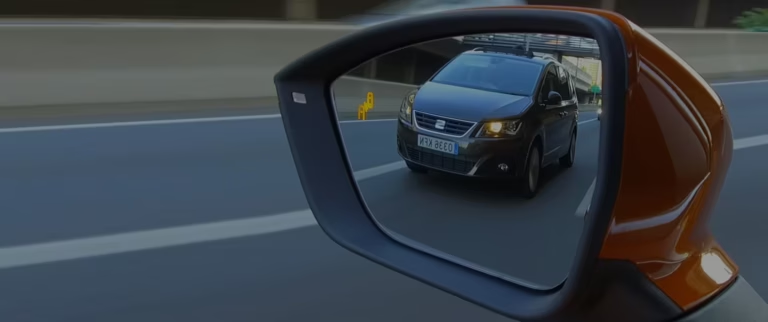
One of the first things a driving instructor teaches you is to check over your shoulder before changing lanes. Side mirrors help, but they have always had a limitation. There is a zone alongside your vehicle that mirrors simply cannot cover. That zone is your blind spot, and it has been responsible for countless lane-change accidents over the decades.
Blind spot monitoring systems were developed specifically to address that gap. Instead of relying entirely on the driver to check an area that is physically difficult to see, the system does the monitoring and alerts you when something is there. It sounds like a simple idea, but the technology behind it is surprisingly sophisticated.
But are these systems actually useful in the real world? Or are they just another piece of technology that adds complexity without meaningfully changing how safely you drive? This article breaks down how blind spot monitoring works, what it costs, who benefits from it most, and whether it is worth having on your vehicle.
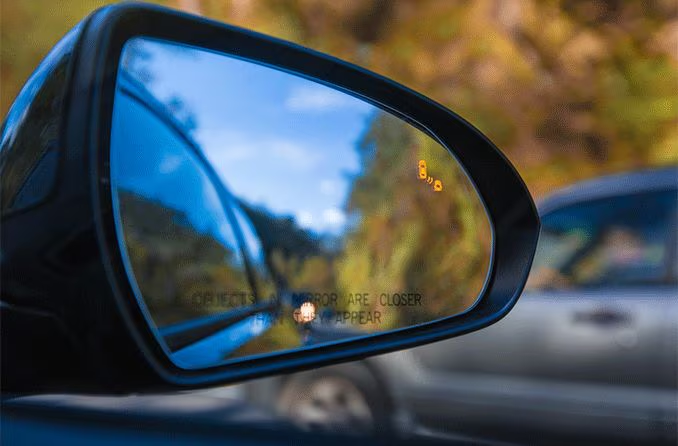
What Is Blind Spot Monitoring and What Does It Actually Do?
Blind spot detection is a driver assistance system that provides electronic coverage of the areas around your vehicle that mirrors and direct vision cannot fully cover. Unlike a reversing camera that you only activate when going backwards, blind spot monitoring works continuously while you are driving, regardless of your speed.
The system is typically part of a broader suite of driver assistance features, which may include:
- Adaptive cruise control
- Lane departure warning
- Rear cross-traffic alerts
- Front and rear parking sensors
- Parking cameras
Having these systems equipped on your vehicle can also have a practical benefit beyond safety. In many regions, insurers recognize the presence of driver assistance technology and may offer reduced premiums as a result. The systems create a more documented, safer driving profile that insurers respond to favorably.
How Does Blind Spot Detection Actually Work?
The technology relies on a combination of sensors that constantly scan the areas your eyes cannot reliably cover while focusing on the road ahead.
Most systems use radar sensors, ultrasonic sensors, or cameras, and in some cases a combination of all three. These sensors track what is moving alongside and behind your vehicle in real time. When another vehicle enters the monitored zone, the system registers its presence and triggers a warning.
Those warnings are delivered in several ways depending on the system:
- Visual alerts: A light or icon appears in or near the side mirror on the relevant side
- Audible alerts: A chime or beep sounds when the hazard is detected
- Tactile alerts: The steering wheel or seat vibrates to get the driver’s physical attention
The combination of alert types is intentional. Different drivers respond better to different stimuli. A driver with the radio playing loudly may not hear an audible alert but will notice a vibration in the wheel immediately.
Here is a helpful video that shows how the system works in a real driving environment:

Where Are Blind Spot Sensors Located on a Car?
The sensors themselves are distributed across the vehicle structure, typically integrated into the rear bumper, side mirrors, or rear quarter panels depending on the manufacturer’s design.
The warning indicators, however, are positioned specifically in the driver’s line of sight. They are usually placed in or near the side mirrors so the driver sees the alert at the same moment they look toward the area they are considering moving into. That placement is deliberate. A warning you have to look away from the road to see is not particularly helpful.
On vehicles where blind spot monitoring is being added as an aftermarket installation rather than a factory feature, sensor and indicator placement can be adjusted to fit the driver’s preferences and the vehicle’s physical layout.
Can You Add Blind Spot Monitoring to an Older Car?
Yes, it is possible to retrofit blind spot monitoring to a vehicle that did not come with it from the factory. But this is not a straightforward DIY project for most people.
Even the most basic aftermarket blind spot systems require wiring to be run through the vehicle. That means working with your car’s electrical system, which is not something to approach without the right knowledge. An incorrect installation does not just mean the system will not work properly. It can create electrical faults that affect other systems in the vehicle.
The quality gap between generic aftermarket systems and properly engineered factory-equipped systems is also worth considering. Budget options have limited sensor range and are more prone to false triggers, where the system warns you when nothing is actually there. Over time, frequent false alerts train drivers to ignore the warnings, which defeats the entire purpose of having the system.
The Insurance Institute for Highway Safety (IIHS) has recognized blind spot detection as one of the most effective driver assistance systems for reducing lane-change crashes. Their research also highlights how the data recorded by these systems can support insurance claims when accidents occur.
If you are going to add it to an older vehicle, have it professionally installed by someone with experience working on automotive electrical systems.
How Much Does It Cost to Add Blind Spot Detection?
Aftermarket blind spot monitoring systems are available across a wide price range. Here is a breakdown of what you typically get at each level:
| Price Range | What You Get | Limitations |
|---|---|---|
| Under $250 | Basic sensors, a pair of indicators, no cameras | Limited range, lower accuracy, higher false alert rate |
| $250 to $500 | More sensors, improved accuracy, better range | Still cannot match factory-installed system performance |
| $500 and above | Brand-name systems, cameras, high-precision algorithms, reduced false triggers | Professional installation still required for best results |
For new vehicles, blind spot monitoring is increasingly offered as either standard equipment or an optional add-on package. When purchasing a new car, the cost of adding BSM through the dealer is often far less than retrofitting it later on an older vehicle.
Should Your Car Have Blind Spot Monitoring?
The honest answer is that it depends on how and where you drive, and what type of vehicle you operate. But for most drivers in most situations, the answer leans toward yes.
Here are the scenarios where blind spot monitoring delivers the most value:
- Larger vehicles: SUVs, vans, and trucks have larger blind spots than sedans and compact cars. The bigger the vehicle, the more area the mirrors and direct vision fail to cover. Blind spot monitoring fills that gap most effectively on larger vehicles.
- Carrying passengers, especially children: When your attention is split between the road ahead and managing activity in the back seat, having an electronic system monitoring your flanks adds a layer of safety that is genuinely useful.
- Highway and multi-lane driving: High-speed lane changes on busy highways are exactly the situation blind spot monitoring was designed for. Vehicles approach quickly, and a momentary lapse in mirror-checking can lead to a serious incident.
- Drivers still building confidence: New or less experienced drivers who are still developing their spatial awareness of the vehicle benefit significantly from the additional feedback these systems provide.
Where blind spot monitoring adds less value:
- Single-lane rural roads where lane changes simply do not happen
- Low-speed urban traffic where vehicles are moving slowly enough that standard mirror-checking is adequate
- Experienced drivers with well-established habits who find additional alerts distracting rather than helpful
That last point deserves some acknowledgment. Some experienced drivers genuinely do not need the additional input. They have well-developed habits, good spatial awareness, and prefer to drive without the visual and auditory interruptions that these systems introduce. That is a legitimate preference and not a dismissal of the technology.
What the Research Actually Says About Blind Spot Monitors
The IIHS conducted research on the real-world effectiveness of blind spot detection and lane departure warning systems. The findings were notable. Vehicles equipped with blind spot monitoring showed a meaningful reduction in lane-change related crashes compared to similar vehicles without the technology.
The research also found that driver behavior changed in the presence of these systems. Drivers made fewer unsafe lane changes overall, not just when the system triggered a warning. The awareness that the system was monitoring those areas seemed to reinforce better lane-change habits in general.
That secondary effect is worth noting. Beyond the direct warnings the system provides, it appears to make drivers more conscious of their blind spots even when the system is not actively alerting them.
What Blind Spot Monitoring Cannot Do
It is important to be clear about the limitations of these systems, because overconfidence in driver assistance technology can create its own risks.
- They do not eliminate the need to check mirrors: Blind spot monitoring is a supplement to proper mirror use, not a replacement for it. Drivers should still check their mirrors and look over their shoulder when changing lanes.
- Sensors can have coverage gaps: No system provides truly complete 360-degree coverage of every possible hazard. Fast-approaching vehicles, motorcycles, or cyclists in certain positions may not trigger alerts in all systems.
- Weather and physical obstructions affect accuracy: Heavy rain, mud, snow, or physical damage to sensor housings can reduce system performance or cause false alerts.
- False alerts can lead to habituation: If a system triggers warnings too frequently when nothing is actually present, drivers learn to tune out the alerts. At that point, the system becomes useless even when a real hazard exists.
Understanding these limitations helps set realistic expectations. Blind spot monitoring is a useful tool. It is not an infallible guardian.
Where Is This Technology Headed?
The automotive industry is moving toward making blind spot monitoring standard equipment across all new vehicles rather than an optional add-on. Several manufacturers have already made it standard across their entire lineup.
The IIHS has been increasingly factoring the presence of driver assistance features into vehicle safety ratings, which creates additional pressure on manufacturers to include these systems. And as the technology improves, the accuracy and reliability of blind spot monitoring continues to get better while the cost of producing it continues to fall.
The trend in insurance is also moving in a similar direction. Just as dashcams became widely accepted as evidence in accident claims, driver assistance data from these systems is increasingly being used by insurers to assess fault and verify circumstances. Some insurers already offer discounts for vehicles equipped with qualifying driver assistance systems.
In practical terms, if you are buying a new car now or in the near future, chances are blind spot monitoring will either come standard or be available at a modest additional cost. The question of whether you need it is becoming less relevant as it becomes the expected baseline.
Final Verdict: Is Blind Spot Monitoring Worth It?
For most drivers, yes. The technology fills a genuine gap in what a driver can practically monitor while operating a vehicle in normal traffic. It is most valuable on highways, during lane changes, in larger vehicles, and for drivers who carry passengers regularly.
For the driver who sticks to low-speed, single-lane roads and rarely encounters traffic, the added value is minimal. But that describes a relatively small proportion of driving situations in the real world.
The more practical question is not whether blind spot monitoring is useful in theory. It is whether the specific system you are considering, at the price point you are paying, will actually perform reliably in your driving conditions. A high-quality factory system is always going to outperform a cheap aftermarket one. Know what you are buying before you decide.
If your car does not have it and you spend significant time on multi-lane roads or highways, adding blind spot monitoring is one of the most practical safety investments you can make. A lane-change accident you avoid with a timely warning is worth every penny of the system’s cost.