
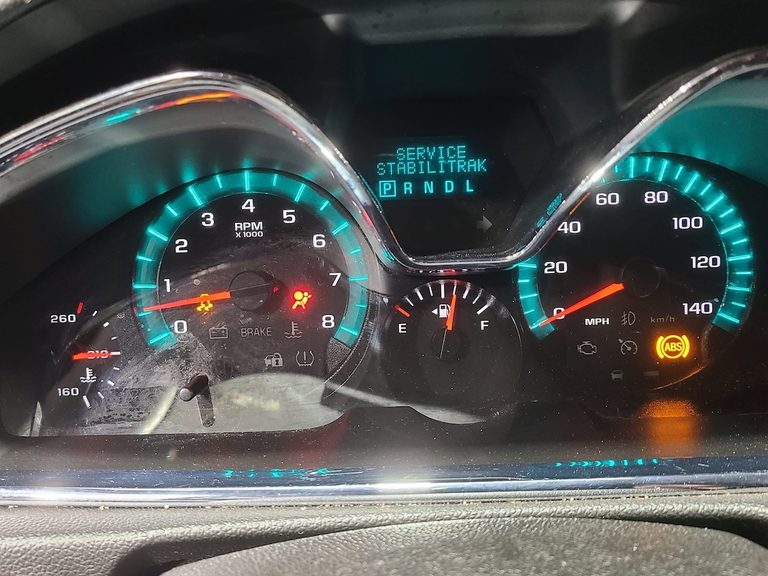
The “Service StabiliTrak” message tends to show up at the worst time, like halfway through a road trip or on a wet morning commute. The Tahoe still drives, so it’s tempting to shrug it off and keep going. That’s usually a mistake, because the message means a safety system has stopped doing its job.
This guide covers what the warning means, the symptoms that come with it, the most common causes, a reset procedure you can try, and a sensible way to diagnose it at home. I’ll also tell you where DIY stops making sense. I’m not going to guess at repair prices or part numbers, since those vary by model year and shop.
What the Service StabiliTrak message means
StabiliTrak is GM’s stability control system. It watches how the Tahoe is moving and compares that with what you’re asking it to do. If the truck starts to slide or the back end steps out, the system can brake individual wheels and cut engine power to help you stay in line.
To do that, it depends on sensor data. When one of those sensors sends bad information, or stops sending anything, the system can’t trust itself and shuts down. The warning typically points to a problem with the system’s sensors or with the stability control itself.
The usual suspects are wheel speed sensors, steering input, and even engine trouble. That last one surprises people, but stability control and the engine talk to each other constantly. A problem on one side can show up as a warning on the other.
Symptoms that come with a StabiliTrak problem
Knowing what the system looks and feels like when it’s unhappy helps you decide how urgent this is. The signs fall into two groups: what you see on the dash and what you feel from the driver’s seat.
Warning lights on the dashboard
When there’s a problem with StabiliTrak, more than one light can come on. You might see the Service StabiliTrak message, the traction control light and the ABS light together. Each one points to a slightly different system, but when they show up at the same time, there’s often one shared problem behind them.
A wheel speed sensor is a good example. ABS, traction control and stability control all use that signal, so one bad sensor can light up the whole group. That’s a useful clue because it narrows your search before you pick up a single tool.
If you see these lights, the next move is scanning for diagnostic trouble codes. A basic OBD scanner is worth keeping in the glove box for this reason. Keep in mind that some inexpensive scanners only read engine codes, so check whether yours can read ABS and stability control modules.
How the light behaves
The way the light acts tells you something. If it flickers on and off, you’re probably dealing with an intermittent problem, like a loose connector or a sensor that’s failing a little at a time. A light that stays on points to something more solid and needs attention sooner.
Pay attention to when it happens. Does it come on after you hit a bump, in the rain, or after the truck has been running for a while? Write that down, because intermittent problems are far easier to track when you know the conditions that trigger them.
If the light stays on, treat the system as unavailable. That affects how the Tahoe behaves in a slide, so a mechanic who knows Chevy vehicles is a smart call before this turns into something bigger.
Loss of traction and stability
You may also feel a difference in the way the truck handles. It can be harder to control, especially on slippery roads. If traction control or StabiliTrak functions are compromised, you may also see reduced engine power, which makes it tough to hold speed on wet or snowy pavement.
Some drivers see a “StabiliTrak Off” message. That means the systems aren’t operating effectively, and the Tahoe may not handle the way you expect in a corner or a sudden swerve. A full-size SUV with a high center of gravity needs those aids more than a small car does, so don’t brush it off.
Is it safe to drive with the light on?
The Tahoe will usually still drive. Steering, brakes and the engine normally keep working as they always do. What you lose is the safety net that kicks in when things go wrong.
For a short, careful trip to a shop or parts store in dry weather, most people get by. In rain, snow, ice or heavy traffic, the risk goes up. If the truck feels strange, it’s losing power, or the ABS light is on along with the brake pedal feeling different, stop driving it and get it checked.
A few common-sense rules apply while you wait for a repair:
- Leave extra room between you and the vehicle ahead.
- Slow down on wet and slick roads and take corners gently.
- Avoid towing or heavy loads until the system is working again.
- Don’t treat the light as something you’ll deal with next month.
Common causes of StabiliTrak problems in a Tahoe
The causes usually fall into three buckets: sensors, electrical connections and worn parts. Engine misfires are a fourth, and they trip people up because the symptom shows up somewhere else. Here’s how each one plays out.
Sensor errors and failures
Sensors are the eyes and ears of StabiliTrak. The ones that come up most often are the wheel speed sensors, the steering wheel position sensor and the throttle position sensor. When any of them sends bad data, you can get a Service StabiliTrak message.
A faulty ABS sensor can cause trouble in the braking system, which affects stability. A problem with the steering angle sensor can change how the truck responds in a turn, because the computer no longer knows where you’re trying to go. A bad throttle position signal can confuse the system about how much power you’re asking for.
Wheel speed sensors live near the wheels, so they take a beating from dirt, water, road salt and metal debris. In my experience they’re also one of the first things I check when a Tahoe comes in with this message. They’re cheap to look at and easy to rule out.
Electrical and connection problems
StabiliTrak runs on small electrical signals, and small signals are easy to disrupt. Loose or corroded connections can create intermittent problems, such as the light flickering on and off while you drive. Inspecting the wiring and connectors for damage is a smart first step.
Look at the harnesses near each wheel, since they flex with the suspension and can chafe or crack. Check plugs for green or white corrosion, bent pins and wires rubbed through by contact with a moving part. A connector that looks fine can still be loose, so unplugging and reseating it is worth a try.
A weak battery can cause odd warnings too, because modules are sensitive to low voltage. If your Tahoe has been slow to start lately, have the battery and charging system tested before you chase more expensive parts.
The brake switch
A failing brake switch can affect the system’s operation. It sends a signal to StabiliTrak so it knows when you’re braking, which helps it manage stability. Faulty connections in that circuit can make the StabiliTrak light come on unpredictably.
One easy check is to have a helper press the brake pedal while you look at the brake lights from behind. If they don’t work properly, or they stay on when your foot is off the pedal, the switch deserves a closer look. Brake light problems and stability warnings sometimes show up together.
Component wear
Over time, the parts in the system wear out. Wheel speed sensors degrade with age, giving inaccurate speed readings and causing stability control issues. Steering wheel sensors can wear out and give bad data, which affects handling.
Age is also why mileage matters when I’m sizing up a problem. A higher-mileage Tahoe has had more years of heat cycles, moisture and vibration working on the connectors and sensors. That doesn’t mean everything needs replacing, but it does mean wear is a reasonable suspect.
Engine misfires
Engine misfires can be linked to worn spark plugs or ignition coils, and they can lead to stability problems. When the engine stumbles, torque delivery gets uneven, and the system can read that as a fault. You might notice a rough idle, a hesitation or a flashing check engine light along with the StabiliTrak message.
If the check engine light is on, don’t skip it. Read those codes first, because fixing the misfire may clear the StabiliTrak message without touching anything else. A flashing check engine light is a stop-driving situation, since raw fuel can damage the catalytic converter.
Causes at a glance
| Suspect | Typical clue | First thing to check |
|---|---|---|
| Wheel speed sensor | StabiliTrak, traction and ABS lights together | Scan for codes, then inspect the sensor and its wiring at the wheel |
| Steering angle sensor | Handling feels off in turns, light appears after steering work | Scan for steering position codes and check for related faults |
| Throttle position sensor | Power delivery feels odd, other engine symptoms | Scan engine codes and look for throttle-related faults |
| Wiring or connectors | Light flickers on and off | Inspect and reseat connectors, look for corrosion and chafing |
| Brake switch | Light comes on unpredictably, brake light oddities | Check brake lights and the switch connection |
| Engine misfire | Rough idle, hesitation, check engine light | Read engine codes and inspect plugs and coils |
| Worn components | Problem grows over time, higher-mileage truck | Test the sensor in question, then replace as needed |
How to diagnose it at home
A good diagnosis saves money, because it keeps you from replacing parts that were never the problem. Here’s the order I’d work in. It starts with the free and easy checks and moves toward the more involved ones.
- Note the conditions. Write down when the light comes on, what the weather was and what the truck was doing.
- Look at the dash. See which lights are on. StabiliTrak alone points one direction, and StabiliTrak plus ABS and traction control points another.
- Scan for codes. Use an OBD scanner that can read the ABS and stability modules if you can. Write down every code before you clear anything.
- Check the basics. Look at tire pressures, tire condition and the battery. Unequal tire wear or mismatched tires can confuse a stability system.
- Inspect the wheel speed sensors. Look at each sensor and its wiring for damage, dirt or loose connectors.
- Check the brake lights. Make sure they work and turn off when you release the pedal.
- Look at the engine. If you have misfire symptoms, check the spark plugs and coils.
- Reset and test drive. Try the reset below, then drive normally and see whether the message returns.
The code is your best friend here. Without one, you’re guessing, and guessing at sensors gets expensive in a hurry. Even a basic code points you at the right corner of the truck.
If you don’t own a scanner, many parts stores will read basic codes for free. Their tools may not always read the ABS and stability modules, so ask what the machine can do. A shop with the right scan tool can get you a more complete answer.
How to reset the StabiliTrak system
Sometimes the Service StabiliTrak message is a one-time glitch, and a reset clears it. It’s worth a try when the light shows up out of nowhere and the truck drives normally. Here’s the procedure as I’d walk you through it.
- Park safely. Pull over and park on a level surface where it’s safe. Do this with the truck stopped, not while driving.
- Turn off the engine. Shut the engine off and remove the key from the ignition. This gives the system a chance to reset.
- Wait a short time. Let the vehicle rest for about 30 seconds to a minute so the system can reboot.
- Turn the ignition to On. Put the key back in and turn it to the “On” position without starting the engine.
- Press the gas pedal. Slowly press the accelerator down five times within five seconds.
- Start the engine. Start the Tahoe and see whether the Service StabiliTrak message has disappeared.
If the message is gone, drive normally and watch for it to return. If it comes back soon, you haven’t fixed anything. You’ve only cleared a symptom, and the underlying fault is still there.
Know what a reset can’t do. It won’t repair a failed sensor, a chafed wire or a worn part, and it isn’t a substitute for reading the codes. These steps are a guideline, and they may not work if there’s a serious underlying problem.
If the message is still there, a deeper diagnosis is needed. A faulty wheel speed sensor, for instance, can trigger the message again and again. At that point, move on to the inspection steps above or see a professional.
If your Tahoe doesn’t use a key
Some Tahoes use a push-button start, so “remove the key” doesn’t apply the same way. The idea is to shut the truck off completely and let it sit for a moment before powering it back up. If the steps don’t match your model, check the owner’s manual or ask a dealer how they want it done, since I won’t make up a version for your year.
When the light keeps coming back
A returning light is the most useful clue you’ll get. It tells you the problem is real and repeatable, which makes it easier to find. Here’s how I’d approach it.
Start with the codes, since they’ll usually name the circuit. If the code points to a wheel speed sensor, inspect that wheel’s sensor and wiring, and compare it with the other side. If it points to the steering angle sensor, a shop with the right scan tool can check it and tell you whether a calibration is needed. I’d rather say “ask the shop” than guess at a procedure for your exact year.
If you get no code or only a vague one, pay attention to patterns. Intermittent faults often trace back to wiring or connectors, and those can take patience to find. Wiggle test harnesses with the engine running, and watch for the light to react.
If a repair doesn’t cure it, the problem might be in a different spot than the first guess. Parts-swapping without a diagnosis is how a $20 sensor problem becomes an expensive one, so stop and get a proper test.
DIY or shop: where to draw the line
| Job | DIY reasonable? | Notes |
|---|---|---|
| Reading codes with an OBD scanner | Yes | Make sure the tool can read ABS and stability modules |
| Trying the reset procedure | Yes | Only a temporary fix if a real fault exists |
| Checking tire pressure and condition | Yes | Simple, and it rules out an easy cause |
| Inspecting wheel speed sensor wiring | Usually | Safely support the truck with jack stands if you need to reach the wheel |
| Reseating connectors | Usually | Be gentle with plastic clips, and disconnect the battery if you’re unsure |
| Replacing spark plugs or coils | Often | Depends on your comfort level and engine access |
| Replacing a wheel speed sensor | Sometimes | Rusted or seized parts can turn it into a big job |
| Steering angle sensor work | Usually a shop | May require a scan tool to calibrate |
| Brake system repairs | Only if experienced | Brakes are a safety item, so don’t guess |
| Anything with warning lights plus odd braking or steering | Shop | Don’t keep driving while you troubleshoot |
A scan tool and a bit of patience get you a long way. Past that, it comes down to how comfortable you are working around wheels, brakes and wiring. If you don’t have jack stands and the know-how to use them, leave that part to a shop.
Regular maintenance to prevent StabiliTrak problems
Maintenance won’t make a sensor immortal, but it cuts down on problems and makes the ones that do show up easier to find. Paying attention to the sensors, the braking system and the general condition of the truck helps keep things running smoothly. Each piece affects the system’s performance and your safety.
Check and replace sensors as needed
Sensors are vital to the StabiliTrak system. They monitor wheel speed and other key data, and over time they can fail or get dirty. Inspect them now and then so you catch a problem early.
If you notice StabiliTrak warnings or odd driving behavior, check the sensors first. Faulty sensors can also affect other things, such as cruise control. Clean or replace them as needed to keep the system accurate.
When you have a wheel off for a tire rotation or brake job, take a look at the sensor and wiring while you’re there. It costs nothing, and you’ll spot cracked insulation or caked-on grime before it causes trouble. That’s the habit I push with customers more than any other.
Keep the braking system in good shape
StabiliTrak relies on a well-maintained braking system, since it uses the brakes to help steady the truck. Check the brake fluid regularly and make sure it’s clean and at the right level. Dirty or low brake fluid can hurt braking performance.
Watch the condition of the pads and rotors, too. Worn components can lead to uneven braking and affect how the system responds. A Tahoe is a heavy vehicle, so it leans on its brakes harder than a lighter car does.
Keep the engine and electrical system healthy
Because misfires can trip the stability system, tune-up items matter. Replace spark plugs and coils when they’re worn, and don’t ignore a rough idle. Follow the maintenance schedule in your owner’s manual for the intervals that apply to your model.
On the electrical side, keep the battery terminals clean and tight, and have a weak battery tested. Look at wiring when you’re under the truck for other reasons. Corrosion and chafing tend to grow quietly until a warning light brings them to your attention.
Mind your tires
Tires aren’t in the source material, but they matter here in practice. The stability system compares wheel speeds, so tires that differ a lot in wear or size can make the numbers look odd. Keep the pressures right, rotate on schedule, and replace tires in sensible sets. If you’ve recently changed tires and the light followed, mention that to your mechanic.
Mistakes to avoid
These are the slip-ups I see most often with this warning. Each one costs time, money or both.
- Clearing the light and forgetting about it. A reset doesn’t repair anything, and the fault is still there.
- Replacing parts without codes. Guessing at sensors wastes money fast.
- Driving hard with the system off. You’ve lost a safety aid, so slow down.
- Ignoring the check engine light. A misfire can be the actual cause of the StabiliTrak message.
- Skipping the wiring check. Connectors and harnesses are a common culprit, and they cost nothing to inspect.
- Working under the truck without jack stands. A jack alone isn’t safe.
- Forcing connectors. Brittle plastic clips break, and a broken clip creates a new problem.
- Waiting too long. Small sensor faults are easier to fix than a pile of related ones.
A customer once pulled into the shop with a Tahoe that had been showing the Service StabiliTrak message for weeks. He’d reset it a few times, and each time it went away for a day or two. When we scanned it and looked at the wheels, one sensor wire had rubbed through against a suspension part, and its a good example of why a reset isn’t a repair.
Fixing that wire took far less effort than the weeks of worry. The lesson was to read the code first and look at the wheel second, before spending money on parts.
Questions Tahoe owners ask
What does Service StabiliTrak mean?
It means the stability control system has detected a fault and may not be working properly. The warning typically points to a problem with the system’s sensors or the stability control itself. Wheel speed sensors, steering input and engine trouble are common triggers.
Can I keep driving my Tahoe with the light on?
You usually can, but with caution. You’ve lost a safety system, so slow down on wet or slippery roads. If the truck loses power, handles strangely or shows other warnings like ABS, stop and get it checked.
Will resetting StabiliTrak fix the problem?
Only if the message was a one-time glitch. If a real fault exists, the light will return. Use the reset as a test, not as a repair.
Why do the ABS and traction control lights come on too?
Those systems share sensors and information. When one part sends bad data, several lights can come on together. That’s often a clue pointing to one shared cause, like a wheel speed sensor.
Can bad spark plugs trigger a StabiliTrak warning?
They can contribute. Worn spark plugs or coils can cause engine misfires, and misfires can lead to stability problems. If your truck runs rough, deal with the misfire as well.
Do I need an OBD scanner?
It helps a lot. A scanner lets you read the codes, which tells you where to look. Make sure it can read the ABS and stability modules if you want the full picture.
When should I take it to a mechanic?
Go in if the light stays on after a reset, if it returns often, or if you feel a change in braking, steering or power. A mechanic experienced with Chevy vehicles can also run a more thorough scan than a basic reader.
The expert verdict
A Service StabiliTrak light on a Tahoe is a real warning, but it’s usually a manageable one. Start by noting when it happens, then scan for codes and check the obvious things like tires, battery, brake lights and wheel speed sensor wiring. Try the reset procedure as a test, and watch whether the message comes back.
DIY makes sense for reading codes, checking tire pressures, inspecting and reseating connectors and trying the reset. It’s also reasonable for basic engine maintenance like plugs and coils if you’re comfortable under the hood. Those jobs cost little and often point you straight at the cause.
See a mechanic if the light stays on, keeps returning, or comes with changes in braking, steering or engine power. The same goes for anything involving the brake system or a sensor that needs calibration. A shop with the right scan tool can find in minutes what takes a weekend of guesswork at home, and your Tahoe is a heavy vehicle that deserves working safety systems.
One clear takeaway: don’t treat the reset as the fix, read the codes, check the wheel speed sensors and wiring first, and get it looked at if the light keeps coming back.