
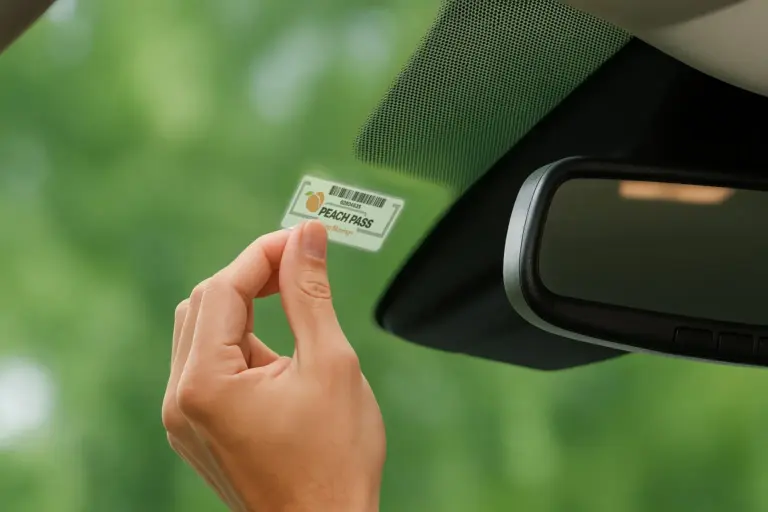
If you’re heading south from Georgia with a Peach Pass on the windshield, the first question is whether it’ll work once you cross the Florida line. According to the information I have, it does. Peach Pass is accepted on Florida toll roads through an interoperable electronic toll collection arrangement, so you shouldn’t need a second account or a pocketful of cash.
I’m a mechanic, not a toll agency, so I’ll stick to what the supplied information says and tell you where I’d double-check. Customers bring me enough road-trip stories that I know the pattern. The tag usually works fine, and the trouble comes from a plate that’s out of date, an empty balance, or a tag that never got stuck to the glass.
This guide covers how Peach Pass works, how it connects to SunPass, E-Pass and LeeWay in Florida, what it does in North Carolina, and what to expect on rates and exemptions. I’ll also give you a pre-trip checklist, a troubleshooting order for when the tag doesn’t read, and my honest advice on confirming coverage before you count on it.
The short answer
Yes, Peach Pass works in Florida. Peach Pass has a partnership with Florida’s SunPass program, so your pass is recognized on SunPass-operated roads, and tolls get billed to your Peach Pass account. You’ll pay the same rates as SunPass holders, which is a real perk for budgeting a trip.
Agreements between toll agencies change over time, though. New roads open, systems get updated, and the list of who talks to whom isn’t carved in stone. Before a long drive, spend five minutes on the Peach Pass website or customer service line confirming current coverage for the roads you plan to use.
| System | Where it applies | What it means for a Peach Pass driver |
|---|---|---|
| SunPass | Primarily Florida | Peach Pass is recognized on SunPass roads, billed at SunPass rates |
| E-Pass | Florida only | Part of the interoperable network, so Peach Pass is accepted |
| LeeWay | Southwest Florida | Also part of the interoperable network |
| NC Quick Pass | North Carolina | Peach Pass works there and is billed at Quick Pass rates |
| E-ZPass | Many states, often listed as 18 | Peach Pass is described as compatible, but confirm the current list |
Before you leave: the quick checklist
Run through this list before any trip that includes toll roads. It takes less time than checking your tire pressure, and it does more for your wallet.
- Log into your Peach Pass account and confirm it’s active and funded.
- Check that the plate and vehicle on the account match the car you’re actually driving.
- Make sure the transponder is mounted on the windshield, not loose in a cupholder or glove box.
- List the toll roads on your route and look for SunPass signage when you get to them.
- Check the Peach Pass site for the current list of states and systems that accept your tag.
- Save the customer service number in your phone.
- Decide on a backup plan in case the tag doesn’t read.
If any of those makes you hesitate, fix it before you load the car. A wrong plate on an account is a lot easier to correct from your kitchen table than from a rest stop in the middle of the state.
Understanding Peach Pass and how it works
Peach Pass is the electronic toll collection system that makes driving Georgia’s toll roads easier. It’s most closely tied to the Georgia Express Lanes and works the way most modern tags do. You mount a small device on the vehicle, and the system handles the payment without you stopping.
What Peach Pass is
Peach Pass is a small transponder you attach to your vehicle for fast, convenient toll payments. In Georgia, it’s your way into the Georgia Express Lanes, which are designated toll lanes meant to offer a smoother ride with less congestion. The device itself does very little. It identifies your account to the equipment overhead.
I tell people to think of it like a key fob for the road. The real action is in the account behind it, which is why a funded balance matters as much as the hardware.
How Peach Pass works
Once the transponder is installed, it communicates wirelessly with sensors on toll roads. As you pass each toll collection point, the toll is automatically deducted from your prepaid account. You never have to stop or slow down for a booth.
That’s the whole idea of interoperability too. If another system’s equipment can read your tag and has an agreement with Peach Pass, it can bill your account. That’s how a Georgia tag ends up working on roads hundreds of miles from home.
Benefits of using Peach Pass
The upsides are straightforward, and they’re the reasons most Georgia drivers keep one in the car.
- Time-efficient travel: you can use dedicated express lanes for quicker trips.
- Cost-effective: it’s often cheaper than paying cash for tolls.
- Convenience: automatic payments mean no cash and no waiting in line.
- Interoperability: the pass can be used on toll roads in Georgia, Florida and North Carolina.
Peach Pass and other states
Your Peach Pass doesn’t stop working at the Georgia line. It opens up toll roads in other states, including Florida and North Carolina, and that can save you from managing a pile of separate toll accounts. The details differ by state, so here’s how each one is described.
Interstate toll compatibility
Peach Pass is designed to work on toll roads outside Georgia. In Florida, it gives you access to SunPass rates, and in North Carolina you pay at NC Quick Pass rates. That means no fumbling for change at a booth as you cross state lines.
- Florida: Peach Pass is accepted on SunPass and E-Pass systems.
- North Carolina: it lines up with the NC Quick Pass and the larger E-ZPass network.
Two things stand out here. The rate you pay depends on the system you’re driving through, and the agency that runs each road sets its own rules. If a road isn’t on the lists above, don’t assume your tag works on it.
Partner states and toll systems
The reach of your pass comes from partnerships between toll authorities. The State Road and Tollway Authority (SRTA) has worked to make the pass usable across multiple regions. Two of those partnerships matter most for a Florida trip.
- E-ZPass: described as a partner of Peach Pass, with compatibility across states that accept E-ZPass.
- Quick Pass: the route to the NC Quick Pass lanes in North Carolina, which also points to compatibility with E-ZPass up the Eastern Seaboard.
The number of E-ZPass states is where I’d be careful. The figure you’ll see most often is 18, but coverage counts change and different sources list different numbers. Check the current map on the Peach Pass site before a long trip instead of trusting any single figure, including mine.
Here are the referenced systems and where each one operates:
- SunPass: primarily in Florida.
- E-Pass: exclusive to Florida.
- LeeWay: specifically within Southwest Florida.
- Quick Pass: North Carolina, with access to the broader E-ZPass system implied.
Together, these partnerships let you cover a lot of ground on one account. They only work if the account details are right, so the boring paperwork matters.
Using Peach Pass in Florida
On a Florida trip, your Peach Pass gives you access to toll roads across the state through a reciprocal agreement with SunPass. You don’t need to buy a Florida tag for the vacation, and you don’t need to open another account. Most of the work is in confirming the details and mounting the tag correctly.
The Peach Pass and SunPass partnership
Peach Pass has extended its reach beyond Georgia by partnering with Florida’s SunPass program. That means your pass is recognized on SunPass-operated roads. When you drive in Florida, tolls are billed to your Peach Pass account, which keeps the experience simple.
I like this setup for visitors. You aren’t carrying a second device, you aren’t tracking a second balance, and the charges all land on one statement. It also makes it easier to spot a mistake later, since everything shows up in one place.
Peach Pass on Florida toll roads
You can use your Peach Pass on most toll roads across Florida. Those roads belong to an interoperable network that includes the E-Pass and LeeWay systems. Look for signage that indicates SunPass acceptance, and your pass should work the same way.
The source puts the coverage at over 750 miles of toll roads. I’d treat that as a general sense of scale, not a promise that every mile accepts your tag. If you plan to use a specific road, confirm that it’s part of the accepted network, particularly if it’s operated by a smaller regional agency.
Mount the transponder correctly, too. Stick it to the inside of the windshield where it has a clear view of the antennas, and follow the instructions that came with it for the exact spot. A tag that lives in a door pocket can’t be read reliably, and that’s the number one reason I see people get billed by plate.
Toll rates and payment methods
When you use Peach Pass in Florida, you’ll pay tolls at the same rate as SunPass holders. That helps you budget, and it’s one of the better reasons to carry the tag instead of paying another way. I won’t quote specific toll prices because they vary by road and change over time.
Where you can find the current numbers is on the Peach Pass site, which includes information on additional states where the pass is valid. Check it before your trip so you know what to expect, and keep it handy in case you have a question once you’re on the road.
- Payment simplicity: funds come directly out of your pre-established Peach Pass account.
- License plate backup: if your transponder isn’t present, the toll system can use your license plate to post charges to your account, so keep your vehicle information up to date.
Why the plate on your account matters
The plate fallback is helpful, but it only works when the information is correct. If you sold a car, bought a new one or swapped plates, update the account before your trip. A wrong plate can send charges to the wrong place or leave tolls unmatched to your account.
I’ve seen this happen after a customer buys a new truck and keeps the old tag in the windshield. The tag reads fine, the account lists the old plate, and nothing lines up. It takes two minutes to fix and a lot longer to untangle after the fact.
Keep the balance funded
A prepaid account only works if there’s money in it. Check the balance before a long drive, since a low balance can cause trouble even when the tag itself is perfect. If your account has automatic replenishment, confirm the payment method on file is still valid.
Look at your statement after the trip, too. Tolls from another state can post a few days later, and it helps to know they match what you drove. If something looks wrong, call customer service while the trip is fresh in your mind.
Understanding toll exemptions
The original information says some vehicles and trips may be eligible for toll exemptions, such as operating a high-occupancy vehicle or riding a motorcycle. In that case, you’d choose a toll-exempt feature when you set up or update your Peach Pass account. It also says the feature isn’t automatic, so you have to enable it yourself.
- Check eligibility: visit the Peach Pass website or contact customer service to see whether your vehicle qualifies.
- Activate the feature: you have to turn on the toll-exempt option on your pass to benefit from it.
Here’s where I’d slow down. Exemption rules are set by the agency that runs each road, and a feature that applies on one system may not carry over to another. Before you count on a discount or exemption in Florida, ask Peach Pass customer service whether it applies to the Florida roads you’ll be driving.
If you drive a motorcycle or carry multiple passengers, it’s worth the phone call. A wrong assumption can mean you pay a toll you thought you’d skip, or you set the tag the wrong way and get a bill later. Write down the answer and the date.
Check coverage before you rely on it
I’ve kept the working assumption that Peach Pass is accepted in Florida, because that’s what the information I have says. I’d still treat it as “verify first.” Interoperability depends on agreements between agencies, and agencies can change them.
Here’s how I’d confirm it without wasting an evening:
- Log into your Peach Pass account and look for information on out-of-state use.
- Visit the Peach Pass page on additional states and read the current list.
- Identify the toll roads you’ll use in Florida and confirm they’re SunPass, E-Pass or LeeWay roads.
- Confirm the plate and vehicle on your account match the car you’re driving.
- Look for the right signage at each toll point and treat a missing sign as a warning.
If anything doesn’t line up, call the number on your account. They answer this question all day, and a straight answer from them beats a guess from a blog post (mine included). Write down the date and the name of the person you spoke with, just in case.
When the tag doesn’t read
Sometimes you do everything right and the lane still doesn’t register your tag. Don’t panic, because most causes are simple. Work through these in order.
- Check the mounting. Make sure the tag is stuck to the windshield in the spot the instructions call for, not on the dash or hanging from the mirror.
- Clear the line of sight. Remove anything in front of it, like a sticker, dash cam bracket or stack of parking passes.
- Inspect the device. Look for cracks, damage or signs it was dropped or baked in the sun.
- Look at the account. Confirm it’s active, funded and tied to the right plate.
- Call customer service. If everything looks fine and it still isn’t reading, they can check what the system is seeing.
Tags are small electronic devices, and electronics wear out. If yours is old, damaged or acting strange, ask Peach Pass whether it needs replacing. A new tag costs a lot less than a stack of violation notices.
A windshield replacement is worth a mention too. If the glass was changed recently, check where the tag is stuck and read the instructions before moving it. Some mounts don’t survive being peeled off and repositioned, and the manufacturer’s directions come first.
Rental cars, new vehicles and shared tags
A Peach Pass belongs to your account, and your account lists specific plates. If you rent a car or buy a new one, the tag in your hand doesn’t automatically match the vehicle. That mismatch is where I see people get tripped up.
Update the plate list whenever the vehicle changes, and check the details when you add or remove a car. If you’re renting, read the rental agreement to see how tolls are handled, since rental companies often run their own toll programs with their own fees. Using your own tag in a rental without checking can leave you paying twice or getting a violation.
The same goes for a family car. If two people share a vehicle and both have tags, only one should be active in the windshield. Two tags in one car can confuse the lane reader and make it unclear whose account gets charged.
Common mistakes to avoid
I’ve watched most of these happen, usually to people who did everything else right. None of them is hard to dodge once you know about them.
- Assuming it works everywhere: Peach Pass is accepted on many roads in Florida and North Carolina, but it isn’t accepted on every road in every state.
- Leaving the tag loose: a transponder in the glove box can’t talk to the overhead antenna.
- Ignoring the balance: an empty account can mean unpaid tolls even when the tag works.
- Forgetting the plate: if the plate on the account is wrong, charges can go missing or land in the wrong place.
- Assuming exemptions carry over: the toll-exempt feature has to be enabled, and you should confirm that it applies in Florida.
- Trusting an outdated state count: the number of E-ZPass states changes, so check the current list.
- Ignoring notices: a toll notice gets harder to deal with the longer it sits in a pile of mail.
- Buying a second tag for one trip: if your Peach Pass already works, an extra Florida tag usually adds hassle without much benefit.
What it costs and how long it takes
I won’t quote toll rates, because they change by road, agency and time. What I can say is that you pay SunPass rates on Florida roads with a Peach Pass, and the tag route is generally the cheaper way to pay. A toll that goes unpaid and turns into a violation can cost far more than the toll itself.
On time, the checks in this article are small. Looking at your balance, confirming your plate and verifying coverage should take a few minutes if your account is in good shape. Sorting out a mistake after the trip takes a lot longer and rarely goes smoothly.
If you’re debating whether a Florida tag makes sense, think about how often you drive there. A one-time vacation doesn’t justify a new account. If you travel to Florida regularly or plan to move, a local tag might be worth a look, but your Peach Pass already covers the basics.
When to handle it yourself and when to call someone
Most of this is fine to do from your driveway. Mounting the tag, checking your balance, updating your plates, reading the coverage list and calling customer service all need nothing more than a phone and a minute. You don’t need a mechanic for a toll account.
Bring the car to a shop when the problem is the vehicle, not the account. If a new windshield has you wondering where the tag can go, or you’re dealing with a cracked or tinted glass issue, a glass shop or the tag maker can tell you what placement works. I’ll help you diagnose a no-start, but I won’t pretend to know how every windshield treatment affects every transponder.
If the tag seems fine and the account looks right, the next call is to Peach Pass. They can see what the system is picking up, which you can’t. Tag questions go to the toll agency, and car questions come to us.
The expert verdict
Here’s what I’d do. Confirm your Peach Pass account is active and funded, make sure the plate on it matches your car, and check that the tag is mounted properly. Then look at the Peach Pass list of additional states and confirm your Florida route is covered.
Most of this is DIY. Checking a balance, updating a plate and mounting a tag are all driveway jobs. If you plan to rely on an exemption, call customer service to confirm that it applies in Florida, since the original information says the feature must be turned on and I wouldn’t assume it carries across states.
Go to a professional when the issue is the windshield or the vehicle itself, and go to the toll agency when the issue is the account or the charges. Keep notes on any call, and open toll notices right away. A little paperwork up front is a lot cheaper than a violation later.
One clear takeaway: your Peach Pass should work on Florida toll roads at SunPass rates, but confirm current coverage, keep the account funded and the plate current, and mount the tag properly before you cross the state line.