
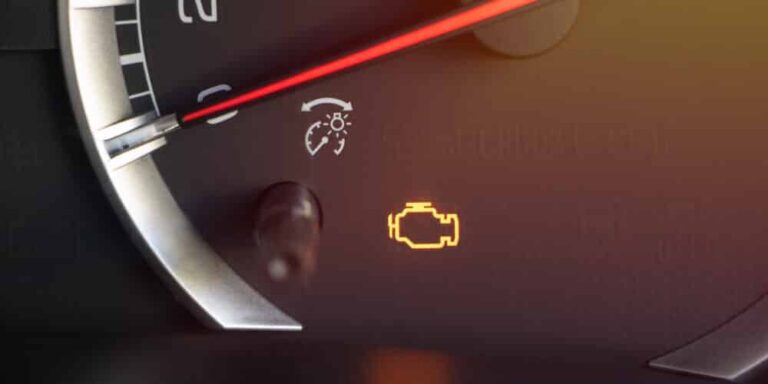
You press the gas to merge, the engine starts to shake, and the check engine light begins flashing. Treat that as a warning to ease off and get somewhere safe. On many vehicles, a flashing check engine light means the computer has detected an active misfire that could overheat and damage the catalytic converter.
A misfire is the most common reason for a flashing light under acceleration, but it isn’t the only possibility. Worn spark plugs, a weak ignition coil, low fuel pressure, an injector fault, or a sensor problem can all affect how the engine runs. The light tells you the engine needs attention; it doesn’t name the failed part.
If the engine is shaking badly, losing power, or the light keeps flashing, don’t keep driving to see if it clears. Pull over when it’s safe, switch off the engine, and arrange a diagnosis. A short drive to a nearby shop may be reasonable if the light stops and the car runs smoothly, but avoid hard acceleration and long trips until you know what’s wrong.
Why a flashing check engine light needs prompt attention
The check engine light, also called the malfunction indicator lamp, is controlled by the engine computer. Sensors monitor engine and emissions systems, and the computer uses that information to spot faults. A steady light usually means a fault has been recorded, while a flashing light often means the engine is misfiring badly enough to risk damage to the catalytic converter.
During a misfire, a cylinder doesn’t burn its air and fuel charge properly. Unburned fuel can travel into the exhaust and overheat the catalytic converter. Keep driving with a severe misfire and you may turn a repair involving ignition or fuel parts into a much more expensive exhaust repair.
The light may flash only when you accelerate because the engine is under greater load. A weak spark plug or ignition coil can work well enough at idle, then break down when the engine needs a stronger spark. Once you lift off the accelerator, the misfire may ease and the flashing may stop. That doesn’t mean the fault has repaired itself.
Some vehicles use different warning strategies, so check the owner’s manual for your model. Still, a flashing check engine light paired with shaking, hesitation, or a loss of power deserves quick attention. Don’t confuse it with a steady light that’s been on for an emissions fault.
What to do when the light starts flashing
- Ease off the accelerator. Avoid asking the engine for more power while it’s misfiring.
- Move to a safe place. Use your hazard lights if needed and get out of traffic before stopping.
- Shut the engine off if the warning continues or the car runs badly. Don’t restart it repeatedly to see if the problem goes away.
- Arrange a diagnosis. If the engine shakes, smells strongly of fuel, or won’t maintain speed, a tow is the safer choice.
If the flashing stops after you slow down, pay attention to how the car behaves. A smooth-running engine with no other warning may be able to reach a nearby repair shop gently, but don’t take it on a long trip or drive it hard. If the light starts flashing again or the engine begins shaking, pull over and arrange help.
Stop as soon as it’s safe if you also see a red oil-pressure warning, a high engine-temperature warning, smoke, or a strong burning smell. Those are separate warning signs that can mean the engine needs to be shut down. Don’t keep driving simply because the check engine light is the one you noticed first.
Common causes of a flashing light under acceleration
Several faults can cause a misfire, and more than one part may be involved. The table gives common possibilities, but a symptom or trouble code is only a starting point. A mechanic should confirm the fault before replacing parts.
| Possible cause | Clues you may notice | What a shop may check |
|---|---|---|
| Worn or fouled spark plugs | Shaking or hesitation under load, hard starting, or a cylinder misfire code | Plug condition, wear, gap, and the vehicle’s maintenance history |
| Weak ignition coil or damaged wiring | Misfire that appears during acceleration or returns intermittently | Coil operation, electrical connections, and misfire data |
| Fuel-delivery problem | Hesitation, loss of power, hard starting, or a lean mixture code | Fuel pressure, injector operation, pump supply, and related wiring |
| Camshaft or other engine sensor fault | Rough running, stalling, difficult starting, or a sensor-related code | Sensor signal, connector, wiring, and engine timing information |
| Air or fuel mixture problem | Rough idle, hesitation, or a lean or rich mixture code | Intake leaks, air-metering data, and fuel control |
| Engine or exhaust problem | Persistent misfire, loss of power, unusual noise, or smoke | Compression, exhaust restriction, and related mechanical condition |
Worn, fouled, or damaged spark plugs
Spark plugs ignite the air-fuel mixture in the cylinders. As a plug wears or becomes fouled, it may still fire at idle but fail under acceleration, when cylinder pressure is higher and the ignition system has more work to do. The result can be hesitation, shaking, or a misfire that makes the warning light flash.
Oil or fuel deposits on a plug can point to another problem, so simply fitting new plugs may not finish the job. A mechanic will compare the plugs and look for differences between cylinders. The appearance can help identify whether the engine is burning oil, running rich, or having a spark problem.
A worn spark plug is one possible cause, not a reason to replace every plug without checking the vehicle’s service requirements. The correct plug type and installation procedure matter. If one cylinder keeps misfiring after a plug change, the coil, injector, wiring, or engine condition may need testing.
A weak ignition coil or damaged ignition wiring
An ignition coil supplies the high voltage needed to fire a spark plug. A weak coil can break down when the engine is under load, so the car may idle normally and then stumble when you accelerate. On older vehicles, damaged plug wires can create similar symptoms.
Coil faults can be intermittent, especially when heat or vibration affects a connection. A scan tool may show a cylinder-specific misfire, such as P0301 for cylinder one, while a coil circuit may set a code from the P0350 range. Codes vary by vehicle and don’t prove the coil is bad on their own.
On some engines, a technician can move a coil to another cylinder and see whether the misfire follows it. That test must be done using the correct procedure, and it doesn’t apply to every ignition setup. Swapping parts randomly can create new problems or waste money.
Low fuel pressure or a faulty injector
The engine needs enough fuel when you accelerate. A weak fuel pump, restricted filter, poor electrical supply to the pump, or a faulty injector can leave one or more cylinders short of fuel. The car may hesitate, surge, or lose power, and the engine computer may record a misfire or mixture code.
A clogged injector can affect one cylinder, while a fuel-pressure problem may affect several. A mechanic can check pressure against the specification for your exact vehicle and look at injector operation. There isn’t one fuel-pressure figure that applies to every engine.
Don’t assume the fuel pump is bad because the car stumbles under load. Wiring, a filter, an injector, or a sensor can produce a similar complaint. Testing the system under the conditions that trigger the fault is more useful than replacing parts based on a guess.
An air leak or incorrect air-fuel mixture
An intake leak can let air into the engine without being measured properly, which may create a lean mixture and rough running. A dirty or faulty airflow sensor can also cause the computer to calculate fuel delivery incorrectly. Depending on the vehicle and the severity of the fault, the problem may show up as hesitation or misfires under acceleration.
Codes such as P0171 or P0172 can point to a lean or rich condition, but they don’t identify the failed part. A technician may inspect intake hoses, use a smoke machine to find leaks, and compare airflow and fuel-trim data on a scan tool. Replacing an oxygen sensor just because a mixture code appears can miss the actual cause.
A camshaft position sensor or related timing fault
The camshaft position sensor helps the engine computer keep track of camshaft position and engine timing. If the signal is missing or unreliable, the computer may have trouble coordinating fuel injection and ignition. Symptoms can include rough running, hard starting, stalling, or a misfire.
A fault in the camshaft sensor circuit may set a code such as P0340, though the exact code depends on the vehicle. The sensor itself isn’t the only possibility; a damaged connector, wiring issue, or timing problem can also affect the signal. A bad camshaft sensor should be confirmed with testing before it’s replaced.
A throttle-position or accelerator-pedal sensor fault can also affect how the engine responds when you press the gas. Those sensors report driver demand or throttle position, while the camshaft sensor reports engine position. They do different jobs, so a symptom under acceleration doesn’t tell you which one has failed.
A faulty oxygen sensor
Oxygen sensors help the engine computer monitor the exhaust and adjust the air-fuel mixture. A faulty sensor can affect fuel control and may contribute to poor running, lower fuel economy, or emissions problems. But an oxygen-sensor fault usually doesn’t prove that the sensor caused a flashing check engine light.
A misfire can change the oxygen content in the exhaust and lead to oxygen-sensor or catalyst-related codes. That can make the sensor look guilty when it’s reporting the effect of another problem. A “bad oxygen sensor” is one possibility to test, not a diagnosis based only on a light or code.
A charging-system or electrical fault
The ignition system and engine computer need a stable electrical supply. A weak battery, charging-system fault, poor ground, or damaged connector can interfere with engine operation and sometimes contribute to a misfire. This is more likely to be worth checking if the headlights dim, the battery warning light comes on, or several electrical systems act strangely at once.
A charging fault is not the usual explanation for a flashing check engine light during acceleration. The shop should measure the electrical system and inspect the connections rather than assume the alternator is responsible. Low voltage can create confusing symptoms, but it needs to be verified.
A faulty engine control unit
The engine control unit, also called the ECU or PCM, uses sensor information to manage fuel and ignition. A fault inside the computer is possible, but it’s much less common than a failed plug, coil, injector, connection, or sensor. Wiring and power-supply problems can also make a working computer appear faulty.
Before replacing an ECU, a technician should check its power, grounds, connectors, communication, and the signals it receives. Some replacement units also need vehicle-specific programming. A computer should be near the end of the diagnostic process, not the first part ordered.
Overheating, low oil pressure, and a loose gas cap
Overheating can make an engine run poorly and can cause serious damage, but a high temperature reading is not a normal explanation for every flashing check engine light. Check the temperature gauge and any separate coolant warning. If the engine is overheating, stop somewhere safe and shut it down rather than trying to reach your destination.
Low oil pressure is also a separate emergency warning, usually shown by an oil-can symbol or a dedicated warning. It doesn’t normally cause the check engine light to flash by itself. If the oil-pressure warning comes on while the engine is running, stop as soon as it’s safe and switch off the engine.
A loose gas cap can trigger an evaporative-emissions fault, often with a steady check engine light after the car has been driven. It’s not a typical cause of a flashing light under acceleration. If the light began after refueling, make sure the cap is fitted correctly, but don’t use that as a reason to ignore a persistent flashing light or rough engine.
What a scan tool can tell you
A basic OBD-II scanner can read many engine codes, but the code describes what the computer detected. It doesn’t automatically identify the part that needs replacing. Write down the code and any freeze-frame information before anyone clears it.
Common examples include P0300 for random or multiple-cylinder misfires and P0301, P0302, or similar codes for a misfire detected on a particular cylinder. Other codes can point to an ignition circuit, fuel mixture, or camshaft sensor circuit. Code definitions can vary by make, model, and engine.
| Code example | What it generally indicates | Why more testing is needed |
|---|---|---|
| P0300 | Random or multiple-cylinder misfire detected | Could involve ignition, fuel, air, compression, or timing. |
| P0301 and similar codes | Misfire detected on a named cylinder | Doesn’t distinguish a plug, coil, injector, wiring, or mechanical fault. |
| P0350-series example | An ignition coil circuit fault may have been detected | The coil, wiring, connector, or control circuit may need checking. |
| P0171 or P0172 | The system has detected a lean or rich mixture condition | An air leak, sensor, fuel-delivery problem, or other fault may be responsible. |
| P0340 | A camshaft position sensor circuit problem may have been detected | The sensor signal, wiring, connector, and timing may all need inspection. |
| P0420 | Catalyst-system efficiency is below the computer’s threshold | An active misfire, exhaust leak, or sensor fault can affect the result. |
The scanner’s freeze-frame data can show conditions such as engine speed and load when a fault was stored, depending on the vehicle. That can be useful when the problem only happens during acceleration. Clearing the codes or disconnecting the battery too early may erase information the shop could have used.
How a mechanic tracks down the cause
A good diagnosis starts with your description. Tell the mechanic whether the light flashes only under hard acceleration, whether the engine shakes at idle, how long the problem lasts, and whether the car has lost power. Mention recent work, fuel stops, or warning lights too.
The technician will usually scan for codes and check live data or misfire counters if the vehicle supports them. Then the likely systems can be tested, starting with the basics. On an engine with one cylinder misfiring, that may mean inspecting the plug and coil before moving on to the injector or compression.
Fuel-system tests may include checking pressure and electrical supply to the pump. Air leaks can be found by inspecting intake hoses or using a smoke machine. If ignition, fuel, and air checks don’t explain the fault, the mechanic may check compression, engine timing, or sensor signals with suitable test equipment.
In the shop, a common pattern is a car that idles smoothly in the parking lot but shakes when the driver accelerates onto a highway. A worn plug or weak coil may only fail under load, so a quick idle check can miss it. The code and misfire data help point to the cylinder, then testing confirms whether the fault follows the plug, coil, injector, or something else.
If the engine is overheated or the oil-pressure warning is on, that gets attention before an extended road test. No one should keep loading an engine that may be short on oil pressure or coolant. Safety and preventing further damage come before reproducing the fault on the road.
Safe checks you can make before booking the repair
You can gather useful information without removing parts. Park somewhere safe, note which warning lights are on, and write down what the engine was doing when the check engine light began flashing. If you have an OBD-II scanner, record the codes, but don’t clear them before the diagnosis.
- Check the owner’s manual for the meaning of the warning light on your vehicle.
- Look at the temperature gauge and oil-pressure warning, if fitted.
- Check the fuel cap if the problem started after refueling, while remembering that a loose cap usually doesn’t explain a flashing light with a misfire.
- Listen for rough running, popping, or unusual mechanical knocking, but don’t rev the engine to reproduce the sound.
- Note whether the engine shakes at idle, only under acceleration, or at a particular speed.
Check the engine oil level according to the owner’s manual, with the car parked on level ground and the engine in the recommended condition. If you need to check coolant, wait until the engine is completely cool. Never remove a radiator or pressurized coolant cap while the engine is hot.
Don’t reach near belts, fans, or ignition components while the engine is running. Ignition systems use high voltage, and electric cooling fans can start unexpectedly. If you aren’t familiar with testing plugs, coils, or fuel components, leave that work to a mechanic.
A rattling sound and a misfire aren’t the same thing. If you describe a noise as “knocking off the engine,” clarify whether you mean a metallic knock, a popping sound, or the engine cutting out. Those symptoms point toward different tests, and accurate wording helps avoid wasted diagnostic time.
What repairs may cost
The repair bill depends on what caused the flashing light, the vehicle, the parts required, and local labor rates. The figures below are broad estimates from the source information, not a current quote for every car. Ask for a diagnosis and an itemized estimate before authorizing a repair.
| Possible repair | Rough estimate provided | What can change the price |
|---|---|---|
| Spark plugs | More than $50 | Vehicle design, number of plugs, access, and whether related parts need attention. |
| Oxygen sensor | More than $238 | Sensor location, parts choice, labor, and whether the sensor is actually the cause. |
| Camshaft position sensor | $170 to $230 | Vehicle, access, diagnosis, and any wiring or connector repair. |
| ECU or control-module replacement | About $900 on average | Vehicle-specific programming, part availability, diagnosis, and installation. |
These estimates shouldn’t be used to decide which part is bad. A sensor code doesn’t automatically mean a sensor replacement, and a misfire code doesn’t automatically mean new plugs. A proper diagnosis may find a loose connector or another fault that changes the repair entirely.
If the shop recommends an ECU, ask what tests confirmed it. The unit may need programming, and replacing it won’t fix a wiring, power, or ground problem. For any estimate, ask what failed, what test showed the failure, and whether the quote includes diagnosis and necessary programming.
Mistakes that can make a misfire more expensive
- Continuing to accelerate while the light flashes. A severe misfire can overheat the catalytic converter.
- Replacing parts based only on a code. Codes identify a detected condition, not always the failed component.
- Clearing the codes before recording them. You may erase useful fault and freeze-frame information.
- Assuming a loose gas cap is the answer. It can cause an emissions warning, but it’s not the usual reason for a flashing light under load.
- Ignoring a flashing light because it stopped. The misfire may return the next time the engine is under load.
- Driving with a separate oil-pressure or overheating warning. Those warnings need immediate attention and can indicate a serious engine risk.
- Buying an ECU before checking the basics. Plugs, coils, wiring, fuel supply, and grounds are more common suspects.
Don’t ask a shop to “just clear the light” and send the car back out. Clearing a code doesn’t repair the misfire, and a flashing warning may return as soon as you accelerate. The useful repair is the one that finds why the engine failed to burn the mixture correctly.
When you can drive to a shop and when to tow
Tow the car if the check engine light keeps flashing, the engine shakes hard, power drops sharply, the car stalls, or you smell raw fuel or burning. Do the same if the temperature gauge is high, the oil-pressure warning is on, or you hear a loud metallic knock. A car that can’t maintain speed safely doesn’t belong in traffic.
If the light flashed briefly during acceleration and then went out, and the engine now runs smoothly with no other warning, you may be able to drive gently to a nearby shop. Keep the trip short, avoid hard acceleration, and pull over if the light flashes again. There’s no safe distance that applies to every vehicle and fault.
A steady check engine light without drivability symptoms is generally less urgent than a flashing one, but it still needs diagnosis. If the car starts misfiring or the light begins flashing, treat the situation as more serious. When you’re uncertain, call the shop and describe the symptoms before deciding to drive.
What I’d do if this were my car
I’d ease off the throttle, get out of traffic, and stop if the light kept flashing or the engine was shaking. Then I’d record any codes and arrange a proper check rather than driving around hoping the warning would disappear. A brief flash that doesn’t return is still worth investigating, especially if it happened under load.
You can safely note the symptoms, check the manual, and read codes if you have a scanner. Leave fuel-pressure testing, ignition diagnosis, and ECU replacement to a shop with the right tools. The clear takeaway is this: a flashing check engine light under acceleration most often points to a misfire, and continued driving can turn that fault into catalytic-converter damage.