
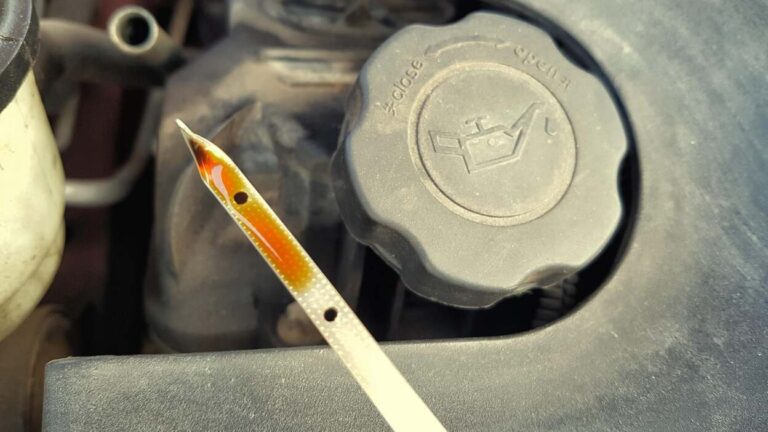
Every internal combustion engine consumes a small amount of oil. That is not a defect. It is just how engines work. The real problem starts when your engine is burning through oil faster than it should, and you find yourself topping up the level between oil changes with no obvious leak anywhere on the ground.
Understanding the difference between normal oil consumption and excessive oil consumption can save you from an expensive engine repair, a failed emissions test, or worse, a seized motor on the side of the highway.
Here is everything you need to know, explained in plain language.
What Causes an Engine to Burn Oil?
Before getting into the warning signs and consequences, it helps to understand what is actually causing the problem in the first place. The most common culprits are:
- Excessive internal engine wear – As an engine ages and accumulates mileage, the internal clearances between moving parts grow wider, allowing more oil to pass where it should not.
- Worn or defective piston rings – The piston rings are responsible for scraping oil off the cylinder walls and sending it back down to the oil pan. When they wear out or get stuck, oil sneaks past them into the combustion chamber and burns.
- Defective valve stem seals – These small seals sit at the top of each valve and prevent oil from being drawn down the valve stem into the combustion chamber. When they harden, crack, or wear out, oil leaks past them and burns during combustion.
- Poor quality engine oil – Cheap or incorrect oil breaks down faster, loses its viscosity more quickly, and is more likely to vaporize under the heat and pressure inside a running engine.
- Oil that has gone too many miles between changes – Old, degraded oil thins out. Thin oil is harder to contain inside the engine and more prone to burning off in areas it should never reach.
How Much Oil Consumption Is Actually Normal?
This is the question most car owners get wrong, and it leads to unnecessary panic on one end and dangerous neglect on the other.
Every engine, including a brand new one, consumes a measurable amount of oil. Car manufacturers openly acknowledge this. The generally accepted benchmark across the industry is consumption of roughly 1 liter per 15,000 km (approximately 9,300 miles). That figure also happens to represent the difference between the minimum and maximum marks on a typical dipstick.
So if you check your oil and it is sitting between those two marks after several thousand miles of driving, your engine is doing exactly what it is supposed to do. You do not have a problem.
Here is why some consumption is unavoidable. After the piston travels down the cylinder bore, a very thin film of oil remains on the cylinder wall. The oil control ring scrapes most of that oil back down toward the oil pan, but it cannot remove every last molecule. That ultra-thin residual film gets burned away during combustion. It is a normal part of how a reciprocating engine functions.
Tip: If too much oil is left behind on the cylinder walls, it usually means the cylinder walls have excessive wear or the piston rings are stuck and no longer scraping properly. The result is an unwanted oil film building up inside the cylinders, which leads to increased oil consumption, reduced engine power, and higher emissions all at the same time.
The movable components inside an engine, particularly the pistons and valves, are never completely airtight or perfectly oil-tight. There has to be a small amount of mechanical clearance for everything to move freely. That clearance is precisely where low-level, ongoing oil consumption comes from. In the combustion chamber, the oil film on the cylinder walls also gets exposed to extremely high temperatures across large surface areas, causing it to evaporate, burn, and exit through the exhaust.
The Numbers: What the Manufacturers Actually Allow
When manufacturers publish oil consumption limits in their service manuals, the figures are expressed as a percentage of fuel consumption rather than a simple volume number. Here is what those percentages look like in real-world terms:
- Modern car engines typically operate well below 0.05% of fuel consumption.
- The maximum allowable limit for modern passenger cars is generally 0.5% of fuel consumption.
- For utility and commercial vehicles, the accepted range runs from 0.25% to 0.5%.
- For buses and heavy vehicles, up to 0.5% is considered acceptable.
For older engines, stationary engines, and those operating under extreme conditions, the acceptable normal consumption may be somewhat higher than these figures.
Calculation Example for a Passenger Car
A car that consumes approximately 8 liters of fuel per 100 km uses 80 liters per 1,000 km.
- At 0.05%: 0.05% of 80 liters = 0.04 liters of oil per 1,000 km (extremely low, essentially new engine territory)
- At 0.5%: 0.5% of 80 liters = 0.4 liters of oil per 1,000 km (at the maximum acceptable limit)
Calculation Example for a Utility Vehicle
A utility vehicle consuming approximately 40 liters per 100 km uses 400 liters per 1,000 km.
- At 0.25%: 0.25% of 400 liters = 1 liter of oil per 1,000 km
- At 0.5%: 0.5% of 400 liters = 2 liters of oil per 1,000 km
These numbers put things in perspective. A passenger car consuming 0.3 or 0.4 liters of oil per 1,000 km is operating within normal parameters. A utility vehicle burning 1 liter per 1,000 km is also well within the acceptable range.
Diesel vs. Petrol: Which Engines Burn More Oil?
Diesel engines consistently consume more engine oil than their petrol counterparts. This is partly due to the higher compression ratios involved and the different combustion dynamics of diesel engines.
Turbocharged engines of any type also require more oil than naturally aspirated engines. The turbocharger itself is lubricated by engine oil, and the shaft spinning at tens of thousands of revolutions per minute inside that turbocharger is constantly bathed in oil. More components requiring lubrication means more oil in circulation and more opportunities for consumption.
From a purely mechanical standpoint, oil consumption is at its lowest immediately after an engine completes its initial break-in period. After that, consumption gradually increases as wear accumulates over the life of the engine. This is not a flaw in the design. It is simply the reality of mechanical systems operating under sustained heat, pressure, and friction over hundreds of thousands of miles.
One important point worth understanding: wear inside an engine tends to affect all internal components relatively equally over time. This is why partial repairs, such as replacing only the pistons or only the piston rings on a high-mileage engine, rarely produce a meaningful improvement in oil consumption. If the rings are worn, the cylinder walls are usually worn too. Fixing one without addressing the other often yields disappointing results.
What Happens When Your Engine Burns Too Much Oil
Your Catalytic Converter and Particulate Filter Will Be Destroyed Faster
This is a consequence that most car owners never think about until they get an expensive repair bill.
Modern engines, particularly diesels fitted with particulate filters, require oils with a carefully controlled sulfated ash content. The acceptable levels are typically around 0.5%, with some applications specifying 0.3% or 0.7% depending on the system. Manufacturers specify these low-ash oils specifically to protect the particulate filter from premature clogging and damage.
Gasoline engines are generally more tolerant, with sulfated ash content sometimes exceeding 1.2%, but they are not immune to the problem.
When an engine starts burning oil excessively, the sulfated ash content entering the exhaust system skyrockets. That ash accumulates in the particulate filter and coats the catalyst substrate. Over time, it blocks the filter, reduces its efficiency, and ultimately destroys it. Replacing a diesel particulate filter is not a cheap job. Depending on the vehicle, you could be looking at several hundred to well over a thousand dollars for parts alone.
How do you know the catalyst is being affected? The exhaust will begin to smell noticeably unpleasant, and emissions testing will return readings significantly above the legal limits.
The Engine Will Lose Noticeable Power
Oil has no business being in the combustion chamber. When it gets there in significant quantities, it disrupts the air-fuel mixture that the engine depends on to generate power cleanly and efficiently. The result is incomplete combustion, which translates directly into reduced power output.
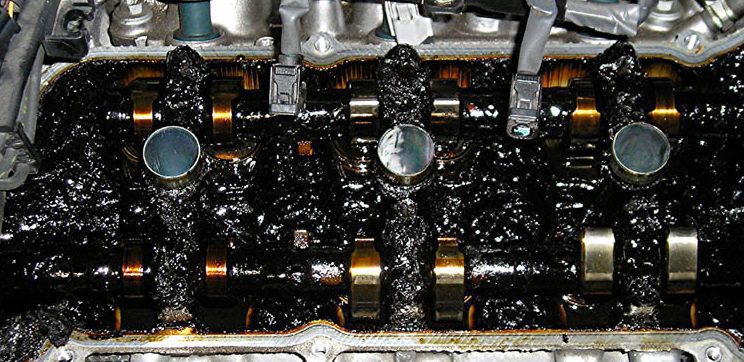
On top of that, burning oil leaves behind carbon deposits. Those deposits build up on the piston crowns, inside the combustion chamber, on the intake valves, and on the exhaust valves. Carbon buildup on intake valves is a particularly serious issue in direct injection engines, where fuel is injected directly into the cylinder rather than into the intake port. The deposits restrict airflow, reduce valve sealing, and progressively choke the engine’s ability to breathe efficiently.
Blue Smoke From the Exhaust
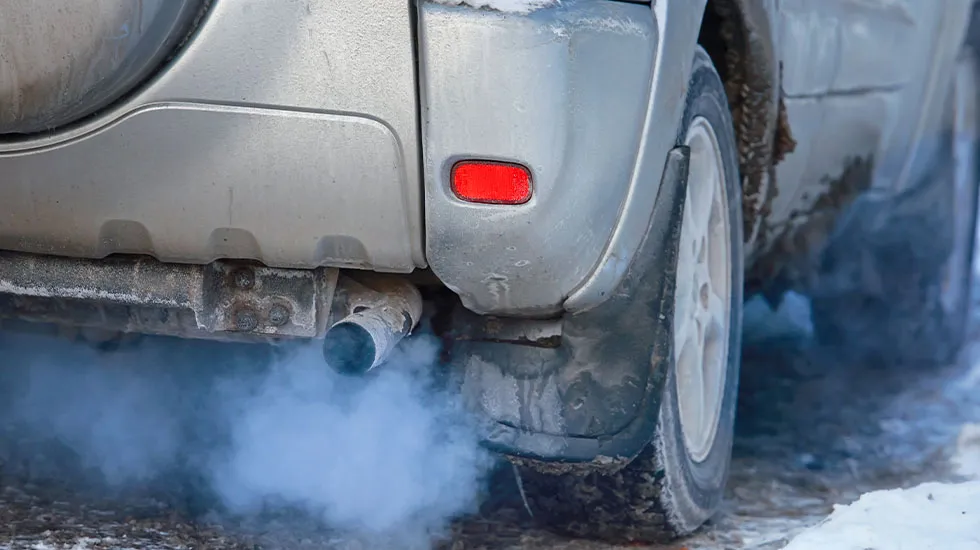
Blue or bluish-gray smoke coming from the exhaust pipe is the clearest visible sign that your engine is burning oil. It is especially noticeable on startup or during hard acceleration, and it tends to have a distinct, acrid smell that is different from normal exhaust.
At oil consumption levels exceeding 1 liter per 1,000 km (approximately 620 miles), blue smoke becomes visible and persistent. At that point, the problem is beyond minor and demands attention.
It is worth distinguishing blue smoke from white smoke, because they indicate completely different problems. White smoke that does not clear after the engine warms up usually points to coolant entering the combustion chamber, most commonly because of a blown head gasket. Blue smoke specifically means oil is burning. Gray smoke can sometimes indicate a combination of both issues or a rich fuel mixture depending on the engine type.
From a health and safety standpoint, blue smoke is not something to take lightly. The hydrocarbons and carbon monoxide levels in the exhaust of an engine burning oil are significantly elevated. Sitting in traffic behind a vehicle producing heavy blue smoke is a genuine air quality hazard.
Can Oil Additives Help With Excessive Consumption?
Oil consumption additives do exist, and some of them produce genuinely noticeable results in the right situation. Products like the Liqui Moly Oil Consumption Stop additive have shown the ability to reduce oil consumption by a factor of three to four times in some cases, primarily by conditioning the seals and slightly increasing oil viscosity to reduce the amount of oil that slips past worn rings and valve seals.
But there are two things you need to understand clearly before reaching for a bottle.
First, additives work best when the consumption is caused by aging seals and mild wear rather than severe mechanical damage. If a piston ring is completely broken or a valve seal has disintegrated entirely, no additive is going to compensate for that. The additive needs something functional to work with.
Second, and most importantly, an oil additive is a temporary management tool, not a repair. It buys you time. It does not fix the underlying problem. If the excessive consumption is being caused by worn rings, damaged seals, or cylinder wall wear, the only genuine fix is a mechanical repair. That might mean a valve stem seal replacement, a top-end rebuild, or in severe cases, a full engine overhaul.
If you plan to keep the vehicle long-term, invest in a proper diagnosis and a real repair. If you are managing the car toward a sale or trying to extend its life a little further before a major decision, an additive can be a reasonable short-term tool, used honestly and with realistic expectations.
Do Not Ignore This Problem
Excessive oil consumption is the kind of issue that is easy to dismiss because the car seems to run fine, at least initially. You top up the oil, everything feels normal, and you move on. But the damage is accumulating quietly with every mile.
Carbon deposits are building up inside the engine. The particulate filter is getting progressively more clogged. The catalyst efficiency is dropping. Engine power is slowly fading. And the oil level on your dipstick keeps dropping faster than it should.
Check your oil level regularly, know what normal consumption looks like for your specific engine, and act when the numbers tell you something is wrong. A quart of oil between changes is one thing. A quart every few hundred miles is a conversation you need to have with a mechanic before the conversation becomes a much larger repair bill.