
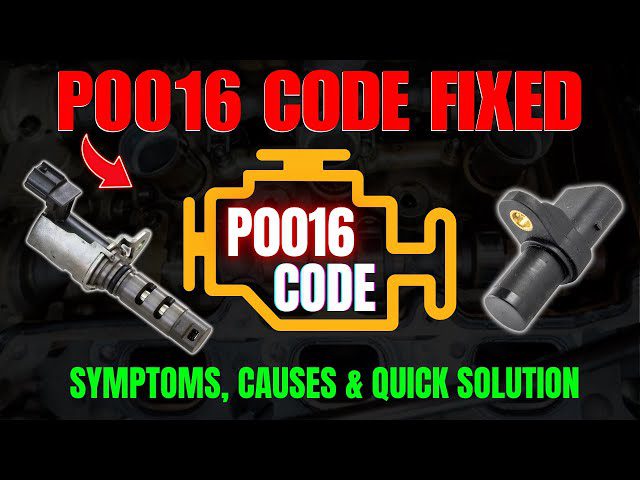
Your Mercedes is running rough, the check engine light has come on, and when you plug in a scan tool, you get a P0016 code staring back at you. Maybe you also noticed the engine hesitating, fuel economy dropping, or the car struggling to start cleanly. Whatever brought you here, this code deserves your full attention because when the crankshaft and camshaft are not talking to each other the way they should be, the engine cannot do its job properly.
The good news is that P0016 is a well-understood fault code with a defined set of causes. Most of them are diagnosable at home with basic tools, and even the more serious repairs are straightforward once you know what you are dealing with. Let’s get into it.
What the P0016 Code Is Actually Telling You
The P0016 code means the engine control unit has detected a correlation fault between the crankshaft position and the camshaft position on Bank 1. In plain terms: the ECU is comparing the signals from the crankshaft sensor and the camshaft position sensor, and those signals are not lining up the way they should.
To understand why that matters, you need a quick picture of how these components work together. The crankshaft is the main rotating shaft at the bottom of the engine. It converts the up-and-down motion of the pistons into rotational power. The camshaft sits above the engine and controls the opening and closing of the intake and exhaust valves. These two shafts must be synchronized to precise timing specifications. The camshaft needs to open and close valves at exactly the right moments relative to where the pistons are in their cycle.
When the ECU measures both positions and finds they are out of sync beyond the acceptable tolerance, it logs P0016 and turns on the check engine light. The “Bank 1” designation in the code refers to the side of the engine that contains cylinder number one. On most Mercedes inline-six and V-series engines, Bank 1 is on the driver’s side, but this can vary by model. The “Sensor A” designation refers to the intake camshaft position sensor on that bank.
This is not a minor housekeeping code. Camshaft-to-crankshaft timing directly affects combustion efficiency, engine power, fuel economy, and emissions. Left unaddressed, it can also cause accelerated wear on timing components and, in severe cases, engine damage.
Symptoms You Will Notice With a P0016 Code
The check engine light is the obvious one, but there are usually other signs showing up alongside it. Here is what Mercedes owners commonly report when P0016 is active.
Check Engine Light
The ECU logs the fault and illuminates the check engine light as soon as it detects the timing correlation is outside specification. On most Mercedes models, the light comes on solid rather than flashing. A flashing check engine light typically indicates an active misfire, which is a more immediate concern. A solid light with P0016 means the system has logged the fault but the situation is not yet at the point of causing cylinder misfires on every cycle.
That said, if the timing is significantly off, misfires can develop, and then you may see the light flashing. If yours is flashing, treat it as urgent and avoid high-load driving until the cause is resolved.
Decreased Fuel Economy
When cam timing is off, combustion is less efficient. The valves are not opening and closing at the optimal moment relative to the piston position, so the engine is not extracting as much energy from each combustion event as it should. The ECU compensates by adjusting fuel trim, but there is only so much adjustment available. The practical result is that you are burning more fuel to produce the same power output.
If you have noticed your fuel range dropping or your average fuel consumption rising on the trip computer, and this coincided with the check engine light coming on, timing correlation is a likely contributor.
Rough Running, Hesitation, or Misfires
Depending on how far out of spec the timing has drifted, you may feel the engine running rough at idle, hesitating under acceleration, or stuttering when pulling away from a stop. In more severe cases, you will feel actual misfires as individual cylinders fail to fire cleanly.
These symptoms are most noticeable at idle and low RPM because that is when the engine is most sensitive to timing accuracy. At higher RPMs, the engine speed itself can mask some of the roughness, though fuel economy and power loss will still be evident.
Hard Starting or No-Start Conditions
In cases where timing is severely out of alignment, the engine may crank for longer than usual before firing, or in extreme cases, may not start at all. This is more characteristic of a jumped timing chain rather than a simple sensor fault, but it is worth mentioning as a symptom of the more serious end of P0016 causes.
Rattling Noise From the Engine at Startup
A rattling or chattering noise from the top of the engine during cold starts, particularly in the first few seconds before it settles, is a classic early warning sign of a worn or stretched timing chain. If you have been hearing this noise before the P0016 code appeared, the timing chain is a very strong suspect. Oil pressure takes a moment to reach the timing chain tensioner on a cold start, and a worn chain rattles until that pressure builds up.
What Causes P0016 on a Mercedes-Benz
Cause 1: A Stretched or Worn Timing Chain
This is the most serious and most common cause of P0016 on higher-mileage Mercedes vehicles. The timing chain connects the crankshaft to the camshaft and must maintain precise tension to keep the two components synchronized. Over time and with accumulating mileage, timing chains stretch. As they stretch, they introduce slack into the system, and that slack allows the camshaft position to drift relative to the crankshaft.
The ECU detects that drift and logs P0016. The higher the mileage and the longer intervals between oil changes, the more accelerated timing chain wear becomes. Mercedes engines, particularly the M272 and M273 V6 and V8 engines from roughly 2003 to 2012, are known for timing chain issues. The balance shaft chain on the M272 engine is a specific weak point that has been well documented in Mercedes owner communities and addressed by multiple technical service bulletins.
A stretched timing chain will not get better on its own. It will continue to stretch until either the tensioner can no longer take up the slack, the chain jumps a tooth on the sprocket, or the chain fails entirely. A jumped timing chain on an interference engine, which most Mercedes engines are, can cause catastrophic valve-to-piston contact and destroy the engine. This is not a repair to defer if the timing chain is confirmed as the cause.
Cause 2: Faulty Camshaft Position Sensor
The camshaft position sensor is a hall-effect sensor that reads a toothed reluctor ring on the camshaft and sends a signal to the ECU. When this sensor fails or begins sending corrupted data, the ECU receives inaccurate camshaft position information and may calculate a false correlation fault between the cam and crank signals.
Camshaft position sensor failures in Mercedes vehicles can be caused by heat damage, oil contamination if the sensor seal fails and allows oil to enter the sensor body, or simple end-of-life failure of the internal electronics. The good news is that a faulty sensor is a relatively inexpensive repair compared to timing chain work.
The challenge is distinguishing between a bad sensor and a real timing problem. Both produce the same code. This is where proper diagnosis matters. Replacing a camshaft position sensor when the actual problem is a stretched timing chain will not fix anything. The code will return immediately after the reset.
Cause 3: Faulty Crankshaft Position Sensor
The crankshaft position sensor reads the crankshaft’s toothed reluctor wheel and provides the ECU with the engine’s rotational position and speed. A failing crankshaft position sensor produces inaccurate position data, which can result in the ECU calculating a false correlation fault even when the camshaft and actual crankshaft positions are properly aligned.
Crankshaft position sensors are exposed to significant heat from the exhaust and the engine block, which can accelerate aging. They can also fail from oil contamination if the crankshaft seal nearby has begun to weep. Symptoms of a failing crank sensor often extend beyond just a check engine light: hard starting, random stalling, and rough idle are common companions.
Cause 4: Oil Quality and Oil Level Problems
This cause surprises some owners, but it is very real. Many Mercedes engines use a variable valve timing system, often called VANOS or Camtronic depending on the model. This system uses oil pressure to adjust the camshaft timing on the fly for optimal performance and efficiency. The camshaft timing actuator, which moves the cam position in response to ECU commands, is hydraulically operated.
When oil is low, the wrong viscosity, or so degraded that it has lost its proper viscosity and lubrication properties, the hydraulic pressure in the VVT system drops. The actuator cannot move the camshaft to the commanded position, or it moves it sluggishly and inconsistently. The ECU sees a discrepancy between where it commanded the camshaft and where the position sensor reports it actually is, and that discrepancy triggers P0016.
This is why oil changes on a Mercedes are not optional maintenance. The oil specification matters too. Mercedes engines require specific oil grades, typically 229.5 or 229.51 specification synthetic oil. Using the wrong viscosity or grade can affect VVT system performance even when the oil is new.
Before spending money on sensors or timing chain work, always check oil level and oil condition first. If the oil is dark, sludgy, or low, a fresh oil change with the correct specification oil is the very first thing to do.
Cause 5: Slipped or Damaged Reluctor Ring
The reluctor ring, also called the tone wheel, is the toothed ring that the position sensor reads to determine shaft position. On the crankshaft, this ring is pressed onto the shaft. In rare cases, this ring can slip on the shaft, changing its position relative to the crankshaft. When that happens, the sensor still reads the teeth correctly, but the reference point is now off, so the ECU calculates the crankshaft position incorrectly.
A slipped reluctor ring is less common than the other causes on this list, but it is impossible to resolve with a sensor replacement or software update. The crankshaft or the ring itself needs to be addressed. This is a significant repair that typically involves engine removal or at minimum deep engine disassembly.
Cause 6: Wiring and Electrical Connection Faults
The wiring between the camshaft position sensor, crankshaft position sensor, and the ECU can develop faults over time. Cracked or corroded connectors, damaged wiring insulation, shorts caused by abrasion against hot engine components, or loose connector pins can all cause signal problems that the ECU interprets as a timing correlation fault.
Wiring faults are often intermittent, making them harder to catch than a clean sensor failure or a stretched timing chain. The code may come and go, appearing in certain temperatures or driving conditions and clearing on its own, which is a hallmark of an intermittent electrical fault rather than a mechanical one.
How to Properly Diagnose P0016 on a Mercedes

The worst thing you can do with this code is start replacing parts without a proper diagnosis. Both a bad camshaft sensor and a worn timing chain produce the same code, but one repair costs $50 and the other can cost $2,000 or more. Here is how to diagnose this systematically.
Step 1: Check Oil Level and Condition First
Pull the dipstick. Check the level and look at the oil on the stick. Is it at the correct level? Is it clean and amber-colored or dark and thick? If the oil is low or degraded, do an oil change with the correct Mercedes-specified oil before anything else. In some cases, particularly when VVT system performance is the issue, a fresh oil change resolves the code entirely.
Step 2: Scan for All Codes, Not Just P0016
Connect a scan tool and pull all stored codes, not just the P0016. Additional codes alongside P0016 help narrow the cause significantly. For example:
- P0011 or P0012 alongside P0016 suggests a VVT system issue, possibly oil pressure related or an actuator fault.
- P0340 or P0341 alongside P0016 points toward camshaft position sensor circuit problems.
- P0335 or P0336 alongside P0016 points toward crankshaft position sensor circuit problems.
- P0016 alone, with a rattling noise on cold start, is a strong indicator of timing chain wear.
Step 3: Inspect the Camshaft and Crankshaft Sensors Visually
With the engine cold, locate both sensors. The camshaft position sensor is typically mounted on the front of the cylinder head near the timing cover. The crankshaft position sensor is usually at the bottom of the engine near the crankshaft pulley.
Check for:
- Oil coating on the sensor body, which indicates a failed seal
- Cracked or brittle wiring insulation near the sensor
- Corroded, bent, or pushed-back pins in the electrical connector
- Any physical damage to the sensor housing
A sensor that is visibly oil-soaked, damaged, or has a compromised connector is a strong replacement candidate. But inspect the connector and wiring even if the sensor itself looks fine.
Step 4: Test the Sensor Signals with a Scan Tool or Oscilloscope
A scan tool with live data capability lets you watch the camshaft and crankshaft position sensor readings in real time while the engine runs. Look at the cam and crank signals simultaneously. A functioning system will show consistent, synchronized patterns. If one signal looks erratic, drops out intermittently, or shows no signal at all, that sensor is the problem.
For a more precise analysis, an oscilloscope connected to the sensor wiring shows the actual waveform. A healthy sensor produces a clean, consistent square wave pattern. A failing sensor produces an erratic, noisy, or partially collapsed waveform. This level of diagnosis definitively identifies a sensor fault versus a mechanical timing problem.
Step 5: Listen for Timing Chain Noise
Start the engine cold and listen carefully in the first 5 to 10 seconds before the oil pressure builds fully. A rattling or chattering noise from the front of the engine that quiets down after the engine warms up is a classic sign of a worn timing chain or a weak tensioner. If the noise is present, the timing chain should be considered a primary suspect regardless of what the sensors show.
Step 6: Check for TSBs and Recalls
Before spending money on any repair, check whether your specific Mercedes model and year has an active technical service bulletin or recall related to timing chain or camshaft correlation issues. Enter your VIN at the NHTSA website to look up any outstanding safety recalls. You can also check for TSBs through the same site.
Mercedes-Benz USA offers a VIN-based recall lookup at Mercedes-Benz USA. This is worth doing before any diagnostic appointment because if there is an active recall covering your timing chain or sensor issue, the repair may be performed at no cost to you.
How to Fix the P0016 Code on a Mercedes-Benz
Fix 1: Change the Oil
If the oil is overdue, degraded, or at a low level, start here. Use the correct Mercedes-approved oil specification for your engine. After the oil change, clear the code and drive the vehicle for a few days to see if it returns. If it does not, low oil pressure from degraded oil was the root cause and the VVT system is now operating correctly.
Fix 2: Replace the Camshaft Position Sensor
If the camshaft sensor is visually damaged, oil-soaked, or tests as faulty on live data, replace it. On most Mercedes models, this is a relatively accessible job that a mechanically confident owner can do at home. The sensor is held in by one or two bolts, has a single electrical connector, and typically takes about 30 minutes to replace.
Use a quality OEM-equivalent sensor. Cheap no-name sensors can cause intermittent issues even when new. After replacement, clear the fault code and test drive the vehicle to confirm the code does not return.
Here is a helpful video guide walking through the sensor replacement process:

Fix 3: Replace the Crankshaft Position Sensor
If diagnosis points to the crankshaft sensor rather than the camshaft sensor, the replacement process is similar in concept but the location is different. The crankshaft sensor is typically at the bottom of the engine block near the crankshaft pulley or flywheel area. Access can be more challenging depending on the model, but the actual replacement process is straightforward once you have access.
Some Mercedes models require the crankshaft sensor to be adapted or calibrated to the ECU after replacement using diagnostic software. Check whether your specific model has this requirement before completing the job.
Fix 4: Repair Wiring and Connectors
If the fault is in the wiring rather than the sensor itself, the repair involves tracking down the damaged section of wiring and repairing or replacing it. For a simple corroded connector, cleaning the terminals with electrical contact cleaner and applying dielectric grease before reconnecting often resolves the issue. For damaged or chafed wiring, the affected section needs to be replaced with proper automotive-grade wire and sealed connectors.
Fix 5: Timing Chain Replacement
If the timing chain is confirmed as the cause, this is the most involved repair on the list and it is not something most owners should attempt at home without significant mechanical experience and a full set of engine timing tools. Timing chain replacement on a Mercedes requires:
- Draining the coolant and oil
- Removing the front engine cover or valve covers depending on the engine layout
- Locking the engine at top dead center using special timing pins and tools specific to the Mercedes engine family
- Replacing the chain, tensioners, guides, and sprockets as a complete kit rather than just the chain alone
- Reassembling with precise torque specifications throughout
This is a multi-hour job even for experienced technicians. If the M272 engine is involved, the balance shaft and timing chain replacement is particularly well-documented as a known wear issue. A Mercedes specialist or a dealer with experience on these engines is the right choice for this repair.
What About the Balance Shaft on M272 and M273 Engines?
If you own a Mercedes with the M272 V6 or M273 V8 engine, the balance shaft chain deserves specific attention when discussing P0016. These engines have a secondary chain that drives the balance shaft, and that chain uses a smaller sprocket that was redesigned in a later production revision after early versions were found to wear prematurely.
The balance shaft chain drives the oil pump, so when it stretches or jumps teeth, it affects both timing and oil pressure. When the timing relationship between the balance shaft and crankshaft is off, the overall cam-to-crank correlation is affected, which can trigger P0016 even though the primary timing chain may still be serviceable.
If your M272 or M273 engine is logging P0016 and has significant mileage, particularly over 80,000 miles without a balance shaft chain service, this component should be inspected as part of any timing-related diagnostic. The repair involves replacing the balance shaft sprocket and chain along with the primary timing chain for a complete and lasting fix.
Estimated Repair Costs for P0016 on a Mercedes
| Repair | Estimated Cost Range | Notes |
|---|---|---|
| Oil change with correct specification oil | $100 to $180 | Always start here if oil is overdue |
| Camshaft position sensor replacement | $80 to $250 parts and labor | Often a DIY repair with basic tools |
| Crankshaft position sensor replacement | $100 to $300 parts and labor | Access difficulty varies by model |
| Wiring repair or connector replacement | $100 to $400 | Highly variable based on damage location |
| Timing chain kit replacement | $1,200 to $3,500+ | Includes tensioners, guides, and sprockets |
| M272 balance shaft sprocket and chain | $800 to $2,500+ | Often done together with timing chain service |
| Professional diagnostic scan | $120 to $200 | Often applied toward repair cost at the same shop |
Frequently Asked Questions About Mercedes P0016
Can I drive my Mercedes with a P0016 code?
It depends on the severity. If the engine is running reasonably smoothly and the code is new, short-distance driving to get the vehicle to a shop is generally acceptable. Do not drive it aggressively or under high load. If the engine is running rough, misfiring, making rattling noises, or if additional warning lights are on alongside the check engine light, do not drive it until it is diagnosed. A jumped timing chain on an interference engine can destroy the engine if driven further.
Will clearing the P0016 code fix the problem?
No. Clearing the code removes it from the ECU memory, but if the underlying cause is still present, the code will return after a short drive. Clearing codes without fixing the root cause is useful for confirming whether a code is current or historical, but it does not repair anything.
How do I know if it is the timing chain or a sensor causing the P0016?
Listen for timing chain rattle on a cold start. Check the oil condition and level. Look for additional fault codes related to the cam or crank sensor circuits. If the sensor wiring and connectors look fine, the sensors test within specification on live data, and you have a high-mileage engine with a cold start rattle, the timing chain is the most likely cause. A proper diagnosis by a shop with Mercedes experience and the right scan tools will give you a definitive answer before any money is spent on parts.
How often should timing chains be replaced on a Mercedes?
Mercedes timing chains are designed to last the life of the engine with proper oil maintenance, and there is no scheduled replacement interval in the owner’s manual. In practice, engines that are well-maintained with regular oil changes using the correct oil specification tend to go very high mileage without timing chain issues. Engines that have had extended oil change intervals, have run low on oil, or have been run with low-quality oil are significantly more prone to premature chain wear.
Get the Diagnosis Right Before Spending on Parts
P0016 on a Mercedes is one of those codes where the difference between a $150 sensor replacement and a $3,000 timing chain job comes down entirely to what the actual root cause is. The code itself does not tell you which one it is. Only a proper diagnosis does.
Check the oil first. Scan for all codes. Inspect the sensors and wiring. Listen for chain rattle. If you cannot pin down the cause at home, spend the money on a diagnostic at a Mercedes specialist before authorizing any repair. That diagnostic fee is always cheaper than replacing the wrong part and still having the same code a week later.
If the timing chain is the cause, address it promptly. A stretched chain that jumps teeth on an interference engine does not give you a warning lap. It just costs you an engine.