
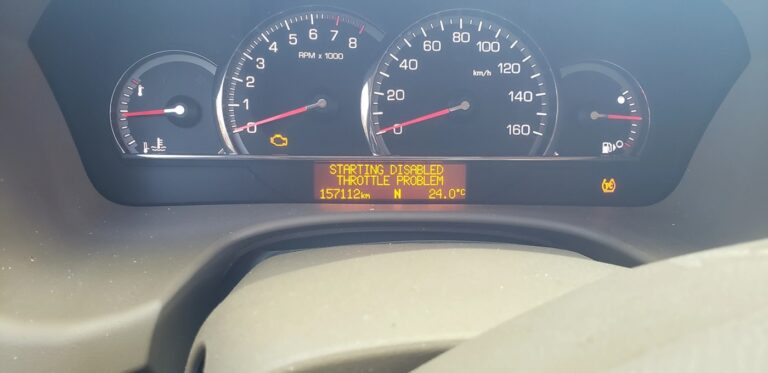
You get in your car, turn the key or press the start button, and instead of the engine firing up, you are greeted with a warning message on the dashboard: “Starting Disabled Service Throttle.” The engine will not start. Or maybe it does start, but the vehicle barely moves and feels completely unresponsive to the gas pedal. Either way, something is clearly wrong, and driving through it is not an option.
This warning is not one of those vague dashboard messages you can push to the back of your mind. When the throttle system is flagged as a problem, the vehicle’s computer is telling you it has lost confidence in a system that directly controls how your engine responds to your inputs. That is a big deal. No functioning throttle system means no reliable control over your engine speed or power output.
The good news is that this warning has a specific set of causes, and once you know what to look for, diagnosing and fixing it becomes much more manageable. Let’s break it all down.
What “Starting Disabled Service Throttle” Actually Means
The “Starting Disabled Service Throttle” message is triggered by the vehicle’s computer when it detects a fault in the Electronic Throttle Control (ETC) system. This system replaced the old-school mechanical throttle cable that used to connect your gas pedal directly to the throttle body. In modern vehicles, that physical connection does not exist. Instead, sensors, modules, and electronic signals do all the communicating.
Here is how the system works under normal conditions. When you press the accelerator pedal, a sensor called the Accelerator Position Sensor (APS) detects exactly how far down you have pushed it. That data gets sent to the ETC module, which processes it and sends a command to the Electronic Throttle Body (ETB) to open by a corresponding amount. Press the pedal 30% of the way down, the throttle body opens 30%. It happens in milliseconds and feels completely seamless when everything is working correctly.
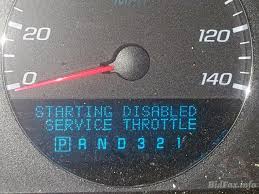
But when any part of that chain breaks down, the whole system can fail. The ETC module is designed to be conservative. When it cannot verify that the system is functioning correctly, it does the safest thing it can: it disables starting or severely limits engine output. That protective shutdown is what triggers the “Starting Disabled Service Throttle” warning.
This issue tends to show up more frequently in vehicles that have not had regular maintenance, particularly around the throttle body and its associated components. Dirt buildup, aging sensors, and deteriorating wiring all contribute to the problem over time.
The Electronic Throttle Control System: A Closer Look at What Can Go Wrong
To properly understand the causes, it helps to know the key players in the ETC system and what role each one plays. Here is a quick breakdown:
| Component | What It Does |
|---|---|
| Accelerator Pedal | Mechanical input from the driver |
| Accelerator Position Sensor (APS) | Monitors pedal position and sends data to the ETC module |
| ETC Control Module | Receives APS data, processes it, and commands the throttle body |
| Electronic Throttle Body (ETB) | Opens and closes to control airflow into the engine |
| Throttle Position Sensor (TPS) | Monitors throttle body position and reports back to the module |
Every component in that chain has to work and communicate properly. A failure anywhere in the system can bring the whole thing down and trigger the warning you are seeing.
What Causes the “Starting Disabled Service Throttle” Warning
1. A Damaged or Faulty Accelerator Position Sensor
The APS is the starting point of the entire throttle control process. If it cannot accurately report the pedal position, the ETC module is essentially flying blind. It has no idea how far you have pressed the accelerator, so it cannot tell the throttle body what to do.
When the APS fails, the module does not guess. It recognizes that it is receiving no data or bad data, logs a fault code, and triggers the warning. Depending on the severity of the failure, the vehicle may not start at all, or it may start but refuse to accelerate properly.
APS failures can happen because of physical damage to the sensor body, corrosion on the electrical connector, general wear from years of use, or contamination from dirt and moisture that works its way into the sensor housing over time.
One thing worth noting: some vehicles have two APS sensors built into the accelerator pedal assembly. This redundancy is a safety feature. If one fails, the system compares the two signals and recognizes the discrepancy. Having two sensors giving conflicting data is just as likely to trigger the warning as having one sensor fail completely.
2. Battery Problems
The ETC system is entirely electrical. Every sensor, every module, and every actuator in the system runs on power supplied by the vehicle’s battery. When that power supply is compromised, the system does not function reliably.
A weak or dying battery is a common but often overlooked cause of throttle system warnings. Here is why it catches people off guard. A battery that is too weak to reliably power the ETC system might still have enough juice to partially light up the dashboard and even attempt to crank the engine. It is not dead in the traditional sense, just not delivering consistent voltage. Voltage fluctuations stress electronic modules and can cause them to behave erratically or trigger fault codes.
Beyond the battery itself, corroded battery terminals create resistance in the electrical circuit. That resistance limits current flow and can produce the same effect as a weak battery, depriving the ETC system of the stable power it needs.
If your battery is more than three to four years old and you are seeing this warning, testing the battery should be one of your first steps. Most auto parts stores will test it for free.
3. ETC Control Module Malfunction
The control module is the brain of the ETC system. It receives data from the APS, processes it, and sends output signals to the throttle body. If the module malfunctions, the entire system goes down regardless of whether all the other components are working perfectly.
Module malfunctions fall into two broad categories. The first is a software glitch. These are more common than most people realize. The module runs on software, and like any software, it can crash, get stuck in a fault state, or behave unpredictably after a voltage spike or electrical disruption. In many cases, a simple reset clears the problem and the system comes back online without any hardware replacement needed.
The second category is physical damage to the module itself. This can happen from prolonged exposure to heat, water intrusion, or an electrical fault that burns out internal components. Physical damage cannot be fixed with a reset. The module needs to be replaced, and in some cases, the replacement unit needs to be programmed to the vehicle.
The tricky part with module diagnosis is that the symptoms can look the same whether it is a software glitch or a hardware failure. That is why resetting is always the first step before assuming the module itself has physically failed.
4. A Faulty Throttle Control Valve
The throttle control valve, which is part of the electronic throttle body, is the mechanical component that actually opens and closes to regulate how much air enters the engine. The ETC module sends it an electrical signal telling it to open a certain percentage, and a small motor inside the throttle body moves the valve to that position.
Over time, carbon deposits from the engine’s combustion process can build up on the throttle valve and around its bore. When enough buildup accumulates, the valve can get stuck. It might stick in the closed position, which starves the engine of air and prevents it from running properly. Or it can stick in the open position, which causes uncontrolled airflow and a dangerous loss of throttle control.
In either case, the throttle position sensor inside the throttle body detects that the valve is not responding to commands correctly. That discrepancy gets reported to the ECM, which triggers the warning and potentially disables starting to protect the engine and the driver.
A stuck throttle valve is sometimes fixable with a thorough throttle body cleaning. But if the valve’s internal motor or gear mechanism is damaged, the throttle body assembly typically needs to be replaced rather than repaired.
5. Wiring and Connection Problems
Every component in the ETC system is connected through a wiring harness. The sensors send their signals through wires. The module sends its commands through wires. Power flows to every component through wires. If any of those wires or connectors fail, the communication chain breaks.
Wiring problems can take several forms:
- Corroded connectors: Moisture works its way into electrical connectors over time and causes oxidation that increases resistance and degrades signal quality.
- Broken or frayed wires: Engine vibration, heat cycling, and physical contact with sharp edges can wear through wire insulation and eventually break the conductor inside.
- Loose connections: Connectors that are not fully seated or that have spread terminals can cause intermittent faults that are particularly frustrating to diagnose because they come and go.
- Rodent damage: This one sounds unusual, but it is more common than you would think. Rodents sometimes chew through wiring harnesses in the engine bay, and the ETC wiring is just as vulnerable as any other.
Wiring faults are often intermittent at first, which makes them particularly difficult to pin down. The warning might come on and then clear itself, leading you to think the problem resolved. It has not. It will come back, usually at the worst possible time.
How to Fix the “Starting Disabled Service Throttle” Warning
Before you start replacing parts, you need a proper diagnosis. Guessing is expensive. The right tool for the job is an OBD-II scan tool that can read manufacturer-specific fault codes, not just generic codes. A basic code reader from a parts store might miss the specific throttle system codes that point you in the right direction. If you do not have access to a quality scan tool, an auto parts store or a shop can pull the codes for you.
Common fault codes associated with this warning include:
- P0120 to P0124: Throttle/Pedal Position Sensor A circuit faults
- P0220 to P0224: Throttle/Pedal Position Sensor B circuit faults
- P2100 to P2104: Throttle Actuator Control Motor circuit faults
- P2110: Throttle Actuator Control System forced limited RPM
- P2135: Throttle/Pedal Position Sensor A/B voltage correlation
Once you have the codes, you have a roadmap. Here is how to address each possible cause.
Fix 1: Address the Accelerator Position Sensor
If the fault codes point to the APS, here is how to approach it:
- Connect your scan tool and check whether the APS is reporting any signal at all. Most diagnostic tools can display live sensor data. When you press the accelerator pedal, you should see the APS reading change smoothly from 0% to 100%. If the reading is flat, jumpy, or missing, the sensor is likely faulty.
- Locate the APS. On most vehicles, it is integrated into the accelerator pedal assembly rather than being a separate component. The entire pedal assembly may need to come out to access it.
- Inspect the electrical connector for the APS. Look for corrosion, bent pins, or a connector that is not fully seated. Clean any corrosion with electrical contact cleaner and reseat the connector firmly.
- If cleaning and reseating the connector does not resolve the fault code, the APS or the pedal assembly it is part of needs to be replaced. This is a relatively straightforward repair on most vehicles.
- After replacement, clear the fault codes with your scan tool and test the accelerator response with the engine running.
Fix 2: Sort Out Battery and Electrical Supply Issues
If the battery or its connections are causing power delivery issues, here is what to check:
- Test the battery voltage with a multimeter. With the engine off, a healthy battery should read 12.6 volts or higher. Below 12.0 volts indicates a significant discharge. Below 11.8 volts and the battery may not be recoverable.
- Have the battery load-tested if possible. A battery can show normal voltage at rest but collapse under the load of starting the engine. Load testing reveals this weak condition that a simple voltage check will miss.
- Inspect both battery terminals. If you see a white, blue, or green powdery buildup, clean it off. Mix a tablespoon of baking soda with a small amount of water, apply the paste to the terminals, let it fizz for a minute, scrub with a terminal brush or old toothbrush, rinse with a small amount of clean water, and dry thoroughly.
- Check the battery hold-down bracket. A battery that vibrates in its tray experiences more wear and faster terminal corrosion. Make sure it is secured properly.
- If the battery is more than four years old and the tests show it is weak, replace it. Also have the alternator tested to make sure it is charging the new battery properly after installation.
Fix 3: Reset or Replace the ETC Control Module
Always try a reset before assuming the module has physically failed. A reset clears any stored fault states in the module and forces it to restart its internal processes from scratch. Here is how:
- Using a scan tool: Connect the tool and use the clear codes function. This resets the module’s fault memory. After clearing, start the vehicle and see if the warning returns.
- Battery disconnect method: Turn the ignition off, disconnect the negative battery terminal, and leave it disconnected for 15 to 20 minutes. This allows the module’s capacitors to fully discharge and forces a complete reset when power is reconnected. Reconnect the terminal, start the vehicle, and test.
- If the warning returns immediately after the reset, the issue is a persistent hardware or sensor fault, not a software glitch.
- If the module is confirmed to have physically failed (usually indicated by specific module fault codes that do not clear), it needs to be replaced. Depending on the vehicle, the replacement module may require programming to match the vehicle’s specific calibration data. This step is critical. An unprogrammed or incorrectly programmed module will not work properly.
Fix 4: Clean or Replace the Throttle Body
If the fault codes indicate a throttle body issue or a stuck throttle valve, start with cleaning before replacing. Throttle body cleaning is a maintenance task that should be done every 30,000 to 60,000 miles anyway, and a clogged throttle body is a very common cause of throttle system warnings.
Here is how to clean it:
- Make sure the engine is off and cool before you start.
- Locate the throttle body. It is connected to the air intake hose and sits between the air filter housing and the intake manifold.
- Disconnect the air intake hose from the throttle body. You may also need to disconnect the electrical connector and any vacuum lines attached to it.
- With the throttle body accessible, use a can of throttle body cleaner (not carburetor cleaner, which can damage sensors) and a clean rag or soft brush to clean the interior bore and the throttle plate. You should see visible dark carbon deposits come off. Work carefully around the throttle plate and do not apply excessive force.
- Reinstall the air intake hose, reconnect the electrical connector and vacuum lines, and start the engine. Let it idle for a few minutes. The idle may be rough initially as the throttle body adapts to its cleaner state. This is normal and usually settles within a few minutes.
- Clear any stored fault codes and test drive the vehicle.
If cleaning does not resolve the issue and the fault codes continue pointing to the throttle body, the throttle body assembly needs to be replaced. This is not a complicated job mechanically, but it does require care to get all the connections right and may require a throttle body relearn procedure using a scan tool afterward to calibrate the new unit to the vehicle’s ECM.
Fix 5: Track Down and Repair Wiring Issues
Wiring diagnosis requires patience. There is no shortcut here, but here is a systematic approach:
- Use your vehicle’s service manual or wiring diagram to identify which wires and connectors belong to the ETC system. This prevents you from spending time inspecting wires that have nothing to do with the problem.
- Start at the connectors. Unplug each connector in the ETC circuit one at a time and inspect the terminals inside. Look for green or white corrosion, bent or pushed-back pins, and melted plastic near the terminals.
- Inspect the wiring harness along its full run through the engine bay. Look for spots where the insulation has worn through from rubbing against the engine or chassis, areas where the harness is kinked or pinched, and any signs of heat damage or rodent chewing.
- Use a multimeter to test continuity on wires you suspect might be broken internally. A wire can look perfect on the outside but have a broken conductor inside the insulation.
- Do not attempt to repair damaged wires with electrical tape and a twist connection. Splice in new wire using proper butt connectors or solder-and-shrink-tube connections to ensure a reliable, long-lasting repair.
- Once repairs are made, clear the fault codes and retest the system.
Can You Drive With This Warning Active?
The short answer is no, at least not safely or reliably. Here is why.
When the “Starting Disabled Service Throttle” warning is active, the vehicle’s computer has either disabled starting entirely or put the engine into a severely restricted operating mode. If the engine does run, the throttle system may not respond predictably to your inputs. You might press the gas and get nothing, or the engine might surge unexpectedly.
Think about what that means in real-world driving situations. You need to merge onto a highway and press the accelerator, but the engine does not respond. You are trying to navigate a busy intersection and the throttle behaves erratically. These are genuinely dangerous scenarios. The throttle system is not a peripheral feature. It is core to the vehicle’s ability to respond to your control inputs.
If you see this warning while driving, get to a safe location as soon as you can and have the vehicle diagnosed before driving it again.
How Much Does It Cost to Fix?
Repair costs vary significantly depending on which component is at fault. Here is a realistic breakdown:
| Repair | Estimated Cost (Parts + Labor) |
|---|---|
| Battery replacement | $100 to $200 |
| Battery terminal cleaning | Free to $30 (DIY) |
| Accelerator Position Sensor replacement | $80 to $250 |
| Throttle body cleaning | $50 to $150 (shop) or under $20 DIY |
| Throttle body replacement | $200 to $600 |
| ETC module reset | Free (DIY) or $50 to $100 (shop) |
| ETC control module replacement | $300 to $800+ |
| Wiring repair | $100 to $400 depending on extent |
Proper diagnosis before replacing parts is the single most effective way to keep these costs manageable. The right diagnostic scan takes the guesswork out of the equation and ensures you are fixing what is actually broken.
When to Let a Professional Handle It
Some of the fixes described here are within reach for a capable DIYer. Cleaning the battery terminals, replacing a sensor with accessible connectors, or cleaning the throttle body are all reasonable home garage repairs.
But ETC module replacement and programming, complex wiring diagnosis, and throttle body replacement with a relearn procedure are jobs where professional equipment and experience genuinely matter. Getting any of those wrong does not just fail to fix the problem, it can create new ones. A shop with proper diagnostic software can read live data from every sensor in the ETC system simultaneously, which makes fault isolation much faster and more accurate than visual inspection alone.
If you have done the basics, checked the battery, cleaned the throttle body, cleared the codes, and the warning keeps coming back, stop guessing and get professional eyes on it. A good diagnosis at a shop will cost you less in the long run than a series of incorrect part replacements.
The “Starting Disabled Service Throttle” warning is your vehicle drawing a clear boundary: fix this before you go anywhere. The throttle system controls your ability to accelerate, maintain speed, and respond to road conditions. There is no version of this problem that is safe to ignore or drive through. Address it now, do it right, and the repair will hold.