
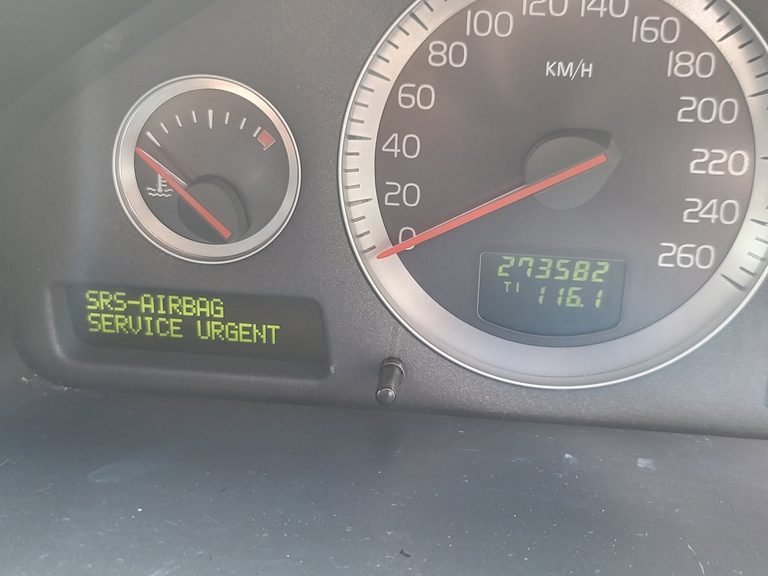
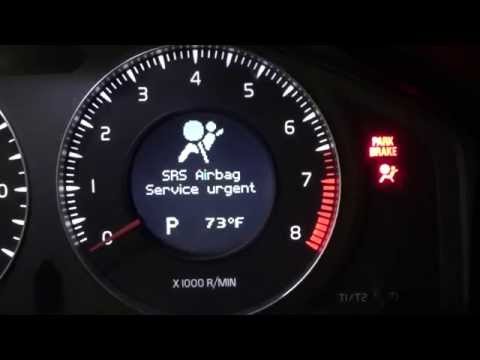
Picture this. You start your Volvo on a normal Tuesday morning, coffee in hand, ready to head to work, and instead of the usual welcome screen you get a message that reads “SRS Airbag Service Urgent.” Your stomach drops a little. Is the car unsafe to drive? Are the airbags going to explode? Should you pull over right now?
Take a breath. That message is not telling you your airbags are about to misfire on their own. What it is telling you is that your Volvo has run a self check on its Supplemental Restraint System, commonly shortened to SRS, and found something it does not like. The car is basically raising its hand and saying “something in my safety system is not working the way it should.”
That said, this is not a warning to shrug off either. The SRS covers your airbags, your seatbelt pretensioners, and a network of sensors that decide how your car protects you in a crash. If that system is compromised and you get into an accident, the protection you are counting on might not show up when you need it most.
In this guide, we are going to walk through exactly what triggers this message, how a technician actually tracks down the cause, what a repair typically looks like, and roughly what it might cost you. Think of this as the conversation you would have with a mechanic who actually takes the time to explain things instead of just handing you a bill.

What the SRS System In Your Volvo Is Actually Doing Behind the Scenes
Before getting into what can go wrong, it helps to understand what is supposed to go right. Volvo built its reputation on safety long before it became a marketing buzzword for every car brand, and the SRS is a big part of that legacy.
Your Supplemental Restraint System is not just the airbags themselves. It is an entire network of hardware and software working together in the background every single time you drive, quietly waiting for the one moment it might need to act in a fraction of a second.
The Parts That Make Up Your Volvo’s Safety Net
Your Volvo relies on several components working in coordination, and if even one of them develops a fault, the whole system can throw a warning. Here is what is actually involved:
- Airbags: Located in the steering wheel, dashboard, seats, and door panels depending on your model and trim.
- Crash sensors: Positioned around the front, sides, and sometimes the rear of the vehicle, these detect sudden deceleration.
- The SRS control module: Basically the brain of the operation. It reads sensor data and decides whether to fire the airbags.
- Seatbelt buckles and pretensioners: The pretensioners yank the seatbelt tight a split second before impact to hold you in the ideal position.
- Seat occupant weight sensor: Built into the front passenger seat, this determines whether an adult, child, or empty seat is present, which changes how (or if) that airbag deploys.
- Wiring harness and connectors: The nervous system tying every one of these parts together electrically.
Here is a real world example. Say you own a Volvo XC90 with three rows of seating. If a child sits in the front passenger seat without a booster, the occupant weight sensor is designed to detect that lighter weight and can adjust or disable that specific airbag to avoid causing injury from deployment force. That is the kind of split second decision making this whole network is built around.
How Airbags and Seatbelts Actually Work Together
A lot of drivers assume airbags do all the heavy lifting during a crash. In reality, airbags and seatbelts are designed as a team, not as separate systems competing for credit.
In the moments right before a collision, sensors detect the sudden change in speed. The seatbelt pretensioner reacts almost instantly, tightening the belt to remove slack and pull you back against the seat. This keeps your body positioned correctly so that when the airbag deploys a fraction of a second later, it actually catches you where it is supposed to.
Without that pretensioner doing its job first, an airbag deploying at close to 200 mph could actually cause more harm than good, since your body would not be in the correct position to absorb the impact safely.
Why It Is Called “Supplemental” and Not “Primary”
Here is a detail most drivers never think about. The word “supplemental” in Supplemental Restraint System is not just a fancy label. It is a reminder that airbags were designed to work in addition to your seatbelt, not instead of it.
Every part of this system, the sensors, the module, the pretensioners, is engineered around the assumption that you are wearing your seatbelt. Skip the belt, and even a perfectly functioning airbag system will not protect you the way it was designed to.
Why That Warning Message Suddenly Showed Up on Your Dash
Now for the part you actually clicked on this article for. What causes a Volvo to throw up the “SRS Airbag Service Urgent” message in the first place?
The honest answer is that it could be a handful of different things, ranging from a genuinely minor electrical hiccup to something that needs real attention before you drive the car another mile.
The Usual Suspects Behind This Warning
| Possible Cause | What Is Actually Happening | How Serious Is It |
|---|---|---|
| Faulty seatbelt latch or buckle switch | The system cannot confirm whether the seatbelt is properly buckled | Moderate, needs attention but often an easy fix |
| Damaged or corroded airbag sensor | A sensor sends inaccurate or no signal to the SRS module | Moderate to serious depending on which sensor |
| Previous airbag deployment | Crash data stored in the module has not been cleared or the module was never replaced | Serious, the system may be partially or fully disabled |
| Wiring or connector issues | Corrosion, a loose connector, or physical damage to the wiring harness | Varies, can range from minor to serious |
| Aftermarket electronics or modifications | A new stereo, alarm, or accessory install disturbed SRS wiring | Usually minor, but needs a proper fix |
| Water intrusion | Moisture reaching a connector or the module itself, often after a flood or car wash | Serious, water and electronics do not mix well |
Let us walk through a few of these in more detail, because knowing which one you are dealing with changes everything about how urgently you need to act.
Seatbelt Latch Problems
This one comes up more often than people expect. Inside every seatbelt buckle is a small switch that tells the car whether the belt is fastened. Over years of use, that switch can wear out, get gunked up with debris, or simply fail electrically.
When the SRS module cannot get a clear reading from that switch, it does not just guess. It throws the warning, because an unclear reading means it cannot reliably decide how to handle pretensioning or airbag deployment for that seat.
Airbag Sensor Trouble
Crash sensors live in exposed locations, often behind the front bumper or along the door sills, which means they are vulnerable to corrosion, road salt, and physical impact from things like curb strikes or minor fender benders that never got properly repaired.
Even a small parking lot bump that did not visibly damage your car could have jostled a sensor just enough to send bad data. That is a scenario a lot of owners never even connect to the warning light that pops up weeks later.
Prior Airbag Deployment
This is the big one, and it comes up a lot with used Volvos. If a car was ever in an accident severe enough to deploy the airbags, the SRS module actually records that crash event permanently. Some modules genuinely cannot be reset after deployment and require full replacement.
Here is where buying a used car gets tricky. Some sellers, either knowingly or not, attempt to “reset” this warning with cheap tools without actually replacing the deployed airbags or the module. If you bought a used Volvo and this warning showed up almost immediately, it is worth having a shop check the vehicle’s history and inspect for signs of prior deployment.
Someone Messed With the Wiring
Ever had a new stereo, backup camera, or remote starter installed at a shop that was not familiar with Volvo wiring? This happens more than you would think. Technicians working near the dashboard sometimes disconnect or brush against SRS wiring without realizing it, and the system notices immediately.
The good news here is that this cause is often the easiest and cheapest to fix, since nothing is actually broken, just disconnected or improperly reconnected.
Reading the Fault Codes Your Volvo Is Storing
Every time the SRS system detects a problem, it does not just flash a warning light and leave you guessing. It stores a specific Diagnostic Trouble Code, or DTC, that points a technician toward the exact issue.
Reading these codes yourself requires a scan tool capable of accessing the SRS module specifically, since a basic engine code reader from an auto parts store will not cut it. Volvo SRS codes typically follow a format that references the specific component involved, such as a particular sensor, the pretensioner circuit, or the module itself.
Here is a simplified look at the kind of information these codes reveal, though the exact code numbers vary by model year and generation:
| Code Category | What It Usually Points To |
|---|---|
| Seatbelt circuit codes | Buckle switch, pretensioner wiring, or the pretensioner unit itself |
| Airbag circuit codes | A specific airbag module, its wiring, or its clockspring connector under the steering wheel |
| Sensor codes | A crash sensor reporting incorrect resistance or no signal at all |
| Module internal codes | An internal fault within the SRS control unit, often the most serious category |
Once a technician pulls these codes, they cross reference them against Volvo’s official diagnostic documentation, which lays out exact testing procedures for each code. This is not a guessing game when done properly. It is a systematic process of elimination.
What Actually Happens If You Just Ignore the Warning
Some drivers see a warning light, feel like the car still drives fine, and decide to just deal with it later. With most warning lights, that might be a reasonable gamble. With this one, it genuinely is not.
Here is what you are actually risking:
- Airbags may not deploy at all in a collision, or may deploy incorrectly, increasing injury risk rather than preventing it.
- Seatbelt pretensioners might not activate, leaving you less secured in your seat during impact.
- The entire SRS system could shut itself down as a safety precaution, meaning none of these protections are active until repaired.
- Resale value takes a hit. A stored SRS fault shows up on a pre-purchase inspection and scares off buyers, or at minimum gives them leverage to negotiate a lower price.
- Insurance complications. If you are in an accident with a known, unaddressed SRS fault, some insurers may scrutinize the claim more closely.
Think of it this way. You would not drive around with your brake warning light on and just hope for the best. This warning deserves the same level of respect, arguably more, because the entire point of this system is to protect you in the exact moment things go wrong.
How a Mechanic Actually Tracks Down the Problem
Diagnosing an SRS fault is not something you want to approach with guesswork. It requires the right tools, a methodical process, and in most cases, genuine automotive experience. Here is what that process actually looks like from a technician’s perspective.
Step One: Pull Codes With an OBD-II Scanner
Every Volvo built since the mid nineties has an OBD-II port, usually tucked under the dashboard near the steering column. This is the starting point for almost any diagnostic job, SRS included.
Here is the basic process a technician follows:
- Locate the OBD-II port under the dashboard.
- Plug in a scanner capable of reading Volvo specific SRS codes, not just generic engine codes.
- Turn the ignition to the accessory position without starting the engine.
- Navigate the scanner’s menu to select the correct Volvo model and access the SRS module specifically.
- Review the Diagnostic Trouble Codes that appear.
- Cross reference each code with Volvo’s official documentation to determine the exact next step.
A word of caution here. Not every OBD-II scanner on the market can access SRS specific codes. Plenty of cheaper, generic scanners only read engine and transmission codes, which means they will tell you absolutely nothing useful about an airbag warning. If you are shopping for a scanner to use at home, confirm it explicitly supports SRS or airbag module diagnostics for Volvo vehicles.
Step Two: Confirm the Findings With a Multimeter
Scan tools tell you what the module thinks is wrong, but they do not always tell you exactly where the physical problem lives. That is where a multimeter comes in, letting a technician verify continuity and voltage at specific points in the wiring harness.
This step matters because a stored code might point to “seatbelt pretensioner circuit fault,” but that could mean the pretensioner itself failed, or it could just as easily mean a wire got pinched somewhere along its route. A multimeter test narrows that down.
- Disconnect the battery first. This is not optional. Working near airbag circuits with the battery connected risks accidental deployment, which is dangerous and expensive.
- Locate the specific SRS component flagged by the scan tool, whether that is a sensor, connector, or pretensioner wiring.
- Set the multimeter to the correct mode, either resistance or voltage, depending on what is being tested.
- Place the leads on the appropriate wiring terminals and take a reading.
- Compare that reading against the specification listed in Volvo’s service manual for that exact component.
This is genuinely not a step for a beginner working in their driveway with a basic multimeter from a hardware store. Airbag systems store residual electrical charge even after the battery is disconnected, specifically as a safety measure to allow deployment even if the battery is damaged in a crash. Handle these components with respect, or better yet, leave this particular step to someone trained to do it safely.
Step Three: Volvo’s Own Diagnostic Software, VIDA
Generic scanners get you part of the way there, but for a truly thorough diagnosis, Volvo dealerships and specialized independent shops use Volvo’s proprietary system called VIDA, short for Vehicle Information and Diagnostics for Aftersales.
VIDA is not something the average car owner has casual access to. It requires a paid subscription and a computer meeting specific system requirements, and it connects to the vehicle through a dedicated communication interface rather than a basic OBD-II scanner.
What makes VIDA worth mentioning here is what it can do beyond simply reading codes:
- Displays real time sensor data as the car sits idling, letting a technician watch values change live.
- Pulls the complete historical record of stored DTCs, including ones that may have cleared themselves but left a trace.
- Allows programming and calibration of electronic modules, including the SRS system itself, something a basic scanner cannot do.
- Provides access to Volvo’s official repair procedures specific to the exact model, year, and trim.
If your local independent shop has VIDA access, that is generally a good sign they take Volvo specific repairs seriously rather than treating your car like any other vehicle on the lift.

Fixing the Problem: When a Reset Works and When It Will Not
Here is the question everyone actually wants answered. Can you just reset this warning light and move on with your day, or are you looking at a real repair bill?
The honest answer is that it depends entirely on what caused the warning in the first place. Sometimes a reset is genuinely all you need. Other times, resetting the light without fixing the underlying issue is like putting a bandage over a problem that is going to come right back, or worse, hide a real safety issue.
When a Simple Reset Actually Solves It
If you recently had work done near the dashboard, like a new stereo installation, and the warning appeared right afterward, there is a decent chance a wire was simply disconnected or loosely reconnected. In cases like this, a reset after properly reconnecting everything can genuinely resolve the issue for good.
For newer Volvo models, technicians often use a dedicated scan tool such as the iCarsoft i906 to interface directly with the car’s onboard computer and clear stored codes once the actual wiring issue has been fixed.
- Connect the diagnostic tool to the OBD-II port.
- Navigate through the prompts to reach the SRS system diagnostics menu.
- Identify any stored SRS fault codes.
- If the underlying issue has genuinely been fixed, clear the codes to reset the warning light.
Here is the important caveat. If the warning light comes right back on after a reset, that is your car telling you the actual problem is still there. It did not just forget about it. Do not keep resetting it repeatedly hoping it eventually sticks. That is treating a symptom while ignoring the disease.
When You Are Looking at a Real Repair
Some causes simply cannot be fixed with a reset, no matter how good the diagnostic tool is. These usually involve either the SRS control module itself or a component that has genuinely failed and needs physical replacement.
If your Volvo was ever in an accident significant enough to deploy the airbags, the control unit likely stored that crash data permanently. In many cases, that module cannot simply be reset and must be reprogrammed by a specialist or replaced outright before the warning will clear for good.
- Reprogramming: In some cases, a technician can access the module and clear stored crash data through official Volvo procedures, provided the module itself is not physically damaged.
- Full module replacement: If the control unit is unresponsive, corroded, or otherwise damaged, replacement becomes the only real option.
- Component level repairs: This could mean replacing a specific airbag, a pretensioner unit, a damaged sensor, or repairing corroded wiring.
These are not jobs to attempt in your garage over a weekend, and honestly, most reputable shops will not let you either, given the safety stakes involved. Always have SRS repairs handled by someone with proper training and the correct diagnostic equipment.
What This Might Actually Cost You
Cost is obviously the elephant in the room, and it genuinely varies quite a bit depending on the cause. Here is a rough breakdown based on common scenarios, though your actual quote will depend on your specific Volvo model, your location, and whether you go to a dealership or an independent specialist.
| Repair Type | Estimated Cost Range | Notes |
|---|---|---|
| Diagnostic scan only | $80 to $150 | Often waived if you proceed with the repair at the same shop |
| Seatbelt buckle switch replacement | $150 to $350 | Parts are relatively affordable, labor is moderate |
| Airbag sensor replacement | $100 to $400 per sensor | Cost varies based on sensor location and accessibility |
| Wiring harness repair | $150 to $600 | Depends heavily on how much of the harness is affected |
| SRS control module reprogramming | $200 to $500 | Only possible if the module is not physically damaged |
| SRS control module replacement | $500 to $1,500+ | Includes parts and required programming, higher for certain models |
| Full airbag replacement after deployment | $1,000 to $3,000+ | Includes airbag units, clockspring, module, and labor |
These numbers are ballpark figures meant to give you a general sense of what to expect, not an exact quote. If a shop tells you the repair will run several thousand dollars, it is always reasonable to get a second opinion, especially from another Volvo specialist rather than a general repair shop unfamiliar with the brand’s specific systems.
Does It Matter Which Volvo Model You Drive?
Somewhat, yes. While the core concept of the SRS system stays consistent across the Volvo lineup, the specific components, sensor placement, and diagnostic procedures shift depending on the model year and generation.
| Model Range | Notable SRS Considerations |
|---|---|
| Older S60, S80, V70 (early 2000s) | Simpler SRS architecture, fewer sensors, generally more affordable to diagnose and repair |
| XC90, XC60 (mid generation) | Additional side and curtain airbag sensors due to larger body size and rollover protection features |
| Newer S60, S90, XC40, XC90 (recent generations) | More sophisticated occupant detection, additional knee airbags in some trims, tighter integration with other safety systems |
If you drive a newer Volvo loaded with advanced safety tech, expect the diagnostic process to involve more sensors and potentially more nuanced fault codes, simply because there is more hardware in the system to begin with.
A Few Things You Can Do to Avoid This Warning Altogether
While some causes of this warning are genuinely unpredictable, like a random sensor failure, there are habits that reduce your odds of ever seeing this message pop up unexpectedly.
- Use a Volvo familiar shop for any electrical work. Stereo installs, remote starters, and aftermarket alarms should always be handled by someone who understands where SRS wiring runs.
- Get body damage properly repaired, even minor bumps, especially if they occur near the front bumper or door sills where crash sensors typically live.
- Have a pre-purchase inspection done on any used Volvo before buying, specifically checking SRS history and looking for signs of prior airbag deployment.
- Avoid pressure washing near dashboard seams and door sills, since water intrusion into sensor housings and connectors is a real and often overlooked cause of electrical faults.
- Do not ignore small warning flickers. If the SRS light briefly flashes and turns off on startup, that is normal. If it stays on or comes back repeatedly, get it checked before it becomes urgent.
None of these steps guarantee you will never see this warning, but they meaningfully reduce the odds, and they are honestly just good practices for owning any modern vehicle loaded with electronics.
Common Questions Volvo Owners Ask About This Warning
Can I still drive my Volvo with this warning on?
Technically, yes, the car will still drive normally in terms of engine performance and handling. But here is the thing, driving with this warning active means your airbags and pretensioners may not function correctly in an accident. Get it diagnosed as soon as reasonably possible rather than putting it off for weeks.
Will disconnecting the battery reset the warning on its own?
Sometimes, but rarely permanently. Disconnecting the battery might clear the warning temporarily, but if the underlying fault is still present, it will come right back once the module completes its next self check. This is not a real fix, just a temporary mask.
Is this warning covered under warranty?
If your Volvo is still within its manufacturer warranty period and the fault is due to a component failure rather than accident damage or aftermarket modification, it is quite possibly covered. Check your specific warranty documentation or contact your dealership directly to confirm.
Can I diagnose this myself at home?
You can pull codes yourself with the right scanner, and that is a genuinely useful first step. But actually testing components and performing repairs involves working near live airbag circuits, which store residual charge even with the battery disconnected. Unless you have real experience with this specific system, this is a job better left to a professional.
Will this affect my car insurance?
Not directly, in most cases, simply having the warning light active will not affect your premium. However, if you are in an accident while the warning is active and unresolved, an insurer may ask questions about why the known issue was not addressed, particularly if it affected airbag deployment during the incident.
Bottom Line: Do Not Let This One Slide
Every warning light on a dashboard deserves some attention, but this particular one sits near the top of the list for a reason. The entire purpose of the SRS system is to protect you in the worst moment of your driving life, and a compromised system means that protection might not show up when you need it most.
Get it scanned, find out exactly what triggered the warning, and get it addressed properly rather than just clearing the code and hoping for the best. Your airbags only get one shot to do their job correctly. Make sure that when the moment comes, they are actually ready to take it.