
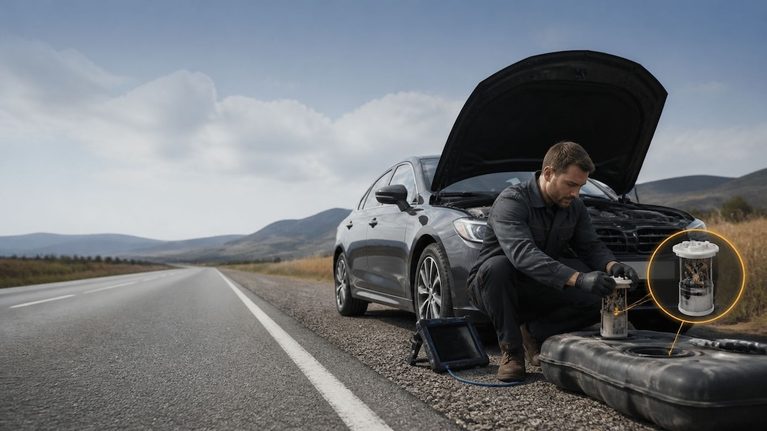
Your engine may start to sputter on the highway, lose power when you climb a hill, then stall before you can reach a safe place to pull over. A failing fuel pump can cause that kind of trouble, sometimes gradually and sometimes with little warning.
On most gasoline-powered cars, an electric pump moves fuel from the tank to the engine at the pressure the fuel system needs. The fuel then reaches the injectors, which deliver it to the engine. A pump problem can leave the engine short of fuel, but a bad relay, blocked filter, wiring fault, or pressure regulator can cause similar symptoms.
If the car loses power while you’re moving, focus on getting out of traffic first. A diagnosis can wait until you and the car are somewhere safe.
What happens when a fuel pump fails while you’re driving?
A pump that’s wearing out may struggle to keep up when the engine needs more fuel, such as during acceleration, a hill climb, or steady highway driving. You may feel a brief hesitation or sputter, then the engine may recover. If fuel pressure drops far enough, the engine can stall and may not restart.
A gasoline engine with fuel injection needs fuel delivered at the pressure its system was designed for. If the pump stops supplying enough fuel, the engine may crank normally but fail to start. The starter turns the engine; the fuel pump supplies fuel. Those are separate jobs, so a no-start doesn’t automatically mean the starter is bad.
Older diesel engines aren’t a safe exception. Diesel fuel systems also depend on pumps, and a delivery or injection-pump fault can leave the engine without the fuel it needs. Don’t count on nursing a failing vehicle to the next town, whatever fuel it uses.
Some carbureted motorcycles are designed to feed fuel by gravity from a tank above the carburetor, so they may not need a fuel pump. That depends on the motorcycle’s design and fuel arrangement. It isn’t a general rule that a bike will run without a pump as long as the tank is more than half full.
Why fuel pumps fail
Normal wear, heat, and frequent driving on a nearly empty tank
Like other electrical and mechanical parts, a fuel pump can wear out with use. Many in-tank electric pumps are surrounded by fuel, which helps carry heat away from the pump. Repeatedly driving with very little fuel can raise the pump’s operating temperature in some designs, but a low tank doesn’t prove that it caused a failure.
Age, mileage, and the conditions the vehicle works in all matter. A delivery car that spends hours in traffic may put its fuel system through a different life than a car used for occasional highway trips. There’s no single mileage figure that predicts exactly when a pump will fail.
Contaminated fuel or debris in the tank
Water, rust, or other contamination in fuel can clog the pump’s inlet strainer or interfere with fuel delivery. If the engine starts running poorly soon after a fill-up, mention that timing to the mechanic and keep the receipt if you have it. Contaminated fuel is one possibility, but it shouldn’t be assumed without checking.
Debris already in the tank can also damage or restrict a replacement pump. If a pump has failed and the tank contains contamination, fitting a new pump without dealing with the debris may lead to another problem. A shop should inspect the fuel and tank if the symptoms or failed parts point that way.
A restricted filter or strainer
A clogged fuel filter or pump strainer can restrict the amount of fuel reaching the engine. Depending on the vehicle, the filter may be a separate service part or part of a larger assembly. Some cars also have more than one filter or screen, so the owner’s manual or service information is a better guide than a generic online schedule.
A restricted filter can make a healthy pump seem weak, and forcing a pump to work against a restriction can add strain. On the other hand, a new pump may not fix the problem if the restriction remains. Ask the shop to check the filter and strainer rather than assuming the pump itself is the only possible fault.
An electrical fault in the pump circuit
The pump needs a reliable electrical supply. A failed fuse or relay, a loose connector, damaged wiring, a poor ground, or corrosion can interrupt power and make the car behave as if the pump has failed. A pump that works sometimes and quits at other times may have an intermittent electrical fault.
Replacing the pump won’t fix a weak connection or a relay that fails when hot. A mechanic can check the pump’s power and ground under the conditions when the fault occurs. A multimeter and a wiring diagram are more useful here than swapping parts until the car starts again.
A pressure regulator, injector, or sensor can imitate a pump problem
The fuel pump isn’t the only part that affects fuel delivery. A faulty fuel pressure regulator, a restricted injector, or a problem with a pressure sensor can cause poor running, hard starting, or a warning light. Those faults don’t automatically mean the pump is about to fail.
That’s why symptoms alone don’t identify the part. A mechanic needs to check whether fuel pressure is correct and whether the pump is receiving the right electrical command. The test results help separate a bad pump from a problem elsewhere in the system.
Incorrect parts or a poor previous repair
A replacement pump that doesn’t match the vehicle’s requirements may not deliver fuel properly. Incorrect installation, a damaged connector, or dirt left in the tank can also cause trouble after a repair. If the symptoms began soon after a pump replacement, bring the invoice and tell the shop when the problem started.
Some vehicles use a pump module that includes other components, while others use a different arrangement. It’s worth confirming what was actually replaced before ordering another part. “New pump” on an invoice doesn’t tell you whether the wiring, filter, tank, or related parts were inspected.
Symptoms that can point to a failing fuel pump
There’s no single symptom that proves the pump has failed. A worn pump can produce several clues, but ignition, charging, sensor, and fuel-quality problems can overlap. The pattern, when it occurs, and what the car does when you try to restart it are all useful details.
| What you notice | What it could mean | What to do next |
|---|---|---|
| The engine sputters or hesitates under load | Fuel delivery may not be keeping up, but an ignition or sensor fault can feel similar. | Note when it happens and have fuel pressure checked under the right conditions. |
| The car cranks for a long time before starting | Fuel pressure may be slow to build or may be bleeding down, though other faults are possible. | Try the spare key if relevant and ask for a fuel-system diagnosis. |
| The engine stalls and won’t restart | The pump, its electrical supply, or another engine system may have stopped working. | Move to a safe location and arrange a tow if the car won’t restart reliably. |
| A new or louder whine comes from the tank area | The pump may be noisy, but low fuel, a restriction, or normal pump operation can also make noise. | Don’t replace the pump based on sound alone. Have it checked alongside fuel pressure. |
| The check engine light comes on | A fuel-pressure, misfire, sensor, or unrelated fault may have triggered it. | Read the stored codes, then test the system rather than treating the code as a parts order. |
| The engine temperature gauge rises | This points to an engine-cooling concern, not a confirmed fuel-pump fault. | Stop safely and deal with the overheating issue promptly. |
A louder whining sound from the tank
Many fuel pumps make a quiet hum while operating, and the sound may be most noticeable near the tank. A pump that develops a much louder or higher-pitched whine could be wearing out or working against a restriction. Low fuel or a change in the pump’s mounting or surrounding parts can also affect what you hear.
A noise by itself isn’t enough to condemn the pump. Some vehicles make a brief sound when the ignition is switched on, while others run the pump only during cranking or when the engine is running. If you can’t hear a pump, that doesn’t prove it’s dead; if you can hear one, that doesn’t prove it’s delivering enough fuel.
Sputtering, hesitation, or surging during acceleration
A weak pump may have trouble supplying enough fuel when you ask the engine for more power. The car might hesitate during acceleration, sputter at higher speeds, or briefly lose power and then recover. A clogged filter, ignition misfire, or sensor problem can cause similar behavior, so pay attention to whether the symptom happens under load, at idle, or all the time.
If the car starts sputtering in traffic, don’t try to reproduce the fault with a high-speed test drive. Note what happened and arrange a safe inspection. A mechanic may need to check fuel pressure while the problem is occurring, because a pump can test normally when it’s cold and fail after it warms up.
Hard starting or a no-start
A fuel pump that can’t build or maintain adequate pressure may cause extended cranking before the engine starts. The car may start normally one day and take several attempts the next. A leaking injector, pressure regulator, weak battery, or another fault can produce a similar pattern.
If the engine cranks but won’t catch, listen for symptoms and note any dashboard warnings, but don’t keep cranking for long stretches. Repeated attempts can drain the battery and won’t repair a failed pump. If the engine doesn’t crank at all, the battery, starter circuit, or start authorization needs attention too.
Stalling, especially after the car has been running
An intermittent electrical fault or a pump that struggles when hot can cause a car to stall after it has been driven for a while. Sometimes the engine restarts after cooling down. That pattern is a useful clue for the shop, but it still doesn’t prove the pump is the cause.
If the vehicle stalls again after restarting, don’t keep driving it to see whether the problem clears up. A repeat stall can leave you without power in a dangerous place. Arrange a tow if the car won’t run consistently.
The check engine light may come on, but it may stay off
A fuel-delivery problem can trigger the check engine light, especially if it leads to low fuel pressure or misfires. Some vehicles may store codes such as P0087 for fuel rail or system pressure that’s too low, or P0230 for a fuel-pump primary-circuit fault. Code availability and system design vary, and neither code by itself confirms that the pump needs replacement.
A weak pump may also cause noticeable trouble without turning on the light. A basic OBD-II reader can miss information stored in other vehicle modules, and not every fault sets a code right away. The code is a lead for diagnosis, not a verdict.
Can a fuel pump fail without warning?
Yes. Some pumps give weeks of clues, such as a louder whine, extended cranking, or hesitation under load. An electrical connection, relay, or pump can also fail abruptly, leaving little time to react.
There isn’t a warning light that reliably tells you the pump is about to quit. Taking repeated stalling, slow starting, or loss of power seriously can help you deal with a developing fault before it leaves you stranded. It can’t guarantee you’ll get advance notice.
Can a bad fuel pump ruin the engine?
A pump that stops working usually causes fuel starvation, loss of power, and stalling. It doesn’t automatically destroy the engine. The immediate concern is that the car may stop responding to the accelerator while you’re in traffic.
Continuing to drive with repeated misfires or a severe fuel-delivery problem can create other risks. Misfires can damage the catalytic converter, and an engine running with an unresolved lean condition may be at risk under heavy load. If the car is running badly, don’t keep using it as a test vehicle.
What to do if the engine stalls while you’re driving
- Keep control of the car. Turn on the hazard lights and steer toward a safe shoulder, exit, or parking area. Don’t switch the ignition fully off while the vehicle is moving.
- Expect the controls to feel different. Depending on the vehicle, steering or brake assistance may be reduced when the engine stops. Keep a firm grip on the wheel and apply steady pressure to the brake.
- Get clear of moving traffic. Once stopped, select Park where appropriate, set the parking brake, and follow local roadside-safety guidance. If it’s unsafe to leave the vehicle, stay inside with your seat belt on and call for help.
- Don’t keep trying to drive it. If it restarts, that doesn’t mean the fault has gone away. An intermittent pump or wiring problem can return without warning.
- Arrange roadside assistance or a tow. Tell the service provider whether the engine stalled, whether it cranks, and what warning lights you saw.
A fuel smell, visible leak, smoke, or damaged wiring is a reason to keep away from the vehicle and call for assistance. Don’t open fuel lines or try to test a pump beside the road. Fuel and electrical sparks are a dangerous combination.
How a mechanic checks whether the pump is really at fault
A good diagnosis starts with the complaint: when the car stalled, whether it restarted, how much fuel was in the tank, and whether the problem appeared after a fill-up or repair. A scan tool can retrieve stored codes and show data from the engine or fuel system, depending on the vehicle. The technician may also need to reproduce the symptom safely.
Next, the shop checks the pump’s power and ground, along with the relevant fuse, relay, wiring, and connectors. A multimeter can reveal a voltage or connection problem that a simple visual check misses. If the pump receives poor power, replacing it may not solve the fault.
The technician can then check fuel pressure and, where needed, fuel volume under the conditions specified for that system. A pressure reading that’s too low can result from the pump, a restriction, a regulator problem, or an electrical fault. The test has to fit the vehicle; there isn’t one pressure figure that applies to every car.
Modern gasoline direct-injection systems can contain very high fuel pressures. Don’t loosen a line or connect a generic gauge unless you have the correct equipment and training. A shop can use the manufacturer’s service information and suitable test tools to check the system safely.
A common shop scenario is a car that starts normally when cold, then hesitates on the highway and stalls after a longer drive. The owner may be sure the pump is bad, but a heat-sensitive relay or connector can cause much the same pattern. Checking the electrical supply and fuel pressure when the fault is present helps avoid replacing a good pump.
What does fuel pump replacement cost, and how long can it take?
A rough parts estimate for a fuel pump can range from $100 to $1,100, with labor sometimes quoted as high as $250. Treat those figures as broad guidance, not a current quote for your vehicle. The pump design, vehicle, parts choice, local labor rate, and access to the tank all affect the final bill.
| Part of the repair | What to expect | What can change the estimate |
|---|---|---|
| Pump or pump assembly | A broad parts range is $100 to $1,100. | The vehicle and whether the pump is sold separately or as part of an assembly. |
| Labor | Labor has been quoted as high as $250, but this isn’t a guaranteed cap. | Whether the pump is accessible through a panel or the fuel tank must be removed. |
| Diagnosis and related work | There’s no useful one-size price for additional checks or repairs. | A restricted filter, contaminated tank, wiring fault, or damaged connector may add work. |
A straightforward pump replacement may take a few hours, while removing a tank, dealing with corroded fasteners, or cleaning contamination can take longer. The shop should estimate the time after it knows the vehicle and has confirmed the fault. Ask whether the quote includes diagnosis, related filters or seals, and any tank-cleaning work that may be needed.
If a shop recommends a pump, ask what test confirmed it was failing. A useful answer might include measured pressure, a failed electrical test, or a repeatable symptom with supporting results. “The light came on” or “the pump sounded noisy” isn’t enough on its own.
Mistakes that can waste money or create a safety problem
- Replacing the pump based on sound alone. A whine can be a clue, but it doesn’t prove the pump is weak.
- Assuming a fuel-pressure code names the bad part. A code points to a system or circuit; diagnosis still has to find the cause.
- Installing a pump without checking the tank and strainer. Contamination or a restriction can cause problems with the replacement too.
- Bridging a relay or using a higher-rated fuse. The wrong electrical test can damage wiring or create a fire risk.
- Opening fuel lines at home without the right procedure. Fuel systems can remain pressurized, and direct-injection systems need special care.
- Driving on after the engine restarts. A temporary recovery doesn’t make an intermittent fault safe.
- Blaming the temperature gauge on the fuel pump. A rising coolant temperature needs its own prompt diagnosis.
Checking the owner’s manual for the correct fuel type and maintenance information is sensible. So is keeping enough fuel in the tank that you’re not routinely running close to empty. Neither step can prevent every pump failure, but both help avoid preventable stress and confusion.
What I’d do if this were my car
If the car sputtered once but is running normally, I’d write down when it happened and book a proper check rather than immediately buying a pump. If it stalled, lost power repeatedly, or won’t restart, I’d stop driving it and arrange a tow. I’d also tell the mechanic whether the engine cranks, whether a warning light came on, and how much fuel was in the tank.
You can safely check the fuel level, read the owner’s manual, and note the symptoms. Leave fuel-pressure testing, wiring diagnosis, and opening the fuel system to someone with the right equipment. The practical takeaway is simple: a fuel pump can fail while you’re driving, but confirm the pump is the cause before replacing it.