
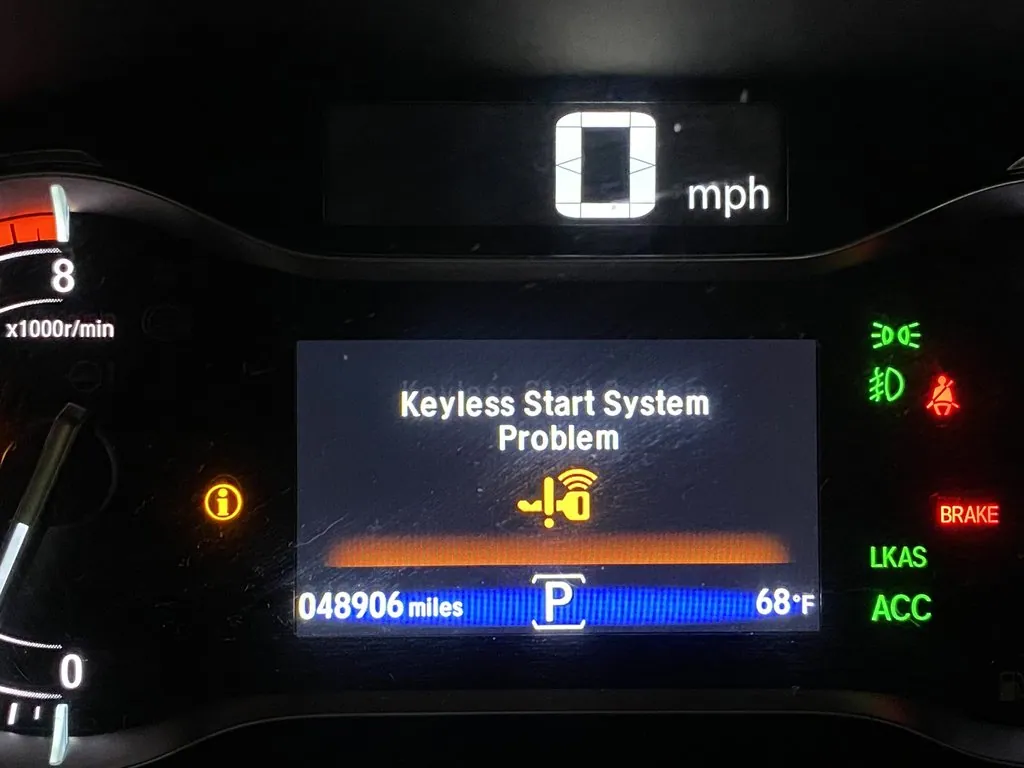
You get in, press the button, and the dash tells you there’s a “keyless start system problem.” Nothing cranks, or it cranks and quits. It’s an annoying way to start a morning, but it’s rarely as bad as it looks. Most of the time the cause is the key fob battery, the start/stop switch, or the car’s own battery.
I’ve seen this message on enough Pilots to know the pattern. The cheap fixes come first, and the pricey ones hide behind a few symptoms you can learn to recognize. This guide covers how the system works, the six causes I’d check, a step-by-step troubleshooting order, what weather does to it, and the 2016 and 2019 model notes.
I’ll also tell you where DIY stops making sense. Some of this is a five-minute job in the driveway, and some of it needs a scan tool and a tech who deals with Honda electrical systems every week. Knowing which is which saves time and money.
Start here: the quick checklist
Before you pull anything apart, run through this list. It goes from the easiest and cheapest to the more involved, and it’s the order I’d use if you called me from the driveway.
- Make sure the fob is actually inside the vehicle, and keep it away from other keys and electronics.
- Press the brake pedal firmly before you press the start button.
- Replace the fob battery, or at least try a fresh one if you have a spare.
- Check the dash lights and the headlights for signs of a weak car battery.
- Listen to what happens when you press the button: silence, a click, rapid clicking, or a crank with no start.
- Check the relevant fuses in your owner’s manual.
- Look for a reset procedure in the manual before you disconnect anything.
If one of those fixes it, great. If not, keep reading, because the way the car fails tells you a lot about what’s wrong.
How the keyless start system works
The keyless start system is meant to make starting the car simple. You carry the fob, sit down, press the button, and the engine starts as long as the car recognizes the fob inside. There’s no physical key to turn, which also means there are more electronic handshakes that can fail.
Components of the system
The system is made up mainly of the key fob, the push-to-start button and the start/stop switch behind it. The fob lets you start the engine without inserting a key. The button is what you press to start or stop the engine.
The car also uses a sensor to detect whether the fob is inside. If it doesn’t find one, the engine won’t start. A low fob battery, a faulty start/stop switch or software trouble can all interrupt that process, so it pays to look after every part of the chain.
How it works when you start the car
When you get into the Pilot with the fob, the car uses radio signals to recognize it. Once the fob is detected, the push-to-start button becomes active. To start the engine, you press the button with your foot on the brake.
The engine starts only if everything in that chain checks out. A problem with the fob, such as low battery voltage, can stop the system cold. A defective start/stop switch can leave the car unresponsive even when the fob is sitting right there. That’s why the fob and the switch are the first two things I look at.
The six common causes
When a Pilot throws a keyless start system problem, these are the usual suspects. I’ve put them roughly in the order I’d check them, which isn’t the order of how often they fail on every car, but it’s the order that wastes the least money.
1. Key fob battery problems
This is the first thing to check. If the fob battery is low or dead, the Pilot may not recognize the fob, and you get start issues. Keep a spare battery on hand, and replace the battery as soon as you notice trouble unlocking or starting the car.
Check the battery for signs of wear or corrosion every so often. A weak signal from a tired battery can stop the car from starting and leave you stranded. Swapping it is usually easy, and all it takes is a small screwdriver to open the fob.
I tell customers to treat the fob battery like the batteries in a smoke detector. Change it before it quits, not after. A coin battery costs very little compared with a tow.
2. Faulty start/stop switch
The engine start/stop switch can wear out or fail, and then the car may not recognize when you want to start or stop it. It’s a core part of the keyless system, so a bad one causes real trouble. If the switch feels loose or doesn’t respond every time you press it, it may be due for replacement.
The tricky part is that a bad switch can imitate other problems, including a dead battery. You press the button, nothing happens, and you assume the battery. That confusion is why I check dash lights and the battery condition before blaming the switch. Once the switch is repaired or replaced, the starting trouble may go away.
3. Malfunctioning starter
A starter problem can cause a lot of headaches. If the Pilot struggles to start, or clicks when you press the button, the starter may be failing. Its job is to turn the engine over, so a failing one can leave you with a car that won’t start at all.
Sometimes a starter can be repaired, but replacement is more common. Frequent trouble spots include a worn-out motor or solenoid issues. Pay attention to how the car starts, because a slow crank, a single loud click or a delay before cranking can tell you the starter is getting tired.
Here’s a shop rule of thumb. If the dash lights stay bright and the car makes a single click, I get suspicious of the starter or solenoid. If the lights dim hard and you hear fast clicking, I look at the battery first. Neither is a guarantee, but it points you the right way.
4. Low car battery
The car battery’s health is crucial for the keyless start system. A low or dead battery can stop the system from recognizing the fob entirely, and it can also cause dim lights or other electrical oddities. Many electronic systems get confused when voltage drops, and the keyless system is one of them.
Check the terminals for corrosion and verify the voltage. If you suspect the battery, get a professional test or replacement. Most parts stores and shops will test a battery quickly, and it beats guessing.
5. Blown fuses and relays
Blown fuses and faulty relays are another possible cause. They control electrical pathways in the car, so a break in one of them can leave the keyless system unresponsive. The fix is often simple if the problem really is a blown fuse.
Inspect fuses and relays for damage or wear. Replace a blown fuse with the correct type and size for your vehicle, because the wrong one can create bigger problems. Your owner’s manual shows which fuse does what and where the fuse boxes live.
A fuse that keeps blowing is a warning, not a nuisance. Something is drawing too much current, and swapping in a bigger fuse just hides it. If a new fuse blows again, stop and get it diagnosed.
6. Faulty ignition components and sensors
Faulty ignition components can stop the car from starting. The ignition switch may fail from wear, and inspecting or replacing it might be necessary if the car shows signs of poor ignition. On the 2019 model, a malfunctioning keyless system sensor can also stop the car from detecting the fob.
Diagnostic tools can check for error codes related to the ignition. Repairs here usually call for an experienced mechanic, since they involve electrical components. If you suspect ignition trouble, going to a dealer can be the safest move to avoid damage from improper handling.
How the symptom points to the cause
The way the car fails gives you clues. This table matches the most common symptoms to the likely cause and the sensible next step.
| What you notice | Likely cause | Next step |
|---|---|---|
| Doors respond slowly and the car doesn’t recognize the fob | Low fob battery | Replace the fob battery |
| Button feels loose or only works some of the time | Faulty start/stop switch | Have the switch checked or replaced |
| Single click, then nothing | Starter or solenoid issue | Test the battery first, then have the starter checked |
| Dim lights, slow crank or fast clicking | Low car battery | Clean the terminals, then test or replace the battery |
| Dead system with no response at all | Blown fuse or relay | Check fuses against the manual |
| Error message returns after a fresh fob battery and a good car battery | Ignition component or keyless sensor trouble | Scan for codes and see a dealer or qualified shop |
| Starts fine warm, struggles in the cold | Weak fob or car battery | Test both before winter |
Troubleshooting keyless start problems
Most keyless start trouble comes down to simple fixes, like fresh fob batteries or a look at other parts of the ignition system. Don’t put these off, because a small problem tends to show up at the worst moment. Work through them in order.
Replacing the key fob battery
If you’re having start issues, the fob is the first place to look. Fob batteries drain over time, and they need replacement. Watch for signs like shorter range or slow response, which usually show up before a total failure.
To replace the battery, open the fob carefully and avoid any force that could damage the case. Most Honda fobs use a lithium coin battery, typically a CR2032, though you should check your fob to be sure. Make sure the new battery sits securely, and if the problem remains afterward, the fob itself may be impaired.
A few practical tips from the bench. Note which way the battery faces before you pull it out. Don’t touch the flat surfaces with greasy fingers, and use a small plastic or smooth tool to pry the case so you don’t scar it. If the fob case won’t open easily, look for a release in the fob and in the manual, since forcing it can crack the housing.
Resetting the start/stop system
Sometimes the system gets stuck, and a reset helps. This can resolve trouble tied to a defective ignition module or a hung-up state. Look for any reset button or process in your Pilot’s owner’s manual first.
Disconnecting the car battery for a few minutes may also reset the system. Reconnect it and try starting the car. If that doesn’t work, have a professional check the start/stop switch, especially if factory settings were disrupted or the switch feels stiff.
Before you disconnect the battery, check the manual for anything you need to know. On many cars it can reset the clock, radio presets and some learned settings, and it may trigger a relearn procedure. Write down any anti-theft or radio codes if the car needs them. And don’t hang around the terminals with loose tools, since a dropped wrench across the battery posts makes a bad day.
Checking for faulty ignition components
If the basics don’t solve it, look at the ignition components. The ignition switch can fail from normal wear, and inspection or replacement may be needed if the car shows signs of poor ignition. A scan for error codes related to the ignition is the next logical step.
This is where I’d stop doing it myself. These repairs involve electrical components and often need a scan tool and some experience. A dealer or a qualified independent shop can read the codes and test the circuit properly, which beats swapping parts hoping one works.
A quick battery check you can do
You don’t need fancy equipment to get a hint about the car battery. Turn the ignition to the on or accessory position and watch the dash and cabin lights. If they’re dim, flicker, or drop out when you press the start button, the battery needs attention.
Look at the terminals for fuzzy white or green corrosion and check that the clamps are tight. A loose terminal can mimic a dead battery, and cleaning and tightening it takes a few minutes. If you’re not sure about the battery, get it load tested, since a battery can show decent voltage at rest and still fall flat when you ask it to crank.
Checking fuses without making it worse
Find the fuse box locations and the fuse chart in the owner’s manual. Pull the fuse that matches the keyless or ignition circuit and look at the metal strip inside, since a broken one means the fuse is blown. Replace it only with the same type and amperage.
If you can’t tell which fuse matters, don’t pull fuses at random. Taking out the wrong one can disable something unrelated, and you may lose track of what you moved. If a replacement fuse blows right away, there’s a deeper electrical issue and it’s time for a shop.
Weather-related keyless start issues
Weather can play a bigger role than people expect. Cold can affect the fob and the sensors, and heat can affect the auto lock feature and other components. Neither one breaks the car by itself, but both can push a marginal part over the edge.
Cold weather
In cold weather, the keyless system can run into trouble because of low temperatures. A fob battery can weaken in the cold, limiting its ability to send a strong signal to the car. Keeping the fob warm when you aren’t using it helps, so a pocket is better than a freezing cupholder.
Temperature sensors in the car may also struggle to read accurately in the cold. That can cause trouble with starting and with other systems. The car’s own battery also becomes less efficient in the cold, and a weak one can fail to supply enough power to start the engine.
My advice is to check the car battery’s health before winter arrives, not after your first no-start. I’ve had customers show up on the first frosty morning, and nine times out of ten the battery had been giving warning signs for weeks. A slow crank in October is a hint worth listening to.
Heat and the auto lock feature
High temperatures can affect the auto lock feature in your Pilot. Intense heat may make components in the locking mechanism less responsive, or cause them to malfunction. You might notice a delay, or a failure in recognizing the fob.
The temperature sensor can also misread conditions inside the car, causing unnecessary alerts or odd feature behavior. These problems are annoying on a hot day, but they usually don’t mean major damage. Parking in the shade or using a sunshade can reduce the strain on these sensitive systems.
Preventive maintenance, such as checking the condition of the car’s electronic components now and then, can help too. If a symptom only appears on very hot or very cold days, tell your technician that detail. It narrows the search a lot, and it helps explain problems that “don’t show up” when the car is in the shop.
Model-specific concerns
The model year can influence which keyless start problems you see and how they get fixed. The 2016 and 2019 Pilots each have their own notes. Treat these as patterns owners and technicians report, not as a promise about your particular vehicle.
The 2016 Honda Pilot
The 2016 Pilot is known for keyless start trouble. A common one is a low fob battery, which can happen more often if you use the fob a lot or if it’s old. That’s the cheapest cause, so check it before anything else.
Another suspect is a defective start/stop switch. If you see the “keyless start system problem” message, it can come from switch failure or a significant flaw in the engine starter. Some owners have even seen it when the vehicle was fairly new, so check whether your Pilot has any warranty coverage that could handle the repair without extra cost.
The 2019 Honda Pilot
The 2019 Pilot can still show keyless start trouble, but the problems tend to look a little different. A malfunctioning keyless system sensor can stop the car from detecting the fob. A low fob battery can lead to the same symptom, as on the 2016.
If you see an error message, a reset may help, though sometimes a faulty component needs replacement. Make sure the fob isn’t impaired and that the system’s sensors aren’t blocked, since either can interfere with how the system works. A fob carried next to a phone, other keys or a metal case may be worth moving before you decide anything is broken.
Maintenance tips for keyless start systems
Keeping the system healthy is mostly basic maintenance. A few habits will prevent most of the no-start calls I see, and none of them costs much.
- Look after the fob: a weak or dead battery causes problems, so replace it when the car stops responding well and keep a spare battery on hand.
- Watch the car battery: a slow-starting engine can mean a low battery, so have it checked on a schedule, especially if the car sits idling a lot.
- Keep sensors clean: dust and dirt can interfere with them, so wipe them gently with a soft, dry cloth and keep moisture out.
- Read the dash messages: if you see a “Keyless Start System Problem,” don’t ignore it, and check whether it relates to the fob, battery or another part.
- Don’t ignore a pattern: if you need a trick to start the car every time, something is wearing out.
Your car’s battery matters in all of this. If the engine is slow to start, or the car spends a lot of time in idle, battery life deserves attention. A battery that’s marginal in summer can quit in winter without much notice.
When the message appears, treat it as information. A message that shows up once after a long sit may be nothing. One that keeps coming back should send you through the checklist and, if needed, to a shop.
Common mistakes to avoid
These are the slip-ups I see most often. None of them is hard to avoid once you know about them.
- Assuming the starter is bad right away: a weak car battery or a dead fob battery is far more common, and cheaper.
- Skipping the fob battery: it’s the easiest check, and people replace expensive parts before trying it.
- Using the wrong fuse: the wrong type or size can cause bigger problems.
- Forcing the fob open: pry too hard and you can crack the case or damage the circuit board.
- Disconnecting the battery without a plan: check the manual first, and expect some settings to reset.
- Ignoring corrosion: dirty or loose terminals can imitate a dead battery.
- Replacing parts by guesswork: a scan for codes and proper tests cost less than swapping a switch or sensor that wasn’t the problem.
- Letting the message ride: a recurring warning usually means a failing part, and it tends to pick a bad moment to quit.
What it costs and how long it takes
I won’t quote prices, because they vary by shop, region, parts and the work involved. What I can give you is the shape of the cost. A fob battery is the cheapest fix, a fuse is next, and a car battery costs more but is a common and fairly routine repair.
The start/stop switch, starter and ignition components sit higher on the cost scale, and the final number depends on the part and the labor to reach it. Ask for a written estimate and ask the shop what testing they did before they recommended a part. If your Pilot is still under warranty, ask the dealer whether the repair is covered before you pay for it.
On time, a fob battery swap takes a few minutes. Checking a fuse or testing the battery takes a little longer, and a proper diagnosis for switch, sensor or ignition trouble takes longer still. A good shop will test first and replace second, and that order saves you money in the long run.
When DIY makes sense and when it doesn’t
The easy checks are fair game for anyone. Replacing the fob battery, looking at the car battery terminals, checking dash lights and looking up fuses in the manual are all safe driveway jobs. They need no special tools beyond a small screwdriver and maybe a battery tester.
Past that, the picture changes. Start/stop switches, ignition components, starters and keyless sensors involve electrical work and trim removal, and a mistake can cause new problems. If your first round of checks doesn’t solve it, a scan for codes and a proper test is usually the smarter route than guessing.
When you do go to a shop, give them details. Tell them what the message says, when it happens, whether it’s worse in hot or cold weather, what the car sounds like when you press the button, and what you’ve already replaced. That information can cut diagnostic time, and it helps the tech decide where to start.
The expert verdict
Here’s what I’d do. Replace the fob battery first, check the car battery next, and then look at the fuses. Pay attention to the sound the car makes, because a click, a slow crank and total silence each point somewhere different.
DIY is reasonable for the fob battery, terminal cleaning, a basic look at fuses and checking the manual for a reset. If those checks don’t solve the problem, take it to a dealer or a qualified shop to scan for codes and test the start/stop switch, starter and ignition components. Check warranty coverage first, particularly on a newer Pilot.
Don’t keep pushing the button over and over, and don’t replace parts without testing. That’s how a cheap fix turns into an expensive afternoon.
One clear takeaway: start with the cheap, easy causes like the fob battery and the car battery, and get the Pilot professionally diagnosed if the keyless start message keeps coming back.