
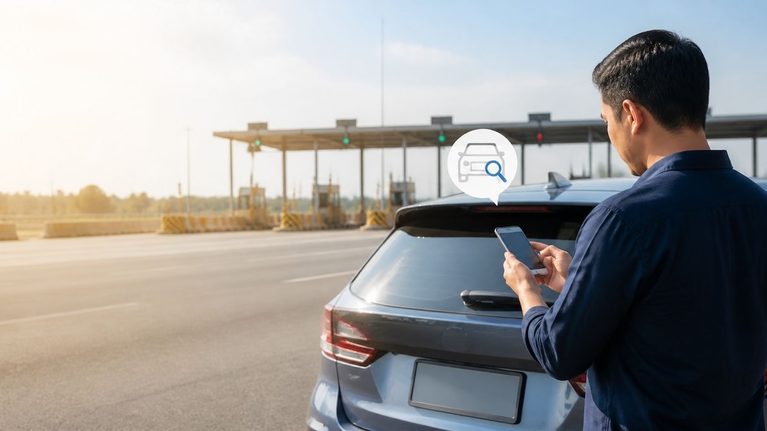
Had a customer come in a few months back, nice guy, drives for a delivery service, absolutely convinced he’d never run a toll without paying in his life. Then a letter showed up from Florida with his plate number on it and three unpaid toll notices plus an admin fee tacked onto each one. Turned out his transponder had expired without him noticing, and every one of those “cashless” gantries he drove under just defaulted to photographing his plate instead.
That’s the thing about toll violations these days, you don’t need to blow through a manned booth waving your middle finger at the attendant to end up with one. Most toll roads now run entirely camera-based, and a violation can stack up quietly while you’re none the wiser, until a letter lands in your mailbox weeks later with fees already attached. Let’s go through what actually counts as a violation, how to check if you’ve got one sitting out there, and how to clear it before it turns into something bigger than a toll fee.
What actually counts as a toll violation
A toll violation is simply what happens when you drive past a tolling point without the required payment going through, whether that’s cash, a transponder charge, or a plate-based invoice getting paid. It sounds straightforward, but there are a handful of different ways you can end up with one, and most of them aren’t intentional.
The common ways people end up with a violation
- Missed tolls: you drove through without paying, whether at a traditional booth or via a transponder that didn’t read.
- Toll evasion: deliberately avoiding payment, the rare intentional case.
- Expired transponder: your device is still mounted on the windshield but the account behind it has lapsed or the hardware’s outdated.
- Incorrect account details: your plate number on file doesn’t match your actual plate, often after a vehicle swap or a plate renewal.
That last one catches more people than you’d expect. I’ve seen customers trade in a car, get a new plate, and forget to update it on their toll account for months. Every toll during that gap gets billed to a plate number that technically isn’t theirs anymore on paper, which creates a mess when the invoice shows up tied to a vehicle they no longer own.
Knowing the toll types helps you avoid tripping one
Not all toll roads work the same way, and knowing which kind you’re driving on changes what you need to have ready.
- Traditional toll booths: you stop, pay cash or card, done. Hard to violate unless you genuinely skip the booth.
- Express lanes: usually require an active transponder, since many don’t accept cash at all anymore.
- All-electronic tolling (toll-by-plate): no booth, no stop, just a camera reading your plate as you pass underneath.
That third category is where most accidental violations happen now, since there’s no human interaction and no obvious moment where you’d realize something went wrong. Keeping your transponder active and your account’s linked plate current is really the whole defense here.
How to check for toll violations using your license plate
If you’ve got a nagging feeling you might owe something, or you’ve already gotten a notice in the mail, checking is usually a five-minute job online. The trick is knowing which state’s system to use, since each toll authority runs its own lookup.
Start with the toll authority for the state you drove through
Toll violations get processed by whichever authority operates the road you were on, not necessarily the state your vehicle is registered in. If you drove through Florida, the SunPass invoice inquiry page is where you’d search for an outstanding toll-by-plate invoice. If it was New York, Tolls by Mail New York handles that lookup instead.
This trips people up on road trips more than anything else. You might live in Ohio, drive through Virginia and Florida on a single trip, and end up needing to check two completely separate state systems for violations, since your home state’s DMV isn’t the one holding the toll records.
Use the right state-specific service
Every state’s toll authority has its own portal, and using the wrong one just wastes your time. Virginia drivers need the Virginia Toll Authority’s own system, Florida drivers use the Toll-by-Plate Information service. Aggregator tools like Turnpike Info can help point you toward the right state portal if you’re not sure where to start.
What you’ll need on hand
Most lookups only ask for two things, so keep them handy before you start:
- License plate number: the exact plate that was on the vehicle at the time, not a new one you’ve since swapped to.
- State of registration: especially important if you’ve driven toll roads outside your home state.
If you’re looking up a specific trip rather than just checking generally, having the approximate date range helps narrow the search considerably, since some systems pull up a long history otherwise.
Managing a violation once you’ve found one
Finding an unpaid toll is one thing, actually clearing it is usually simpler than people expect. The main thing is not letting it sit, since most of these systems add fees the longer an invoice goes unaddressed.
Don’t let the notice age
If you’ve got a letter in hand or found something through an online search, resolve it as soon as you reasonably can. An unpaid toll that turns into a formal violation almost always comes with an administrative charge on top of the original toll amount, and that charge tends to be far more than the toll itself was ever going to cost you.
Go straight to the issuing authority’s portal
Each toll authority runs its own payment and dispute system, so you’ll need to go to whoever issued the invoice rather than a generic toll site. If you’re dealing with an invoice from Georgia’s State Road and Tollway Authority, for example, My Peach Pass is where you’d review and resolve it. Have the invoice number and plate details ready before you start, it speeds the process up considerably.
Payment options vary by authority
Most toll authorities give you a couple of ways to settle up:
- Credit card online: the fastest option, and what most people end up using since it clears the violation immediately.
- Mailing a check: still accepted by many authorities, just make sure the invoice number is included so the payment gets applied to the right account.
Rules differ state to state and sometimes even road to road, so it’s worth reading whatever’s printed on your specific invoice rather than assuming every toll authority works identically.
What happens if you ignore it
This is the part people underestimate. A toll violation isn’t like a parking ticket you can quietly let expire. Left alone, it tends to grow teeth.
Administrative charges stack up
On top of the original unpaid toll, you’ll typically owe an administrative fee set by the state authority to cover processing the violation. These aren’t small symbolic amounts in a lot of cases, and if you let the invoice go unpaid past its due date, additional charges can pile on top of what you already owed.
Registration stops are the real teeth
This is the one that actually gets people’s attention. Enough unresolved toll violations, and the DMV can place a registration stop on your vehicle, meaning you can’t renew your registration until everything’s paid off. Drive around on a stopped registration and get pulled over, and you’re looking at further penalties, in some cases even having the vehicle impounded.
It can follow you further than you’d expect
In some jurisdictions, chronically unpaid tolls can escalate to collections, and from there it’s not unreasonable to see it reported to credit agencies, which can ding your credit score over what started as a handful of missed toll charges. None of this happens overnight, but it’s a real escalation path if you just keep tossing the notices in a drawer.
| Stage | What happens | What it costs you |
|---|---|---|
| Missed toll | Camera captures plate, invoice generated | Original toll amount |
| Unpaid past due date | Administrative fee added | Toll plus processing charge |
| Continued non-payment | Registration stop possible | Can’t renew registration until resolved |
| Long-term ignored | Collections, possible credit reporting | Credit score impact, collection fees |
Preventing violations in the first place
Most of this is avoidable with a little bit of upkeep, nothing complicated, just a few habits worth building in.
A transponder linked to a funded account solves most of it
If you drive toll roads with any regularity, something like SunPass or E-Pass tied to a prepaid, auto-replenishing account takes care of the bulk of the risk. You’re not fumbling for cash at a booth, and as long as the account stays funded and the transponder’s current, you shouldn’t see a toll-by-plate charge at all on roads that accept it.
Estimate your route cost before a long trip
Toll calculators, like the one offered through the Central Florida Expressway Authority, let you plug in your route and get a rough idea of what you’ll owe before you ever leave the driveway. It’s a small step, but it’s useful if you’re trying to budget a trip or weighing whether an alternate, toll-free route makes more sense for that particular drive.
Check your account balance like you’d check your gas gauge
Get in the habit of glancing at your toll account balance every so often, same as you’d check your oil or your tire pressure. A transponder account that quietly runs dry is functionally the same as not having one, you’ll still get billed, just through the more expensive toll-by-plate route instead of your discounted transponder rate.
Answering the questions I hear most about toll trips and charges
How do I check my toll history for a specific trip?
If you’ve got a SunPass or similar transponder account, log in online or through the mobile app and your travel history is right there with dates and amounts. Without an active transponder, you’d use the toll-by-plate system instead, entering your plate number and a date range to pull up anything charged during that window.
What if I think a charge is wrong?
Don’t just pay it and move on if something looks off, disputes exist for a reason. SunPass account holders can file a dispute through the website, the mobile app, or by calling customer service directly. If you’re dealing with a toll-by-plate charge instead, the Toll-by-Plate information page walks through how to contest it.
Does a stopped registration actually happen often?
It’s not the first step, authorities generally give you several notices and opportunities to pay before escalating to a registration hold. But I’ve had customers find out the hard way when they went to renew their tags and got turned away because of toll violations they genuinely didn’t know existed, often tied to a rental car they drove months earlier that never got properly billed to them.
Can a rental car toll come back to bite me?
Yes, and this is worth knowing if you rent often. Rental companies typically handle the toll on your behalf and then bill you afterward, sometimes with their own added service fee. If a rental toll notice goes to the rental company and then to you weeks later, it’s easy to lose track of, so keep an eye on your statements for a month or two after any toll road driving in a rental.
What I’d do if I found a violation on my own plate
First thing, I wouldn’t panic, most of these resolve for the cost of the original toll plus a modest fee if you handle it quickly. I’d go straight to the issuing state’s portal, not a generic search site, and knock it out with a credit card payment while I had the invoice number in front of me. The whole process usually takes less time than it took to read the notice in the first place.
If I had a transponder and it still happened, I’d check the account status first, expired payment method or lapsed registration link is the usual culprit there. And if I was about to take a long trip through a handful of different states, I’d spend five minutes confirming my transponder actually covers wherever I was headed, rather than finding out the hard way three states from home.
Bottom line: toll violations almost always trace back to an expired transponder, an outdated account, or a camera catching a plate with no payment behind it, not deliberate toll dodging. Check your plate on the right state’s toll authority site the moment you suspect something’s off, pay it before the administrative fees stack up, and dispute anything that genuinely looks wrong rather than letting it sit. Keep your transponder funded and your account details current, and you’ll likely never need to run this search at all.