
Your Ford’s wipers stop working, the radio comes on with the key out, and the battery is flat the next morning. When several electrical features act up together, a problem with the GEM module is one possibility. So are a weak battery, a bad connection, a blown fuse, or a fault in one of the circuits the module controls.
The GEM is part of the vehicle’s body electronics, and faults can be frustrating because the symptoms may come and go. I wouldn’t replace the module just because the wipers or remote entry have stopped working. First, check whether the problem is with the module itself or with the power, ground, wiring, fuse, or component connected to it.
What a Ford GEM module does
In Ford terminology, GEM generally stands for Generic Electronic Module, not “General Electric Module.” It’s a computer that monitors or coordinates a range of electrical functions. The exact features it handles depend on the Ford’s model and year.
Depending on the vehicle, those functions can include power windows, daytime running lamps, interior lighting, windshield wipers and washers, remote keyless entry, warning chimes, and the perimeter alarm. Some Fords also use the GEM for battery-saving functions or rear-window features. A fault in one of those circuits can look like a module problem, but it doesn’t prove the module has failed.
Think of the GEM as one part of a larger electrical system. Switches and sensors provide information, the module processes it, and the relevant circuit or component responds. If power or ground is missing, a connector is corroded, or a sensor is giving the wrong signal, the module may not be the part that needs replacing.
Ford changed its electrical layouts over the years, and not every vehicle uses the same module name or setup. Before ordering a GEM, confirm that your specific model has one and check where Ford locates it. A scan tool and service information matched to the vehicle are far more useful than a symptom list from a different Ford.
Electrical symptoms that can point to a failing GEM
A failing GEM can cause several unrelated cabin features to behave strangely, especially if the module has an internal fault or its power and ground connections are unreliable. The same symptoms can come from ordinary fuses, relays, wiring, switches, or a weak battery. Look for a pattern rather than treating one bad accessory as proof of a bad module.
Several electrical features fail at the same time
If the wipers, interior lights, power windows, and remote entry all stop working around the same time, a shared power supply, ground, connector, or module deserves attention. A single failed wiper motor would not normally explain a dead radio and power windows too. When more than one system is affected, the technician should look for what those circuits have in common.
Write down which features work and which don’t, and whether they fail together or at different times. “The electrical system is acting up” is a fair description, but a list of specific symptoms gives the shop a better place to start. If the fault changes when you hit a bump or move the steering column, mention that as well.
The car has little or no electrical power
A Ford that seems completely dead with the key in the ignition may have a GEM-related power or relay problem, but check the battery and main connections first. Look for a dark dashboard, no interior lights, or a complete loss of accessory power. A loose battery terminal or failed power connection can make the whole car appear lifeless.
“Won’t start” can mean two different things. If the starter doesn’t turn the engine, check the battery, starter circuit, ignition switch, and start authorization. If the engine cranks normally but won’t run, the fault may be in the fuel, ignition, or engine-management system rather than the GEM.
The battery keeps going flat
A GEM that fails to let a circuit shut down could contribute to a battery drain. For example, an interior light or another accessory may remain on after the car is parked, even if the problem isn’t obvious during the day. But a weak battery, alternator problem, stuck relay, or aftermarket accessory can also drain the battery.
Look for lights or accessories that stay on after you lock the vehicle, but don’t assume that’s the whole story. A proper parasitic-draw test checks whether the car is using too much current while parked and helps isolate the circuit responsible. The vehicle’s modules may need time to power down, so a quick check immediately after switching off the engine can be misleading.
The wipers, washers, or rain sensor act up
Wipers that stop, run intermittently, or operate when they shouldn’t can be caused by the GEM, but the motor, switch, wiring, fuse, or rain sensor can produce similar symptoms. If the washers work but the wipers don’t, or the wipers work only on certain settings, those details can help narrow the fault. A technician should check the relevant inputs and circuit before condemning the module.
If the wipers fail in rain or snow, don’t keep driving and hope they’ll come back. Pull over somewhere safe and arrange help if you can’t see clearly. A suspected electrical fault isn’t worth pushing through in poor visibility.
The radio, lights, or remote entry work with the key out
A radio that switches on by itself, interior lights that come on unexpectedly, or remote entry that stops responding can be linked to the GEM or its connected wiring. A stuck switch or relay can produce similar behavior. If the radio remains powered after the car is parked, make a note of how long it stays on and whether other accessories remain active too.
Some vehicles have battery-saving behavior that shuts accessories off after a period of time, but a circuit that repeatedly wakes up or stays on can still drain the battery. If the battery is dead the next morning, tell the mechanic which lights or accessories you saw operating with the key removed. That clue can help identify where to test.
A fuse repeatedly blows, even with the key off
A fuse that keeps blowing points to excess current, often from a short circuit or a component drawing too much power. It doesn’t automatically mean the GEM is defective. The fault may be in a wire, connector, motor, or other part of the circuit protected by that fuse.
Don’t fit a fuse with a higher rating to stop it blowing. The fuse protects the wiring, and bypassing that protection can create a fire risk. If a correctly rated replacement blows again, stop replacing it and have the circuit tested.
You hear sizzling or the starter engages unexpectedly
A sizzling or crackling noise below the left side of the steering area is not a normal GEM symptom, but it does deserve prompt attention. An electrical connection, relay, or wire may be arcing even if you don’t smell burning or feel heat. If you see smoke, feel heat, or notice a strong burning odor, stop using the vehicle and get help.
A starter that engages while the engine is already running is also a serious electrical fault, not a reason to assume the GEM is bad. Pull over and shut the vehicle off safely if you can. Don’t keep driving it to see whether the sound goes away.
| Symptom | Other possible causes | Useful next check |
|---|---|---|
| Several cabin features stop working together | Shared fuse, power supply, ground, connector, or module fault | List every affected feature and test the circuits they share. |
| The battery is dead after the car sits | Weak battery, charging issue, stuck relay, accessory, or parasitic draw | Test the battery and measure parked-current draw before replacing a module. |
| Wipers stop or run intermittently | Wiper switch, motor, fuse, wiring, rain sensor, or GEM | Check the fuse and test the switch and motor circuit. |
| Radio or lights operate with the key removed | Stuck switch, relay, wiring fault, or module not shutting down | Record which circuits stay on and how long they remain active. |
| The same fuse blows repeatedly | Shorted wire or a component drawing excessive current | Stop replacing fuses and have the circuit tested for a short. |
| Electrical power is completely lost | Battery, battery connection, main fuse, ground, or module power fault | Test battery condition and main connections first. |
This table is a way to organize the clues, not a parts-replacement guide. Electrical systems can produce the same symptom from several different faults. Testing is what separates a failed module from a bad connection or a faulty component.
Check these common causes before condemning the module
Loose or corroded wiring and connectors
A loose connection can interrupt power or ground, making the GEM and the circuits it controls behave unpredictably. Corrosion around a connector can also interfere with a good electrical connection. This is one reason a visual inspection matters, especially if the problem started after previous electrical work.
Look for connectors that are not fully seated, damaged insulation, green or white deposits, or pins that appear bent or burnt. Don’t pull on wiring to see whether it’s loose, and don’t unplug a module while the circuit is powered. If you find corrosion at a main connector, have it assessed before simply brushing it away and reinstalling the parts.
A short circuit or damaged wire
A wire can short against the body or another wire if its insulation is damaged. A short can blow a fuse, interrupt a feature, or in some cases damage the module connected to that circuit. Wiring near a previous repair or collision is worth a closer look, but the location of a blown fuse alone doesn’t identify the exact short.
Use the correct wiring diagram and a meter to trace the circuit. A test light can be useful on some basic circuits, but the wrong kind of test light or probe can damage sensitive electronics. If you’re unsure where a wire goes, don’t pierce insulation or bridge terminals as a guess.
Damage from a collision or hard impact
A serious impact can damage a module, its mounting, or the connectors and wiring around it. Problems may appear immediately or show up later as a loose connection begins to fail. If the electrical symptoms started after a crash or interior repair, give the shop that history.
That timing still doesn’t prove the GEM itself was damaged. A collision can affect several parts of the vehicle, and the wiring harness or fuse-box connections may be the real issue. Inspecting the mounting and connectors can prevent an unnecessary module replacement.
Excessive heat
Heat can harm electronic components when they’re exposed to temperatures beyond what they’re designed to tolerate. The module’s location and the source of the heat matter, so don’t assume engine heat has reached the GEM just because an electrical fault appeared. A technician can check for heat damage, melted connectors, or wiring routed too close to a hot component.
If the vehicle is also overheating, treat that as a separate problem that needs attention. A high temperature reading doesn’t diagnose the GEM. It does mean the engine-cooling issue shouldn’t be ignored.
A damaged sensor or switch
The GEM may rely on information from switches or sensors to control certain features. A faulty rain sensor, door switch, or other input can make the system behave as if the module has lost control. The sensor may be the problem even when the symptom appears at a module-controlled feature.
A scan tool that can read the relevant Ford systems may show whether the module sees the expected input. A mechanic can also test the switch or sensor directly. Replacing the GEM without checking its inputs is an expensive way to guess.
An internal GEM fault
The module itself can fail, especially if its internal electronics or connections are damaged. This becomes a more likely explanation when the power, ground, wiring, related fuses, and input signals all test correctly, but the module still fails to control the affected circuits. Even then, the diagnosis should match the vehicle’s service information.
In the shop, I’m wary when someone says a module is bad because “the computer said so.” A scan result can point toward a circuit or communication problem, but a proper diagnosis checks the wiring and power supply too. Computers don’t make a poor connection disappear.
How a mechanic diagnoses a Ford GEM problem
Start with the vehicle’s year, model, and exact symptoms. Ford changed its electrical layouts, so a test procedure that fits one model may not fit another. The mechanic should confirm which module the vehicle uses before looking up parts or programming details.
The first checks are usually the battery, battery connections, charging condition, and relevant fuses. Low voltage can create several electrical symptoms at once, and a loose or corroded battery connection can make an otherwise healthy module appear unreliable. The shop should also check the related grounds and power feeds.
Next, the technician can inspect the fuse box and module connectors for corrosion, loose terminals, damaged wiring, or signs of heat. A fuse should be tested rather than judged only by looking at it; a meter can confirm whether power reaches both sides of the fuse when the circuit should be active. If the same fuse has blown more than once, the short needs to be found before another fuse is installed.
A Ford-capable scan tool can read body-system information that a basic engine-code reader may not show. Stored faults, live data, and communication information can help identify whether the GEM is receiving a switch or sensor input and whether it is responding. A code is a clue, not automatic permission to replace the module.
For a dead-battery complaint, the mechanic may perform a parasitic-draw test. That means checking current use while the car is parked and narrowing the drain to a circuit or component. The test must account for the vehicle’s shutdown process, because some modules remain active for a while after the doors are closed.
One common shop-style example is a Ford with intermittent wipers, an interior light that sometimes stays on, and a battery that goes flat overnight. The owner may arrive expecting a GEM replacement, but the first checks should still include the battery, door switches, wiring, and connector condition. If the module is being kept awake by a bad input, replacing it won’t solve the underlying fault.
If the fault only happens occasionally, try to note the conditions that bring it on. Was the vehicle wet, cold, or recently repaired? Did the problem appear after hitting a bump, opening a door, or using a particular switch? Those details can help a technician reproduce a problem that may not show up during a quick inspection.
Find the GEM without damaging the fuse box
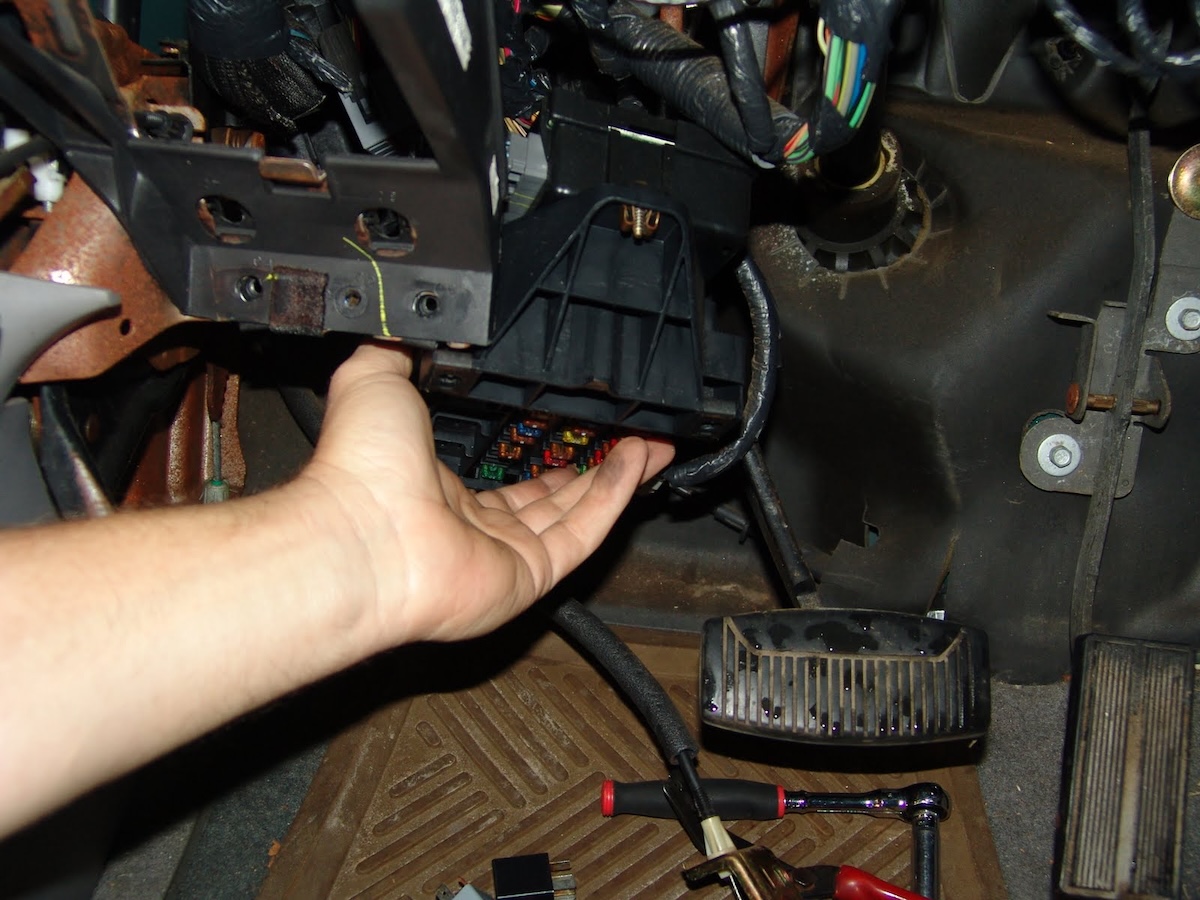
On many relevant Ford models, the GEM is mounted to or near the interior fuse box, often on its upper or back side. Some versions are attached with three screws, but the exact position and fastening method vary by vehicle. Check the service information for your Ford before removing trim or reaching behind the fuse panel.
On some layouts, the fuse box and GEM are removed together as an assembly. The back of the fuse box may have two large bulkhead connectors held in place with retaining bolts, and smaller connectors may attach at the side of the module. Some versions use a 10 mm-headed bolt at the large connectors, but don’t assume every Ford has the same fasteners.
If you’re checking the module yourself, work slowly and take photos before disconnecting anything. Follow the battery-disconnection procedure in the owner’s or service manual, and don’t unplug connectors while the circuit is powered. There may be airbag wiring or other sensitive components nearby, so don’t probe connectors you can’t identify.
- Confirm the location first. Use vehicle-specific service information instead of removing panels based on a general guide.
- Isolate power as directed. Follow the manual’s battery procedure and any required waiting period before working near electrical connectors.
- Remove trim and retainers carefully. Avoid pulling on the fuse box or using force against wiring and plastic clips.
- Release the connectors correctly. Remove any retaining bolts or locks as designed. Don’t twist or pry a connector loose by its wires.
- Inspect the terminals and surrounding plastic. Look around the large bulkhead connectors, the shielded part of the fuse box, and the outer edges of the pins.
- Stop if you find damage. Corroded, burnt, loose, or bent terminals need proper assessment before the assembly goes back in.
The original inspection approach calls for checking around the bulkhead connectors and beneath the plastic guard, including the outer pin areas. A clean brush may help remove light surface debris after the circuit has been safely isolated, but aggressive scraping can damage terminals. Green or white corrosion, burnt plastic, or loose pins call for more than a quick brush-off.
If a connector is difficult to remove, don’t force it. A broken locking tab can leave the connector loose when it’s reinstalled, creating another intermittent fault. For many owners, visual inspection and a clear description of the symptoms are as far as a safe driveway check should go.
Does a replacement GEM need programming?
It may. Ford service procedures can require a replacement GEM to be programmed or configured for the vehicle before it works correctly. The exact requirement depends on the model and year, so don’t assume a replacement module can simply be plugged in and used.
A Ford dealer or a qualified shop with compatible equipment can check whether the vehicle needs programming after installation. The shop may also need to confirm that the replacement part matches the vehicle’s setup. A used or incorrect module can create extra problems if it isn’t suitable or can’t be configured for that car.
Programming is different from clearing a fault code or disconnecting the battery. Removing battery power may reset some temporary electrical behavior, but it won’t repair a shorted wire, damaged connector, or failed module. If the original problem returns, the fault still needs to be diagnosed.
Before approving replacement, ask whether the shop tested the module’s power, ground, inputs, and outputs. Also ask whether the quoted job includes programming or configuration. That conversation is especially worthwhile if the symptoms are intermittent or the module has already been replaced once.
What a Ford GEM repair may cost
A GEM repair or replacement can cost more than $300, depending on the vehicle, the fault, the part, labor, and any programming required. Treat that figure as a broad estimate, not a fixed price for every Ford. A wiring or fuse fault may call for a different repair than a confirmed module failure.
The total can change if the fuse box has to be removed, a connector needs repair, or the shop has to spend time tracking an intermittent battery drain. The cost can also depend on whether the correct module is available and whether it needs vehicle-specific configuration. Ask for an estimate after diagnosis rather than comparing prices for a part alone.
Diagnostic time can be short when there’s an obvious loose connection or damaged fuse. An intermittent fault can take longer because the technician may need to wait for the symptom to return or isolate a drain across several circuits. That’s not wasted work; it’s how the shop avoids putting an expensive module in a car that still has the same fault.
When you review the estimate, ask what test confirmed the GEM was faulty and whether the price includes diagnosis, installation, and programming. If the shop found corrosion, ask whether it’s limited to cleaning or whether the connector itself is damaged. A clear explanation is a good sign that the repair is based on evidence.
When a GEM problem makes the car unsafe to drive
A failed radio or power window may be inconvenient, but dead wipers, exterior lights, or turn signals can make the car unsafe in poor weather or at night. Don’t drive in rain if the wipers aren’t reliable, and don’t head out after dark if required lighting isn’t working. Arrange a repair or tow if you can’t use the vehicle safely.
If you hear sizzling, see smoke, smell burning insulation, or the starter engages unexpectedly, stop using the vehicle and get professional help. Electrical problems can worsen if you keep operating the affected circuit. Don’t leave a repeated fuse failure to deal with later.
If the only symptom is a dead battery, a jump-start may get the car going, but it won’t identify the drain. If the battery goes flat again, have the charging system and parked-current draw checked. Repeatedly jump-starting the car without finding the cause can leave you stranded and may put extra strain on the battery.
Mistakes that can turn a small fault into a bigger repair
- Replacing the GEM based on one symptom. A bad wiper motor or switch can stop the wipers without any module failure.
- Assuming every electrical problem is connected. Several faults may happen together, but each circuit still needs to be tested.
- Installing a larger fuse. The fuse protects the wiring. A higher-rated fuse can allow a short to overheat the circuit.
- Unplugging the module with power connected. Follow the vehicle’s service procedure before disconnecting electrical components.
- Cleaning corroded pins aggressively. Bent or damaged terminals can make an intermittent connection worse.
- Buying a used module before checking programming needs. Confirm the part and configuration requirements for your exact Ford first.
- Ignoring a battery drain because the car still starts. The next start may be the one that doesn’t happen.
Keep the old repair invoice and make a quick symptom log if the fault comes and goes. Note the date, weather, battery condition, warning lights, and which accessories were affected. A few accurate details can save diagnostic time, especially when the car behaves normally at the shop.
Questions Ford owners ask about GEM faults
Can a bad GEM stop the engine from starting?
It can contribute to a no-start on a vehicle where the module is involved in the relevant power or control circuits. But a no-start can also come from the battery, starter, ignition, fuel system, wiring, or another control module. Tell the mechanic whether the engine cranks, because that separates two different kinds of starting problems.
Will a bad GEM make the check engine light come on?
It may be associated with warning lights or stored faults, but a check engine light doesn’t identify the GEM as the failed part. A basic reader may show engine-related information without reading all body-system faults. Use a scan tool that can access the systems fitted to your Ford, then confirm the fault with circuit tests.
Does a bad GEM always drain the battery?
No. A battery drain is one possible symptom if a circuit remains active, but a weak battery, charging fault, stuck relay, or added accessory can do the same thing. A parasitic-draw test is the way to find which circuit is using power while the vehicle is parked.
Can a GEM problem affect the air conditioner?
Electrical symptoms can overlap, but an air-conditioning fault alone doesn’t prove the GEM is bad. The HVAC controls and related electrical circuits vary by model, and the problem could be a fuse, control, sensor, wiring, or another component. Have the actual circuit tested before replacing a module.
Can I reset the GEM by disconnecting the battery?
Disconnecting the battery may clear a temporary electrical glitch on some vehicles, but it won’t fix a damaged connector, short, or failed module. It can also reset other settings, so follow the owner’s manual. If the same symptom returns, stop relying on resets and get the fault diagnosed.
What I’d check first in the shop
I’d start by confirming the Ford’s model and year, then checking the battery, terminals, grounds, and the fuses for the affected circuits. Next, I’d look for corrosion or loose connections and scan the body systems with equipment that can communicate with the vehicle’s modules. Only after those checks would I condemn the GEM.
You can safely record symptoms and inspect for an obviously blown fuse or visible connector damage if you know what you’re looking at. Leave module removal, wiring tests, and programming to a technician if you’re unsure. The main takeaway is simple: a GEM can cause several strange electrical problems, but test the power, wiring, and affected circuits before replacing it.