
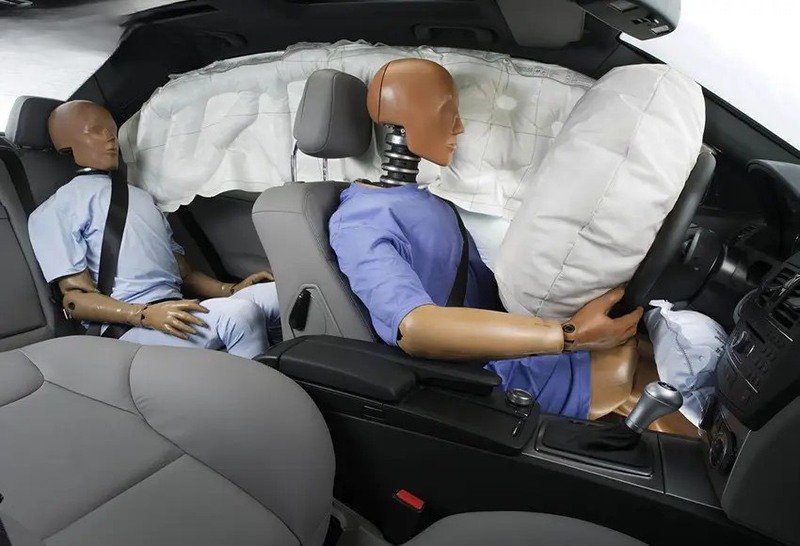
Most drivers never think about their airbags until the moment they need them. That split second usually lasts less time than it takes to finish this sentence, which is exactly the point. Airbags exist to buy you time your body simply does not have during a crash.
Here is something that tends to catch people off guard: airbags inflate in about one-twentieth of a second after a crash sensor registers an impact. Blink your eyes right now. That took longer than a full airbag deployment.
An airbag goes from a folded packet in your steering wheel to a fully inflated cushion in roughly 1/20th of a second. That speed is not an accident of engineering. It is the entire point.
But speed alone does not tell the whole story. Whether an airbag fires at all depends on the type of crash, how hard you hit, and whether you had your seatbelt buckled. Frontal airbags generally need an impact equivalent to smacking a solid barrier at somewhere between 8 and 14 mph before they trigger, though that number moves around depending on restraint use.
Drivers who skip the seatbelt can see airbags fire at speeds as low as 10 to 12 mph, while side airbags follow a different rulebook entirely. Those deploy around 18 mph for wide-object impacts, but drop to just 8 mph for narrow-object crashes, like clipping a pole.
Once you understand these thresholds, your car’s safety system stops feeling like a mystery box and starts making a lot more sense.
The National Highway Traffic Safety Administration puts frontal airbag deployment in the range of hitting a parked car at 16 to 28 mph or higher. That range exists because engineers calibrate these systems to fire only when the crash is genuinely dangerous, not every time you tap a curb too hard.
What Actually Tells Your Airbags to Fire
Airbags do not deploy just because your car got hit. They deploy when onboard sensors decide the hit was bad enough to warrant it. Those sensors are mostly watching for one thing: how fast your vehicle is decelerating.
A sudden, violent slowdown tells the system something serious just happened. A gradual one does not.
For front airbags specifically, deployment usually kicks in during moderate to severe frontal or near-frontal collisions. The exact trigger point shifts depending on whether the seatbelt is doing its job.
- Drivers with no seatbelt on may see airbags fire at speeds as low as 10-12 mph
- Belted occupants typically need closer to 16 mph before deployment happens
A handful of variables decide whether your airbags go off in any given crash:
- Direction of impact (frontal, side, or rear)
- How severe the collision actually is
- How quickly the vehicle decelerates
- Whether occupants are wearing seatbelts
- The specific make and model of the vehicle
Modern crash sensors are surprisingly good at telling the difference between a minor bump and a genuine emergency. A shopping cart dent in a parking lot will not trigger anything. Slam into a concrete barrier at the same low speed, though, and the airbags might still fire, because the deceleration rate is completely different even if the speedometer reading looks similar.
Plenty of vehicles run multiple crash sensors scattered around the frame, each one watching for impacts from a different angle. Once any of them registers a hit that clears the deployment threshold, an electrical signal races out and starts the inflation sequence.
There is also a diagnostic module running quietly in the background, constantly checking that the whole airbag system is healthy. If something is off, that is when you see the airbag warning light pop up on your dash. Do not ignore that light. It is the one warning that could mean the difference between protection and a system that fails silently.
Just How Fast Is “Fast” When an Airbag Fires
The numbers here are genuinely wild. An airbag inflates in approximately 1/20th of a second. That is not marketing language. That is the literal, measured deployment time engineers design toward.
In the real world, that translates to somewhere between 20 and 30 milliseconds from the moment impact is detected to full inflation. Compare that to a human eye blink, which takes 100 to 400 milliseconds, and the airbag wins by a wide margin.
| Event | Approximate Time |
|---|---|
| Crash sensors detect impact | 0 to 5 milliseconds |
| Signal sent to inflator | 5 to 10 milliseconds |
| Chemical reaction fills the bag with gas | 10 to 30 milliseconds |
| Airbag begins deflating (it is not meant to stay full) | Within 1 to 2 seconds |
| Human eye blink, for comparison | 100 to 400 milliseconds |
Every airbag in the vehicle, whether it sits in the steering wheel, the dashboard, the seat, or the roof rail, is engineered to hit that same tight window. There is no version of this system that fires slowly and still works.
It helps to separate two very different numbers that often get mixed up: the speed at which the airbag physically inflates, and the crash speed needed to trigger deployment in the first place. Those are not the same measurement, and confusing them leads to a lot of the myths floating around online.
Deployment Thresholds Depend on More Than Just Speed
| Scenario | Approximate Trigger Speed |
|---|---|
| Belted occupant, frontal crash | Higher threshold, varies by manufacturer |
| Unbelted occupant, frontal crash | 10-12 mph |
| Side impact, wide object | 18 mph |
| Side impact, narrow object (pole, tree) | 8 mph |
Since a seatbelt already handles most of the restraint work, vehicles calibrate a higher airbag threshold for belted passengers. Skip the belt, and the system compensates by lowering that threshold, because the airbag is now doing more of the heavy lifting on its own.
You will also find claims floating around that airbags are tuned for impacts roughly equivalent to a 35 mph crash. That number is not wrong exactly, it just depends heavily on the manufacturer, the model year, and the specific crash sensor calibration used in that vehicle.
Why Milliseconds Actually Decide Whether You Walk Away
Here is the part that makes airbag engineering genuinely impressive. The system has to deploy within that 20 to 30 millisecond window, no earlier and no later, because the physics of a crash do not leave any room for error.
Your car’s sensors catch the collision, the control unit crunches that data almost instantly, and the airbag fires before you have even fully registered that you are in a wreck. That timing is not a happy coincidence. It is precision engineering built around one unavoidable law of physics: an object in motion stays in motion until something stops it.
When your car slams into something and stops abruptly, your body does not stop with it. It keeps moving forward at whatever speed you were traveling, right up until something, ideally an airbag and not the steering column, gets in the way.
Skip the airbag entirely, and your body reaches the steering wheel, dashboard, or windshield unprotected. That is the scenario airbags exist to prevent.
To close that gap in time, airbags inflate at speeds approaching 200 mph. That sounds almost violent on paper, and honestly, it kind of is. But that velocity is exactly what is needed to get a cushion in place before your forehead or chest reaches something hard.
A few reasons this timing matters so much:
- Your body accelerates toward the point of impact faster than most people realize
- Brain and organ trauma can happen within milliseconds of a hard stop
- The usable “survival space” inside the cabin shrinks rapidly during a crash
- Protection has to already be in place before contact, not arriving after the fact
Think of it like trying to catch a dropped phone before it hits tile. Wait even a fraction of a second too long and it is already too late. Airbags cannot afford to be late, but they also cannot fire too early or too aggressively, because the deployment itself carries enough force to cause injury if the timing or positioning is off.
That balancing act, fast enough to matter but controlled enough to avoid causing harm, is arguably one of the more underrated feats of automotive engineering on the road today.
What Airbag Deployment Actually Looks Like in a Real Crash
Numbers on a spec sheet are one thing. Seeing how this plays out in an actual collision is where it clicks. Deployment generally happens within that same 20 to 30 millisecond window after impact, with the bag itself expanding at somewhere between 100 and 200 mph and up to 5 PSI of pressure behind it.
That force can sound alarming out of context. In practice, the airbag’s whole job is to put something soft between you and everything else in the cabin that is decidedly not soft.
Take an unbelted driver in a frontal crash. Front airbags typically fire once the impact is equivalent to hitting a rigid wall at 10 to 12 mph. Buckle up, and that threshold shifts, because now the airbag and seatbelt are sharing the workload instead of the airbag doing it alone.
This next part trips a lot of people up: airbag deployment is triggered by deceleration force, not raw speed. A crash into a concrete wall at 30 mph can generate more violent deceleration than a 50 mph collision with another vehicle, especially if that other vehicle absorbs some of the energy or the impact is a glancing blow rather than a direct hit.
A Few Everyday Scenarios Worth Knowing
- Parking lot fender bender at 5 mph: Airbags almost certainly stay dormant. The deceleration simply is not violent enough.
- Rear-ending a stopped car at 20 mph: Front airbags typically will not fire, since they are calibrated for frontal impacts hitting the front of your car, not what happens to the driver from behind.
- Clipping a guardrail at an angle at 25 mph: Side curtain airbags may deploy depending on the angle and how directly the impact hits the door structure.
- Hitting a deer head-on at 45 mph: Front airbags will very likely deploy, since the sudden stop generates enough deceleration force regardless of what you hit.
Modern cars pack several airbags into different spots around the cabin, each one tuned for a different kind of impact:
- Front airbags (driver and front passenger)
- Side-impact airbags built into the seats or doors
- Curtain airbags that drop down from the roofline
- Knee airbags positioned below the dashboard
Even with all these variations, the entire deployment sequence for a frontal impact wraps up in 15 to 50 milliseconds. Faster than a blink, faster than a flinch, faster than your brain can even process what is happening.
Airbag Myths That Refuse to Die
A lot of misinformation floats around about how airbags actually work, and some of it can genuinely put people at risk if they believe it. Let us clear a few things up.
| Myth | Reality |
|---|---|
| Airbags deploy in every crash, big or small | They typically only trigger in collisions exceeding roughly 10 mph, and the exact threshold depends on impact direction and severity |
| Airbags alone are enough protection, seatbelts are optional | Airbags are a supplemental restraint system, designed to work with a seatbelt, not instead of one |
| Sitting close to the wheel does not matter | Distance matters a great deal, since deployment force can cause injury at close range |
| Kids are fine in the front seat if they are tall enough | Children under 13 should stay out of the front seat regardless of height, due to deployment force |
Seating position genuinely matters more than most drivers assume. Aim for at least 10 inches of clearance between your chest and the steering wheel. That buffer gives the airbag room to fully inflate before making contact, rather than slamming into you mid-deployment.
Children under 13 belong in the back seat, full stop. Their smaller frames and still-developing bones are not built to absorb the force of a deploying airbag safely, even a well-functioning one doing exactly what it is supposed to do.
It is also worth remembering that most modern vehicles carry far more than a single airbag. Side, knee, and curtain airbags each get calibrated for specific angles and speeds, which is part of why a crash from one direction might trigger a completely different set of airbags than a crash from another.
Above all, treat airbags as a backup system, not a primary one. Seatbelts remain your first line of defense. Skip the belt, and you are not just risking injury from the crash itself, you are also changing how and when your airbags are designed to respond.
Keeping This System Ready for the Day You Hope Never Comes
An airbag system only works if it is actually maintained. That warning light on your dashboard exists for a reason, and it is not one to shrug off.
If that airbag light comes on, get it checked by a qualified technician as soon as possible. It could be something minor, like a loose connector under a seat, or it could mean a sensor has failed and the system will not deploy at all when you need it most.
A few other things worth knowing about keeping your airbag system in working order:
- Airbags that have deployed once cannot be reused. The entire module, sometimes along with the steering wheel or dashboard panel, needs replacement after a deployment.
- Aftermarket seat covers or steering wheel modifications can interfere with sensors if installed incorrectly, so stick with shops familiar with your specific model.
- Used vehicles should always get a pre-purchase inspection that includes airbag system diagnostics, since some sellers disable warning lights instead of fixing the underlying issue.
- Airbag control modules typically get recorded crash data (similar to a black box), which shops use to verify whether the system fired correctly after an accident.
None of this is expensive or complicated to check. A quick diagnostic scan at most repair shops will tell you whether your airbag system is functioning as designed. Skipping that check because everything “feels fine” is exactly the kind of decision that turns a survivable crash into something much worse.
Your airbags will only get one shot to do their job correctly, and it happens in less time than it takes to say the word “crash.” Make sure that when the moment comes, the system behind that dashboard light is actually ready for it.