
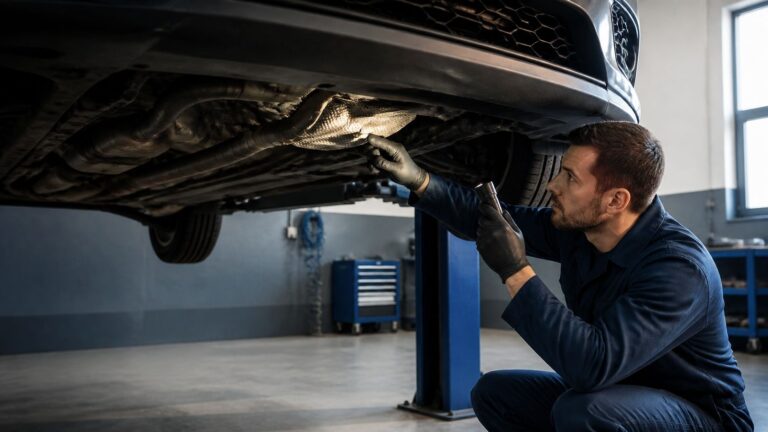
I had a guy pull into the shop convinced his transmission was falling apart because of a rattle that only showed up creeping through a parking lot at 5 mph. Turned out to be a $30 exhaust hanger that had rusted through. He’d been living with that noise for two months, dreading a transmission bill, over a part that took fifteen minutes to swap.
That’s the thing about rattles at low speed. They sound scarier than they usually are, but they’re also not something to just tune out and live with. A rattle means something is loose, broken, or wearing out, and at low speed you’re actually hearing it more clearly because road noise and wind noise aren’t drowning it out the way they do at highway speed. Let’s go through the actual causes, roughly in order of how often I see them, what they sound like, and what they cost to fix.
Loose exhaust hangers and clamps
This is the most common rattle I run into, and it’s almost always worse at low speed and idle because that’s when engine vibration has the most opportunity to shake a loosely hanging exhaust pipe against the chassis or heat shields.
Your exhaust system hangs underneath the car on rubber hangers and metal clamps, and because it’s constantly exposed to road spray, salt, mud, and moisture, those hangers corrode faster than almost anything else on the underside of the vehicle. Once a hanger rots through or a clamp loosens, part of the exhaust system starts swinging free, and every engine vibration translates into a rattle against the floor pan, heat shield, or subframe.
The sound usually starts mild, a faint tink-tink at idle or low speed, and gets louder as the metal fatigues further or the hanger finally gives way completely. I’ve had customers tell me they started avoiding driving the car in to work because the rattle got embarrassing before they finally brought it in.
Fix and cost: replacing a defective hanger runs around $30 for the part, with labor adding up to roughly $120 depending on how accessible it is and what else needs to come off to reach it. While you’re under there, have the rest of the exhaust system checked, a hanger rarely fails in isolation, and nearby clamps or hangers are often close behind it.
A catalytic converter breaking apart internally
This one has a distinctive sound once you’ve heard it: it sounds like marbles or gravel shaking around inside a can, especially noticeable at low speed and idle when there’s less background noise to mask it.
Catalytic converters contain a ceramic honeycomb substrate coated in precious metals that does the actual emissions conversion work. That substrate can crack or crumble due to overheating or physical impact, like hitting a curb, a pothole, or road debris hard enough to shock the housing. Once it’s cracked, loose fragments rattle around inside the converter housing every time the car moves.
Catalytic converters don’t fail often on their own without a root cause, overheating usually traces back to a misfire dumping unburned fuel into the exhaust, or a failing oxygen sensor throwing off the air-fuel mixture long enough to cook the converter. That’s why I always tell customers: before you replace a cracked converter, figure out what killed it, otherwise you’re just setting up the replacement to fail the same way.
Fix and cost: replacement itself is usually quick once you’re actually doing it, but the cost varies a lot depending on your car’s make and model since converter pricing is tied heavily to the precious metal content and how the unit is integrated into your specific exhaust design. Get a quote specific to your vehicle rather than assuming a flat number.
A heat shield that’s rusted loose
Heat shields are the thin metal panels wrapped around sections of your exhaust system, there to keep exhaust heat away from nearby components, wiring, and the car’s floor. They take a beating from road spray and mud, and because they’re thin sheet metal, they rust through faster than heavier exhaust components around them.
Once rust eats through the weld points holding a heat shield in place, the shield starts vibrating loose and rattling against the exhaust pipe or nearby chassis parts. This is a noise that tends to change pitch or intensity with engine RPM rather than staying constant, since it’s directly tied to exhaust vibration.
Fix and cost: if the rust damage is mild, a mechanic can often just reweld the loose joint back into place. If rust has eaten too deep into the metal to weld reliably, you’re looking at a full shield replacement, which runs around $160 for the part, with labor cost depending on the shop you use.
Loose brake hardware
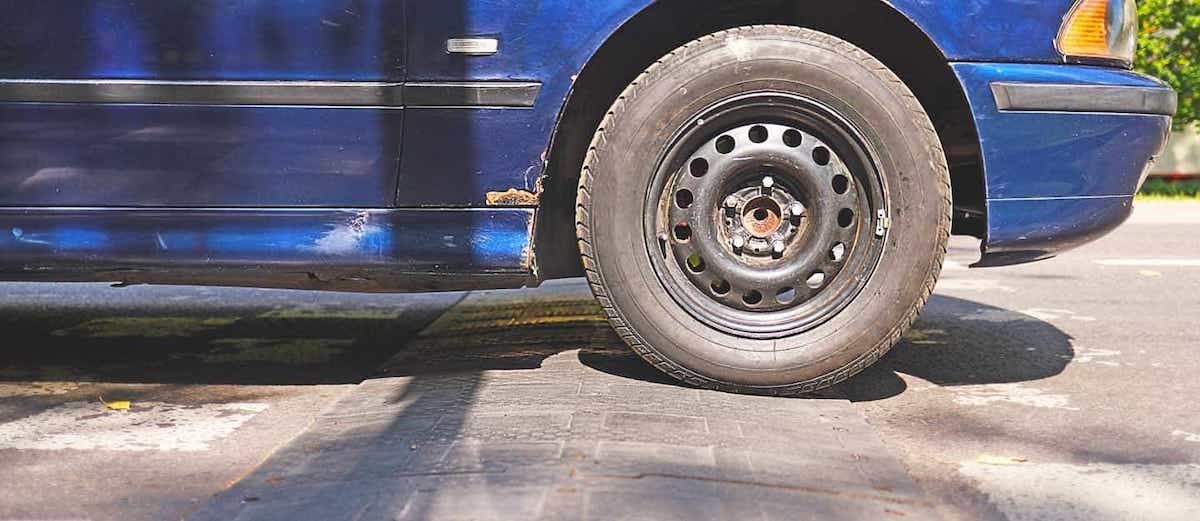
Braking puts a lot of repeated stress and vibration through a system made up of multiple small components, clips, pins, pads, and hardware, that all need to stay properly seated. If any one piece is fitted loosely, it doesn’t take many stops before it starts working itself free enough to rattle.
This kind of rattle often shows up more when you’re braking at low speed or rolling over small bumps, since that’s when the loose hardware has room to shift and knock against the caliper or rotor.
Fix and cost: your mechanic can usually install anti-rattle clips to secure the hardware back down, and these parts are cheap, you’re mostly paying for labor time. If the underlying components have worn down too far for a clip to hold properly, you may need actual replacement brake hardware or pads instead.
Low oil pressure acting up at idle and low speed
If the rattle is coming specifically from the engine area and sounds more like a light ticking or tapping than a clank, check your oil level before anything else. When oil pressure drops, hydraulic valve lifters can’t maintain the proper clearance they need, and they start making noise as a result.
This noise tends to be subtle rather than dramatic, the kind of thing you notice more at idle or crawling along in traffic because there’s less going on around you to drown it out. It’s easy to miss at first, which is exactly why it tends to get worse before people bring it in.
Fix and cost: top off the oil to the proper level and figure out why it was low in the first place, whether that’s a leak somewhere or the engine burning oil internally. Ignoring this one is riskier than most other rattles on this list, since running an engine low on oil pressure for an extended period risks real wear damage to the valvetrain and bearings, not just an annoying noise.
Piston slap on an older or higher-mileage engine

This one mostly shows up on older vehicles with a fair number of miles. Over time, the piston and cylinder wall can wear enough that the piston no longer fits the bore as snugly as it did when new, and it slaps slightly against the cylinder wall during certain phases of the combustion cycle.
The telltale pattern here is that the noise is most noticeable right after a cold start and quiets down noticeably as the engine warms up and the piston expands to fit the bore more closely again. If your rattle follows that specific pattern, cold and loud, warm and quiet, piston slap is a reasonable suspect.
Fix and cost: the honest answer is that piston slap typically doesn’t cause significant additional engine damage on its own, and fixing it properly means replacing the piston and cylinder, which is genuinely expensive. For most daily drivers, especially older vehicles where this shows up, the repair cost usually isn’t worth it relative to what the car’s worth. I’d keep an eye on oil consumption and overall engine performance rather than rushing into an expensive piston job for noise alone.
A quick reference for narrowing it down by sound and location
| Symptom | Likely cause | Typical cost |
|---|---|---|
| Mild tink-tink that gets louder with acceleration | Loose exhaust hanger or clamp | ~$30 part, up to $120 labor |
| Sounds like marbles or gravel in a can | Cracked catalytic converter substrate | Varies by make/model |
| Rattle that changes with RPM, from under the car | Rusted heat shield | ~$160 part plus labor |
| Rattle during braking or over small bumps | Loose brake hardware | Low cost, mostly labor for anti-rattle clips |
| Light ticking from the engine, worse at idle | Low oil pressure affecting valve lifters | Cost of oil top-off plus fixing the leak/burn source |
| Rattle on cold start, quiets as engine warms | Piston slap (older/high-mileage engines) | High if repaired, often not worth it |
Is it safe to keep driving with a rattle?
Any rattle, whether it’s coming from the hood or the rear of the car, is telling you something is loose or failing. That doesn’t mean every rattle demands you pull over immediately, but it does mean you shouldn’t just get used to it and ignore it indefinitely, which is a trap a lot of drivers fall into once a noise becomes familiar.
A loose exhaust hanger isn’t going to strand you on the way to a meeting, so no, you don’t need to cancel your morning because of it. But understanding roughly what’s causing the noise gives you the information you need to decide whether this is a “get it looked at this week” situation or a “pull over now” situation. Low oil pressure and anything affecting your brakes lean toward the more urgent end of that scale. A loose heat shield or exhaust hanger is annoying but rarely dangerous in the short term.
Why the front of the car specifically rattles
Front-end rattles often trace back to brake components, since that’s where a lot of hardware lives up front, calipers, pads, hardware clips, and mounting bolts that can work loose over time. If you’re hearing the rattle specifically from the front wheels, especially when braking, loose brake hardware is the first thing I’d check.
Why the rear of the car specifically rattles
The exhaust hanger located toward the rear of the car is one of the most common sources of rear rattling, mainly because of its exposed location underneath the vehicle where it takes the brunt of road spray, salt, and moisture exposure. It’s genuinely not unusual to replace a rear exhaust hanger more than once over a five year span, especially if you live somewhere that salts the roads in winter.
Can low oil actually cause a rattle?
Yes, and the mechanism is straightforward. Your engine’s oil pump pushes lubricating oil through passages to all the moving parts that need it. If the oil level drops too low, whether from a leak or the engine burning it off internally, the pump can start drawing in air instead of a solid stream of oil.
Once air gets into the system instead of oil, lubrication at components like the hydraulic valve lifters suffers immediately, and that’s when you start hearing a rattling or tapping noise from the engine. Left unaddressed, this isn’t just a noise problem, insufficient lubrication accelerates wear on parts that are expensive to replace.
Common mistakes I see with rattle diagnosis
- Assuming every rattle is “just the exhaust” without actually checking, when it’s sometimes something more urgent like a cracked converter or loose brake hardware.
- Replacing a cracked catalytic converter without tracing the root cause first, then watching the new one fail the same way a year later.
- Letting oil level run low for months because the rattle is quiet and only noticeable at idle, until it turns into a bigger lifter or bearing problem.
- Chasing an expensive piston slap repair on an older car where the noise isn’t actually causing meaningful damage.
- Ignoring a rattle because it’s been there “for a while now” and nothing bad has happened yet, that’s not evidence it’s harmless, just evidence it hasn’t failed completely yet.
DIY versus taking it to a shop
Checking your oil level and topping it off is something every driver can and should do themselves, it takes five minutes and costs nothing beyond a bottle of the correct oil. Same goes for a basic visual inspection underneath the car with a flashlight, you can often spot a disconnected hanger or a visibly rusted-through heat shield without any special tools.
Actual repair work, welding a heat shield joint, replacing an exhaust hanger in a tight spot, diagnosing and replacing a catalytic converter, or installing brake hardware correctly, is shop territory for most people. None of these jobs are exotic, but they typically require lifting the car safely and having the right tools on hand, and brake work specifically isn’t something I’d recommend guessing your way through.
My take: if the rattle is mild and you’ve confirmed your oil level is fine, it’s reasonable to drive it to a shop rather than treating it as an emergency. If the rattle is coming from the brakes, or you’ve confirmed low oil pressure is the cause, get it looked at sooner rather than later. Either way, don’t let a cheap fix like a $30 hanger turn into a bigger bill just because the noise became background noise you learned to live with.