
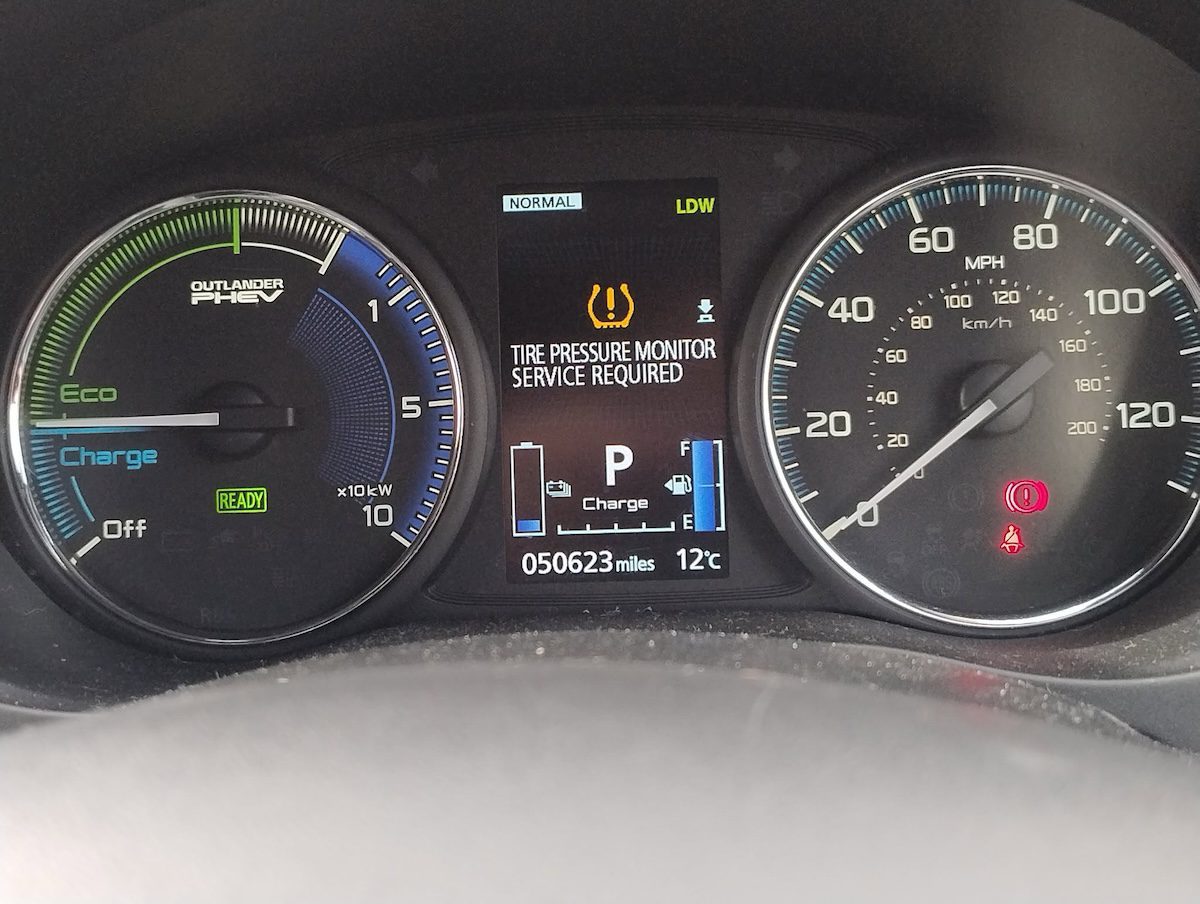
You are sitting in the drive, coffee in hand, and the Outlander throws a message at you that was not there yesterday. TPMS Service Required. You walk around the truck, kick a couple of tires, and nothing looks flat. So you get in and drive off, hoping it goes away on its own.
Sometimes it does go away. Most of the time it does not, and the reason is that this particular message is not complaining about your air. It is complaining about the monitoring hardware itself. That is a different problem with a different fix, and the two get mixed up constantly.
I have been turning wrenches on Mitsubishi SUVs long enough to know exactly how this one plays out. The owner ignores the message for three weeks, then the tire shop quotes them four new sensors and a module, and now everybody is angry. This guide is here to keep you out of that conversation.
Below you will find what the message really means, how the Outlander system is wired together, the seven causes ranked by how often I actually see them, the reset procedures by model year, and what a fair repair should cost you. Grab a gauge and follow along.
What “TPMS Service Required” Actually Means on Your Outlander
Here is the single most useful thing you can take from this page. The Tire Pressure Monitoring System in your Outlander has two separate jobs, and it has two separate ways of yelling at you about them.
Job one is watching your air pressure. When a tire drops well below the number on your door placard, you get the low pressure telltale, the little horseshoe with an exclamation mark in the middle of it. Job two is watching itself. When the car cannot hear from one of its sensors, or the data coming back makes no sense, you get a malfunction warning. On the Outlander that malfunction warning shows up in the multi information display as TPMS Service Required or, on some model years and some markets, Tire Pressure Monitor Service Required.
So the message is the car telling you that its own early warning system has gone partly blind. Your tires might be perfectly fine right now. The problem is that if one of them starts losing air next Tuesday, the car may not be able to tell you.
That distinction changes how you should react. A low pressure light means stop and add air today. A service message means you can drive, but you should check your pressures by hand until the fault is cleared, and you should not put the repair off for months. Federal rules back this up. Under FMVSS 138, a TPMS must have both a low pressure warning and a separate malfunction indication, and the malfunction lamp typically flashes for about a minute at startup before staying lit. The Outlander follows that same pattern, and the owner forum threads are full of people who never made the connection.
Two Warnings, Two Completely Different Problems
Let me put the two side by side, because once you can tell them apart you will never waste money on the wrong repair again.
| What you see | What the car is saying | How fast you need to act | Usual fix |
|---|---|---|---|
| Solid TPMS warning lamp, horseshoe with the exclamation mark | One or more tires are significantly under inflated | Right now, before your next long drive | Inflate to the placard pressure, cold |
| Lamp flashes for roughly 60 to 90 seconds at startup, then stays solid | The monitoring system itself has a fault | Within a week or two | Diagnose the sensor, then reset or replace |
| “TPMS Service Required” text in the driver display | Same idea as the flash, delivered as a message instead of a lamp | Within a week or two | Scan for the code, find the dead corner, repair it |
| Message appears and disappears on its own | A marginal sensor, a weak vehicle battery, cold weather, or radio interference | Track it for a few days before spending money | Often clears once the underlying condition passes |
One more detail worth knowing. On Outlanders with the tire pressure readout in the cluster or on the smartphone link display, you can often see which corner has gone quiet. If three wheels are showing numbers and the fourth shows dashes or a blank, you have just saved yourself an hour of diagnosis. Write down what you see before you call anybody.
What Is Actually Inside Your Outlander Tire Pressure System
You cannot fix what you cannot picture. The Outlander uses a direct TPMS, which is the type with real pressure sensors living inside each wheel. That matters, because the other type, called indirect TPMS, borrows wheel speed data from the anti lock brakes and has no sensors at all. Mitsubishi went with the direct setup, so there is hardware in your wheels that can and eventually will fail.
The Five Parts That Make It Work
- The transmitters. One per monitored wheel, bolted or snapped into the valve stem hole. Each one holds a pressure sensor, a temperature sensor, an accelerometer, a microchip with a unique ID, and a sealed lithium battery. On most Outlanders these units transmit at 315 MHz in North America and 433 MHz in European and Asian markets, so a part bought for the wrong region will simply never talk to the car.
- The receiver. On the Outlander the TPMS receiving function is bundled into the Keyless Operation System ECU, what the service manual calls the KOS-ECU. On other Mitsubishi platforms it lives in the ETACS-ECU. Either way, there is no separate black box hiding under the carpet that you can swap for a hundred bucks, which is worth knowing before a shop suggests it.
- The data bus. The receiver hands the information to the rest of the car over the CAN network. That is why a corroded ground or a chafed harness can produce a TPMS complaint that has nothing to do with tires.
- The telltale and the display. The lamp in the instrument cluster plus the text messages in the driver information display.
- The scan tool interface. The diagnostic port under the dash. This is where the sensor ID registration happens, and on newer trucks it is the only way in.
How the Car Decides Something Is Wrong
The sensors do not scream constantly. That would kill the batteries in a month. Instead each transmitter wakes up on a schedule, sends a short packet with its ID, the pressure, the temperature, and a battery status flag, then goes back to sleep. When you are driving, packets go out much more often. When the car is parked, the interval stretches out to save power.
The KOS-ECU keeps a list of the sensor IDs it expects to hear. If one of those IDs goes silent for long enough, or if a sensor reports that its internal battery voltage has sagged below the threshold, the module sets a diagnostic trouble code and requests the malfunction warning. Mitsubishi service information groups these under the Wireless Control Module diagnosis, and the most common entry is a low battery voltage signal from the transmitter.
Read that again if you own a truck that is more than six years old. The most common single cause of this message is a battery that has quietly died inside a sealed sensor. There is no serviceable cell in there. When it goes, the whole transmitter goes with it.
Factory Sensors Versus the Aftermarket Ones
Two families of replacement parts show up in Outlander wheels. Original equipment sensors are the direct match, usually pre programmed with the right protocol, and they just need to be registered to the vehicle. Universal programmable sensors from brands like Schrader, Autel, Continental, and Huf arrive blank. The shop writes your vehicle profile into them with a TPMS tool, then registers them the same way.
Both work when installed properly. Where people get burned is the valve stem hardware. The Outlander transmitter seats against a rubber grommet or a metal stem with a locking engagement. A forum member with an Outlander PHEV tracked his own intermittent warning to a non factory valve fitted during a puncture repair, and the difference was obvious once the parts were laid side by side. The genuine stem clicks into the sensor and will not pull back out without pressing the release. The generic one slid in and slowly worked loose over months of bumps.
That is a twenty dollar part causing a two hundred dollar diagnosis. Ask your tire shop what stem kit they are using before they mount anything.
Know Your Numbers Before You Touch Anything
Every repair step in this article depends on one thing: getting the tires to the correct cold pressure first. Resetting a TPMS on a tire that is four pounds low is like resetting a smoke alarm while the toast is still burning.
The authority for your specific truck is the placard on the driver side door jamb, sometimes on the door post or inside the fuel filler flap, plus the tire and loading section of the owner manual. The number stamped on the tire sidewall is the maximum the tire can hold, not a target, and inflating to that figure is one of the most common mistakes I see at the air pump.
| Outlander generation | Typical tire sizes | Typical cold pressure, front and rear | Notes |
|---|---|---|---|
| 2007 to 2013 | 215/70R16, 225/55R18 | 32 to 33 psi | Higher figure on some 18 inch builds and when loaded |
| 2014 to 2021 | 225/55R18 | 35 psi | Most common Outlander spec in North America |
| 2022 and newer | 255/45R20, 235/60R18 | 33 to 36 psi | Split by wheel size and load, check the placard |
| Outlander PHEV | 225/55R18 | 35 to 36 psi | Heavier curb weight, do not run it soft |
| Compact temporary spare, if fitted | T155/90D16 style | 60 psi | Checked twice a year even if never used |
Those figures are the general ranges published by tire pressure references and by Mitsubishi placards. Your truck may differ by a pound or two depending on trim, tire size, and market, and the placard always wins. One practical note from the tire data sites: if you must add air to a tire that is warm from driving, add about 2 psi above the cold spec, then recheck in the morning.
The First Ten Minutes: Check These Before You Spend a Dollar
Do not book a shop yet. Run this short list in order. It solves maybe a third of the cases outright, and in the rest of the cases it hands you the exact information a technician will want, which keeps your bill down.
- Check every tire cold, including the spare. First thing in the morning, before the truck moves. Write each number down next to its position. A pattern in the numbers tells you a story that a single reading never will.
- Compare against the placard, not the sidewall. Anything within a pound or two is fine. Anything five pounds off needs air before you diagnose anything else.
- Look at the valve stems. Cracked rubber, a stem leaning hard to one side, a missing cap, green or white corrosion around the base. All of these are cheap findings that point straight at the fault.
- Remember what changed recently. New tires, a rotation, a puncture repair, aftermarket wheels, a battery replacement, a jump start, a new remote starter or dash cam. Roughly half of the TPMS complaints I see follow one of those events within a week.
- Read the codes. A basic OBD2 reader will not always show chassis codes, so use one that covers ABS and body systems, or a TPMS specific tool. The code tells you which corner is unhappy and why.
- Test the vehicle battery. Anything under about 12.4 volts resting can throw weird electrical complaints across several modules. A ten dollar load test at an parts counter can save you a sensor.
Symptom to Cause Cheat Sheet
| Symptom | Most likely cause | First move |
|---|---|---|
| Message on, all four pressures look correct on the display | One sensor stopped reporting, often a dead battery | Scan for the wheel specific code |
| Message came on within days of new tires | Sensor damaged on the mount, or new sensor never registered | Go back to the installer, this is their job to finish |
| Message came on after a rotation | Positions not relearned yet | Drive 20 to 30 minutes above 25 mph and recheck |
| Message appears only in freezing weather | Pressure dropped with temperature, or a marginal sensor | Add 2 to 3 psi, monitor for a week |
| Message flickers on and off over weeks | Weak transmitter battery, loose valve stem, or interference | Check stems and any aftermarket electronics you added |
| Message plus a dead display readout on one corner | That transmitter is gone | Replace that sensor and register it |
| Message after a jump start or a new vehicle battery | Stored fault code, or a low voltage glitch | Clear codes, then retest on a full charge |
The Seven Causes, Ranked by What I See in the Bay
Every truck is different, but the distribution is not. Here is the order I mentally run through when an Outlander rolls in with this message.
1. A Dead Sensor Battery, Which Is Most of Them
The sealed cell inside a TPMS transmitter is rated for somewhere between five and ten years, and heat plus constant vibration shorten that. An Outlander built in 2016 that is only now hitting its first sensor failure is completely normal. The battery does not fade gradually in a way you can feel. It works, then it stops.
There is a related point that shops do not always explain. A valve service kit, the new grommet, nut, and cap, does not include a battery. Kits fix leaks and corrosion. They cannot revive a dead transmitter. If somebody sells you a rebuild kit for a battery code, you have bought the wrong part.
2. Damage From a Curb, a Pothole, or a Tire Machine
The sensor body sits a couple of inches inside the rim, right in the path of a mounting shovel or a careless bead breaker. I have pulled transmitters with cracked housings, bent stems, and in one memorable case a sensor that had been knocked clean off the stem and was rattling around inside the tire. Alloy wheel damage near the valve hole can also upset the seal.
3. A Sensor That Was Never Registered to the Truck
Mitsubishi service information is blunt on this. When a TPMS transmitter or the receiver is replaced, the tire pressure sensor ID registration must be performed, and the system will not function until it is done. A brand new sensor sitting in the wheel with its ID unknown to the KOS-ECU is, as far as the car is concerned, missing hardware.
This is the classic secondhand wheel trap. Somebody buys a nice set of takeoff alloys with sensors already mounted, bolts them on, and wonders why the message never clears. Those IDs belong to a different vehicle.
4. Corrosion and Salt, Especially in Winter States
Aluminum wheels and steel valve hardware do not age gracefully under road salt. Corrosion seizes the nut, wrecks the seal, and can eat into the sensor housing. If you live where the trucks run wet all winter, budget for valve service at every tire change and inspect the stems each spring.
5. A Leaking Valve Core or a Missing Cap
A slow leak at the core will drop a tire a pound a week, and the water that gets in past a missing cap corrodes the core from the inside. The TPMS sees this as low pressure first and a fault later. Valve cores cost pennies. Keep a couple in the glovebox along with a small core tool.
6. Radio Interference From Something You Added
This one surprises people. A cheap remote start, an aftermarket alarm, some dash cams and USB transmitters, and certain LED conversion kits radiate broadband noise that can sit right on top of the 315 MHz band the sensors use. The symptom is an intermittent message that seems to follow you around with no pattern. If the trouble started within a week of installing an accessory, unplug it and drive for three days.
7. A Weak Vehicle Battery or a Receiver Side Fault
Rare, but real. Low system voltage corrupts module memory and produces fault codes that point at hardware that is fine. Charge or replace the vehicle battery, clear the codes, and retest before you authorize anything expensive. If the registration procedure works on three wheels but refuses on all four, the manual points at the KOS-ECU, and that is the moment to hand the truck to a dealer.
Do Not Forget the Fifth Wheel
Depending on year, trim, and market, your Outlander may carry a full size matching spare with its own transmitter, or a compact temporary spare that is not monitored at all. If your display shows five positions, you have five sensors to keep alive, and shops regularly miss the one hanging underneath the cargo floor.
Owners on the Eclipse Cross and Outlander forums have chased a service message for weeks only to find the fifth sensor was the culprit. It is an easy thing to overlook, because nobody looks at a spare until they need it.
Two habits fix this. Check the spare pressure twice a year, and if it is a compact temporary unit, bring it to about 60 psi, or whatever the sidewall and placard specify. And when you rotate tires, confirm with the shop whether the spare is part of the monitored set, because a rotation that ignores it can leave the display showing nonsense.
When Cold Weather Sets Off the Warning
Air contracts as it cools. The rule of thumb in the tire industry is roughly one psi lost for every ten degrees Fahrenheit the temperature drops. A tire that sat at 34 psi in a warm garage will read 30 psi after a cold night, and that is often enough to trip a low pressure telltale on a 35 psi truck.
Mitsubishi handbooks for cold climate markets even carry a note that low ambient temperatures and atmospheric conditions can bring the warning on. An Eclipse Cross owner reported exactly that, raised his pressures slightly, and the complaint went away.
Keep the two situations separate in your head. Cold weather produces a low pressure warning that clears once you inflate and drive. A true TPMS Service Required message points at a hardware or communication fault, and cold alone will not usually cause it. If your message arrived with the first freeze and vanished after you added air, it was the weather. If it has stayed put for a week or more, stop blaming the thermometer.
How to Reset the TPMS on a Mitsubishi Outlander
Resets get asked for after a tire rotation, after inflation changes, after a battery swap, and after any sensor replacement. The method depends heavily on how old your truck is, so I will give you both paths. Find your model year first, then follow the matching section.
Step by Step for the Button and Menu Style Reset
This is the procedure that applies to the Outlanders with a driver accessible reset control, whether that is a physical button near the lower dash or an entry inside the settings menu. Work through it in order and do not skip the tire pressure step.
- Park on level ground, set the parking brake, and shut the engine off.
- Bring all four tires, and the spare if it is monitored, to the placard pressure measured cold. Resetting with a soft tire guarantees the light comes back.
- Turn the ignition to the ON position without starting the engine. On a key truck that is one click past accessory. On a push button truck, press the start button twice without touching the brake pedal.
- Locate the TPMS reset control. On most Outlanders it lives in the dash menu, reached through the steering wheel switches or the trip button, and on some earlier builds it is a small button on the lower dash panel.
- Press and hold the reset control until the TPMS warning light blinks several times, then release it. If nothing blinks, you are in the wrong ignition mode.
- Start the engine and let the system work. Give it about 20 minutes of running or driving so the relearn can complete. On some builds the truck needs to be moving above roughly 15 mph for that whole window, so plan a real drive rather than an idle in the driveway.
- Shut down, restart, and check. A successful reset stays reset. If the message returns within a few minutes or a few miles, you do not have a reset problem, you have a failed component.
These steps vary by model year and by market, so treat the owner manual as the final word for your specific truck. The reset procedure printed in the manual for a 2022 Outlander is not identical to the one for a 2014, and guessing is how people end up buying tools they did not need.
The Scan Tool Route: Tire Pressure Sensor ID Registration
Newer Outlanders generally do not hand you a magic button. The receiver has to be taught the sensor IDs, and that happens through the diagnostic port. Mitsubishi uses the MUT-III scan tool for this, and capable aftermarket TPMS tools from Autel, Bartec, and similar brands can do the same job for a fraction of the dealer rate.
The factory procedure, published in the Outlander and Outlander Sport service literature, runs like this.
- Connect the scan tool to the data link connector under the dash and turn the ignition to ON.
- Open the Special Functions menu and select Tire Pressure Sensor ID Registration.
- Choose the four tire ID registration option, the one that changes tire pressure to trigger the transmitters.
- Start immediately and keep moving. The manual warns that all four IDs must be registered within 20 minutes. If you run past that window, the previously stored ID codes are erased and you start over from scratch.
- At each wheel, drop the pressure by at least 2.9 psi, down to about 25.2 psi or lower. That pressure change wakes the transmitter and makes it broadcast its ID. You can begin at any wheel, there is no required order.
- Watch the tool. It may take up to a minute for the ID to appear. If nothing shows, drop another 2.9 psi. Still nothing, roll the tire slightly so the transmitter moves to a new position, then drop the pressure again.
- Write down which wheel produced which ID. The scan tool cannot tell you where a registered sensor is mounted, so the paper record is what keeps your display accurate later.
- Confirm the completion message, then wait at least one minute and reinflate all four tires with the ignition still ON.
- Check the data list. Each tire should show registered ID reception as YES. If any shows NO, drive about five minutes and check again. Still NO, register that ID again.
- If you replaced a sensor, retighten the valve nut to 45 to 53 inch pounds, which is 5 to 6 Nm, after inflation. The transmitter is held to the wheel by that nut and a rubber grommet, and the grommet compresses over time.
Two diagnostic clues come straight out of that procedure. If an ID will not register on one wheel no matter how many times you try, that transmitter is faulty and needs replacing. If registration fails on every wheel, the fault has moved upstream to the KOS-ECU, and that is dealer territory.
If you would rather watch the process than read about it, these two videos cover Mitsubishi TPMS work end to end and are worth fifteen minutes of your time.
- TPMS Reset Procedure for Mitsubishi Vehicles on YouTube, which walks through both the automatic reset and the tool assisted version.
- TPMS Mitsubishi OBDII Relearn on YouTube, a tool maker walkthrough of the relearn on Mitsubishi platforms.
- How to Reset TPMS on Mitsubishi Outlander on YouTube, focused specifically on this model.
When the Reset Does Not Stick, Do This Instead
A reset that holds for a month tells you the fault was temporary. A reset that dies in ten miles tells you something is physically broken and no amount of button pressing will fix it. That second pattern is where owners burn the most time, repeating the same procedure over and over.
Here is the escalation path I use.
- Pull the codes. Get the specific DTC and, if the tool supports it, the wheel position and the sensor ID that triggered it.
- Test each transmitter with a TPMS activation tool. The tool wakes each sensor and reads back pressure, temperature, and battery state. A sensor that will not respond to activation is dead, full stop.
- Run the manual deflation test if you have no tool. With the ignition ON and the display in front of you, let a couple of psi out of one tire at a time and watch for that corner’s reading to change. The wheel that never reacts is the one you are looking for. Reinflate afterward.
- Inspect the stem and the wheel. Pull the tire down if you are comfortable doing so, and look at the sensor body, the grommet, the nut, and the rim around the valve hole.
- Load test the vehicle battery. Rule out the cheap electrical gremlin before you condemn a module.
- Clear the codes and road test. Drive at least twenty minutes above 25 mph so the system has a full chance to relearn positions.
- Hand it over with documentation. If the message survives all of that, take your code printout and your pressure log to a dealer or a shop with Mitsubishi capable equipment. You will get an accurate diagnosis in half the time.
Reset Mistakes That Waste Your Saturday
- Resetting before inflating. The system stores what it sees at reset time, so a soft tire becomes the new normal.
- Expecting an instant result. Relearn windows take minutes of driving, not seconds of button holding.
- Disconnecting the battery to clear the light. It can wipe stored memory and it will erase your radio and window settings, but a genuinely dead sensor comes right back on the next drive cycle.
- Buying sensors before diagnosing. Parts thrown at a symptom is how a ninety dollar repair turns into a six hundred dollar one.
- Forgetting the spare, or forgetting that a used wheel set carries someone else sensor IDs.
Replacing a TPMS Sensor Without Getting Ripped Off
When the diagnosis points at a transmitter, the repair is straightforward in concept and moderately fiddly in practice. The tire has to come off the wheel. There is no way around that.
What the Job Involves
- Break the bead and demount the tire, taking care to position the machine head away from the sensor body.
- Remove the old transmitter, then fit the new one with a fresh valve service kit, meaning new grommet or seal, nut, and cap.
- Torque the valve nut to the specification in the service data, which for the Outlander is in the 45 to 53 inch pound range. Overtightening cracks the housing or strips the stem.
- Remount, inflate, and rebalance the wheel. Skipping the balance shows up as a steering wheel shake at highway speed.
- Register the new sensor ID to the vehicle and clear the codes.
- Road test for twenty minutes and confirm the message stays gone.
Expect roughly 30 to 60 minutes per wheel at a shop, and two to three hours if you are doing all four at home with a tire machine.
What It Should Cost You
Pricing swings hard depending on who does the work and whether the tire is already off the rim. Here are the ranges published by tire cost guides and by shops, rounded for sanity.
| Who does the work | Per sensor, parts plus labor and programming | All four sensors | Comment |
|---|---|---|---|
| Dealership, OEM parts | $180 to $350 | $600 to $1,200 | Most expensive, but the registration is done right the first time |
| National tire chain | $110 to $200 | $300 to $600 | Solid middle ground, tools on site |
| Independent tire shop | $80 to $170 | $250 to $500 | Best value if they own a TPMS tool, ask first |
| Warehouse club tire center | $65 to $120 | $250 to $450 | Cheapest installed price, limited programming options |
| You buy the sensor, shop installs during a tire change | $35 to $90 | $140 to $360 | The smart play whenever new tires are already on the order |
One extra line item to watch: a relearn or reprogram by itself usually runs $25 to $100 depending on who does it. Some shops bundle it free with a tire purchase, and some charge it separately on a rotation. Ask before the work starts.
One Sensor or All Four
This is the argument that gets people worked up, and the honest answer depends on age and mileage. If a single sensor was damaged by a curb or a tire machine, replace that one. If the sensors are original and the truck is seven years old, the battery in the other three is on the same countdown, and doing all four at once saves you three separate mount, balance, and programming fees later.
My working rule: under six years old, fix the fault. Over six years old and the tires are due anyway, do all four while the wheels are bare. That is not an upsell, that is arithmetic.
Buying the Right Part
- Match the frequency. North American Outlanders commonly use 315 MHz transmitters, while European and many Asian market trucks use 433 MHz. A sensor for the wrong band will never communicate, no matter how many times you register it.
- Confirm fitment by year, trim, and build date. Mitsubishi changed suppliers and stem styles across generations, and the parts catalogs are not always obvious about it.
- Decide between OE and programmable universal. OE parts are pre programmed and simply registered. Universal sensors from Schrader, Autel, Continental, or Huf need to be written with a TPMS tool first, which means the shop must own one.
- Always buy the valve service kit. Grommet, nut, cap. It is a few dollars and it prevents the leak that brings you back in three months.
- Check the warranty. Two years is common on aftermarket units, longer on OE. Keep the receipt inside the glovebox with your service records.
If You Want to Do It Yourself
Plenty of owners do, and the savings are real. Here is the honest tool list.
- Jack, jack stands, lug wrench or impact, and a torque wrench for the wheel nuts.
- Tire changing machine or a manual bead breaker set. This is the part that stops most people.
- Inch pound torque wrench for the valve nut, plus a valve core tool.
- TPMS programming and activation tool. Entry level units start around $50 to $150, and shop grade tools run several hundred. The tool is a one time purchase that pays for itself on the second sensor.
- A decent digital tire gauge, and wheel weights or a trip to a shop for balancing afterward.
A practical hybrid route that a lot of my customers use: let the tire shop mount and balance the new sensors for a small fee, then do the ID registration at home with your own tool. You skip the expensive part of the labor and keep control of the programming step.
Keep the System Alive: A Maintenance Calendar That Takes Ten Minutes
Nobody wakes up excited about tire maintenance. The trick is making it so short and so infrequent that you actually do it. This schedule is what I run on my own vehicles.
| Interval | What to do | Why it matters | Time it takes |
|---|---|---|---|
| Monthly | Check all four tires cold with a gauge and top up to placard pressure | Catches slow leaks long before the TPMS threshold, saves fuel and tread | 5 minutes |
| Every fuel stop on a long trip | Glance at the display readout, look for a corner reading low | Free early warning while you are already standing there | 10 seconds |
| Every 5,000 to 7,500 miles | Rotate the tires and ask for the TPMS relearn | Even wear, and keeps wheel position data honest | Shop visit |
| Twice a year | Check the spare, inspect valve stems and caps, look for corrosion | The spare is always the forgotten one | 10 minutes |
| Every tire change | New valve service kits, careful sensor handling, relearn afterward | Prevents the leak and the message that follow a sloppy mount | Shop visit |
| At six years or 75,000 miles | Have each transmitter tested with an activation tool | Tells you which batteries are marginal before they strand you | 15 minutes |
| At every state inspection, where applicable | Confirm the TPMS lamp behaves correctly at startup | A malfunction lamp can be a rejection item depending on where you live | 1 minute |
What to Say at the Tire Shop
Three sentences at the write up counter will save you a comeback visit.
- “This truck has TPMS, please use the sensor safe mounting procedure and position the valve away from the machine head.”
- “Please fit new valve service kits, not just new caps.”
- “Does your price include the relearn or ID registration after the work, and can you show me the display readout when I pick it up?”
And one warning that gets repeated in every tire forum for a reason. Do not let anyone use an aerosol sealant or a fix a flat product in a tire with a TPMS sensor. The goo clogs the small pressure port in the transmitter and turns a twenty dollar puncture repair into a sensor replacement.
Why Ignoring That Message Costs You More Than the Repair
It is tempting to treat this as cosmetic. The truck drives fine, the tires look fine, the message is just annoying. Then a tire lets go on the highway at speed and it stops being an annoyance.
The Physics Nobody Tells You About Underinflation
A soft tire flexes more. Flexing generates heat. Heat is what separates the tread from the carcass and what turns a tire into shrapnel. An underinflated tire also puts a smaller and oddly shaped contact patch on the road, which lengthens stopping distance and makes the truck wander when you make a sudden lane change.
Add the wallet damage. Underinflation scrubs the outer shoulders off your tread, so a set of tires that should last 50,000 miles gives up at 35,000. Rolling resistance goes up, and fuel economy drops with it. On a vehicle that fills up as often as an Outlander, that is real money over a year.
The Warning Light Arrives Later Than You Think
This is the part that surprises most drivers. FMVSS 138, the federal standard behind every TPMS on the road, requires the low pressure warning within 20 minutes of a tire reaching 25 percent below the manufacturer recommended cold pressure. On a truck placarded at 35 psi, the light is allowed to stay dark all the way down to about 26 psi.
The tire industry itself has said publicly that the 25 percent threshold is often too late to prevent damage. The US Tire Manufacturers Association made that point during National Tire Safety Week, and NHTSA crash data backs the concern with roughly 11,000 tire related crashes a year in the United States, several hundred of them fatal.
Two conclusions follow. First, a functioning TPMS is genuinely worth keeping alive, because it catches the slow leak you would never notice. Second, do not treat the light as your only line of defense. A ten dollar digital gauge used once a month catches the problem a full month earlier than the federal threshold does.
Inspections and Resale Value
Rules differ by state and by country, so check locally, but a lit TPMS malfunction lamp is a rejection item in a number of safety inspection programs, and an illuminated airbag style warning at startup is the sort of thing an inspector is trained to catch. If your inspection is coming up, fix the fault first rather than paying twice.
The same logic applies at trade in. A warning message on the dash invites the used car manager to discount the truck by far more than the repair costs. Four sensors at an independent shop will usually run less than the deduction you would take.
DIY or Hand It to a Pro: A Honest Line
| Task | Do it yourself | Pay somebody |
|---|---|---|
| Monthly pressure checks and topping up | Yes, no excuses | Never worth the fee |
| Reset procedure via the dash menu | Yes, free and takes ten minutes | Only if your truck has no menu access |
| Reading codes with a scan tool | Yes, if your reader covers chassis systems | Worth it if you have no tool |
| Valve core and cap replacement | Yes, a five minute job | Usually free at a tire shop |
| Sensor replacement with a tire machine | Only if you own the equipment | Most owners should pay for this |
| ID registration on a newer truck | Yes, with a capable TPMS tool | Reasonable at $25 to $100 if you have no tool |
| Intermittent fault diagnosis, CAN or KOS-ECU testing | No | Yes, dealer or a Mitsubishi capable shop |
One more piece of advice that saves money every single time. When you hand the keys over, hand over your notes too. The date the message first appeared, the pressures you measured, what you had done to the truck recently, and any codes you pulled. A technician with that information works faster and guesses less, and the invoice reflects it.
Watch for the shop that condemns the receiver module without a code printout, or that insists all four sensors plus a relearn plus a diagnostic fee is the only possible answer before anything has been tested. Good TPMS work starts with an activation tool in front of each wheel, not with a parts catalog.
Where Mitsubishi Is Taking This Technology Next
The Outlander has always been the model where Mitsubishi tries its new interior tech first, and the tire system is following the same path. Direct TPMS is being woven deeper into the vehicle rather than sitting off in its own corner.
Sharper Data, Better Displays
Expect more trucks to show a numeric pressure for each wheel in the cluster, with the values temperature compensated so a hot summer highway run does not look like overinflation. The newer full color clusters already point in that direction, and the Outlander PHEV driver display is a good example of how much tire information can live in a normal gauge pack.
On the hardware side, transmitters are getting smaller, drawing less current, and lasting longer. The industry conversation has moved past pressure alone toward sensors that can report tire temperature trends, load estimates, and eventually tread wear. Longer battery life is the near term win, because it pushes the first sensor failure out past the point where most owners have traded the vehicle in.
Tire Data Feeding the Rest of the Truck
Pressure data is already useful to stability control and to the all wheel drive logic. As those systems get more sophisticated, tire condition becomes an input rather than an afterthought, which improves wet braking behavior and torque distribution. Smartphone integration is the other visible trend, with alerts reaching your pocket instead of waiting for you to sit in the driver seat.
None of this changes the fundamentals for an owner of a truck that is already on the road. Your Outlander still has four or five sealed transmitters with batteries on a clock, and keeping them registered and inflated is still the whole job.
Questions I Get Asked Every Week About This Message
Can I keep driving with TPMS Service Required showing?
For normal driving, yes, as long as you are checking the pressures by hand every week or so. What you have lost is the automatic warning, so a fast leak would go unnoticed. Do not take a long highway trip or carry a full load until the fault is fixed.
The message came on but all four tires read fine. What gives?
That is the signature of a system fault rather than a pressure problem. One sensor has stopped reporting, usually from a dead battery. Scan for the code and find out which corner.
Will a new vehicle battery clear the message?
It can clear a stored code that was set during a low voltage event, but it will not repair a failed transmitter. Charge the battery properly, clear the codes, and see what returns on the next drive cycle.
Do I have to go to a Mitsubishi dealer?
Not for the common cases. Any shop with a TPMS activation and programming tool can test, replace, and register sensors. The dealer becomes the right call when the registration fails on all four wheels or when the KOS-ECU itself is suspect.
I bought a secondhand wheel set with sensors in it. Why will the light not clear?
Those sensor IDs were never registered to your truck. They need to be written into the receiver, and in many cases the used sensors belong to a different model year and will not work at all.
How long do the sensors last?
Five to ten years is the normal range, shortened by heat, vibration, and corrosion. Original sensors on a seven year old Outlander are entering their failure window whether they have shown a symptom yet or not.
Is the message the same as the low tire pressure light?
No, and that is the point of this whole article. The lamp with the horseshoe and exclamation mark means add air. The service message means the monitoring hardware needs attention.
Does a tire rotation require a reset?
On most Outlanders the system relearns positions on its own after a few minutes of driving, though the display can show the wrong corners briefly. If your truck uses a position based relearn, a shop should trigger it with a tool during the rotation. Always confirm the pressures afterward, because rotation is the perfect moment to equalize all four.
Where the Information in This Guide Comes From
I wrote this from experience, but the numbers and the procedures came from published sources. Here is what I leaned on, so you can check anything that sounds off to you.
- Mitsubishi Motors service information for the Outlander and Outlander Sport, covering the Tire Pressure Sensor ID Registration method, the 20 minute registration window, the 2.9 psi pressure drop trigger, and the 45 to 53 inch pound valve nut torque. Reproduced in trade form by Modern Tire Dealer.
- Mitsubishi Outlander workshop manual, Wireless Control Module and TPMS diagnosis sections, for the low transmitter battery voltage DTC logic. Available through Mitsubishi Technical Information and mirrored on mioutlander.com.
- NHTSA Tire Pressure Monitoring Systems and 49 CFR 571.138 for the 25 percent underinflation trigger, the 20 minute warning requirement, and the separate malfunction lamp rule.
- NHTSA technical report DOT HS 811 681, Evaluation of the Effectiveness of TPMS in Proper Tire Inflation, for the real world data on severely underinflated tires.
- Tire placard and pressure references including tirepressure.com and YOUCANIC, plus the Outlander placard data published by CarsGuide.
- Repair cost ranges from CarSymp TPMS service cost data and The Cost Guide.
- Owner experience threads on My Outlander PHEV and Eclipse Cross Forums, which is where the non factory valve stem story and the cold weather reports came from.
- Video walkthroughs linked earlier in the reset section, all on YouTube.
Do This Before You Close the Tab
Forget the article for a second and go look at your truck. Find the placard on the driver door jamb, read the number, then go get a gauge and write down all four pressures plus the spare. That single piece of paper tells you whether you are dealing with air or with hardware, and it is the difference between a free fix and a four hundred dollar one.
If the pressures are correct and the message is still sitting there, you already know what happens next. Something stopped talking to the KOS-ECU, and the fastest route to the answer is a scan tool reading the code and an activation tool waking each sensor in turn. Take your notes with you and refuse to authorize parts before a diagnosis.
One last thing, and it is the question I would want answered if this were my truck. When did you last put a gauge on your spare? If you have to think about it, the answer is probably the reason your next TPMS message is already on its way.