
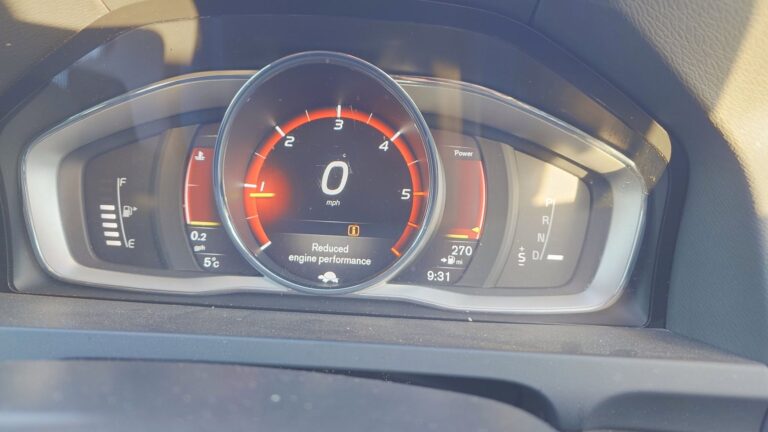
You are cruising down the highway, minding your own business, when suddenly your Volvo loses power, a little turtle icon lights up on the dash, and the words “Reduced Engine Performance” stare back at you. Your first instinct is probably panic. Is the engine about to blow up? Should you pull over immediately? Is this going to cost you thousands of dollars?
Take a breath. That turtle is not a sign your car is dying on the spot. It is your Volvo’s way of protecting itself from something it does not like, and it is doing exactly what it was designed to do. This protective response, commonly nicknamed “limp mode,” deliberately dials back your engine’s power so you can limp your way to a service center instead of risking real damage.
That said, ignoring it or hoping it fixes itself is not a great plan either. Understanding why this happens, what usually causes it, and how a shop actually tracks down the problem can save you real money and a lot of unnecessary stress. Let us walk through everything, from what this warning actually means to what it might cost to fix.
Why Your Volvo Deliberately Slows Itself Down
Limp Mode Is Not a Malfunction, It Is a Safeguard
Here is the thing most drivers do not realize. Limp mode, sometimes called safe mode, is not your car breaking down. It is your Engine Control Module, or ECM, noticing that something is operating outside of its normal, safe range and deciding to intervene before that something turns into a five figure repair bill.
Think of your ECM as a very cautious babysitter. The moment it sees something acting up, whether that is a sensor sending weird readings or the engine running hotter than it should, it steps in and takes away the car’s ability to run at full strength. Not because it wants to punish you, but because letting the engine keep running normally under those conditions could cause real, expensive damage.
When this protective mode kicks in, your Volvo typically:
- Caps your top speed somewhere around 30 to 50 mph
- Limits engine RPM to roughly 2,000 to 3,000
- Displays the reduced performance warning message along with the turtle icon
- Still allows enough power to drive yourself to safety or to a repair shop
This whole system is genuinely clever when you think about it. Your car is not just shutting down and stranding you in traffic. It is giving you exactly enough power to get somewhere safe while preventing the specific conditions that could turn a manageable issue into a blown engine or a fried transmission.
Picture this scenario. You are driving your Volvo XC60 home from work when the throttle body starts acting erratically. Instead of letting the engine surge unpredictably or potentially overheat from an airflow imbalance, the ECM steps in, caps your power output, and lets you drive at a reduced but stable speed the rest of the way home. Annoying? Absolutely. But it beats being stranded on the shoulder waiting for a tow truck.
Warning Signs That Show Up Alongside the Turtle
When your Volvo triggers reduced engine performance, it rarely shows up as a single isolated warning. Usually, you get a cluster of indicators all at once, which actually helps narrow down what is going on.
- The main “Reduced Engine Performance” text message on your dash
- The turtle icon, which has become something of an infamous symbol among Volvo owners
- Your check engine light turning on
- Possibly a temperature warning symbol, depending on the cause
- Other system specific lights, depending on what triggered the issue in the first place
Each of these lights is your car trying to tell you something specific. The turtle icon in particular is important to recognize, because it tells you this power reduction is intentional, not some random mechanical failure happening on its own. Your car knows exactly why it slowed down, even if you do not yet.
The Real Culprits Behind Reduced Engine Performance
Now for the part you actually want answered. What is actually causing this? In the real world, a handful of specific systems are responsible for the vast majority of limp mode triggers in Volvos. Let us go through them one by one.
Throttle Body and ETM Trouble
The throttle body system is easily one of the most common reasons Volvos end up in reduced performance mode. The Electronic Throttle Module, or ETM, controls exactly how much air enters your engine. When it starts misbehaving, your ECM does not take chances. It cuts power immediately as a precaution.
Symptoms that point toward throttle body or ETM issues typically include:
- Idle speed that jumps around erratically instead of holding steady
- Throttle response that suddenly feels off or delayed
- The engine revving unusually high right at startup
- Hesitation when you press the gas pedal
- Idle behavior that seems inconsistent from one drive to the next
Carbon buildup is by far the most frequent cause here. Over years of driving, deposits slowly accumulate on the throttle plate and the housing surrounding it, which restricts airflow and confuses the sensors trying to measure it. Regular cleaning can head off a lot of these problems before they get bad enough to trigger a warning, though a severely gunked up unit sometimes just needs to be replaced outright.
Mass Airflow Sensor Failures
Your Mass Airflow sensor, usually just called the MAF sensor, measures how much air is coming into the engine and reports that data to the ECM, which uses it to calculate the correct fuel mixture. When this sensor fails, your engine can start misfiring, hesitating during acceleration, or stalling outright, all of which can eventually trigger reduced performance mode.
MAF sensor problems tend to progress in a fairly predictable pattern, worsening over time rather than failing all at once:
- Slight hesitation during acceleration paired with noticeably worse fuel economy
- Rough idling and jerky, uneven acceleration
- Actual stalling, particularly noticeable when sitting at idle
- Full reduced performance mode kicking in
Here is a quick diagnostic trick you can try at home before heading to a shop. With the engine running, gently tap on the MAF sensor housing. If your idle immediately changes or stumbles when you do this, that is a strong hint the sensor has internal damage and needs replacing.
Diesel Particulate Filter Blockage
If you drive a Volvo with a diesel engine, DPF clogging deserves its own conversation, because it is a genuinely common and somewhat unique cause of reduced performance. The Diesel Particulate Filter captures soot particles produced during combustion and periodically burns them off in a process called regeneration.
When that filter gets severely clogged, several things happen at once:
- Exhaust flow becomes restricted
- Turbocharger efficiency drops noticeably
- The ECM steps in and limits performance to protect the system
Here is the part that trips up a lot of owners. Regeneration requires very specific driving conditions to work properly, generally sustained speeds above 37 to 50 mph maintained for an extended period, long enough to reach temperatures high enough to actually burn off the accumulated soot. If your daily driving consists mostly of short trips around town, your DPF might genuinely never get the chance to regenerate on its own.
Keep an eye out for black smoke coming from your exhaust, noticeably worse fuel economy, and any DPF specific warning lights on your dash. These are your early signals that regeneration is not keeping up.
Fuel System Problems
Fuel delivery issues are another frequent trigger for reduced engine performance. The fuel system involves several components working together, including the fuel pump, filter, injectors, and pressure regulator, and any one of them acting up can throw the whole system out of balance.
Common fuel system culprits include:
- Fuel pump failure: causes intermittent power loss and can make starting the car noticeably harder
- Clogged fuel filter: restricts fuel flow, especially noticeable when you press hard on the accelerator
- Dirty or failing injectors: lead to misfires and poor combustion overall
- Pressure regulator issues: create incorrect fuel pressure throughout the system
Here is some genuinely good news though. A lot of these problems are preventable with basic, routine maintenance. Something as simple as swapping your fuel filter on schedule can head off issues before they ever get bad enough to trigger a limp mode warning.
Ignition System Failures
Failing spark plugs or ignition coils are another well known trigger for reduced performance warnings. Modern Volvo engines use a separate ignition coil for each individual cylinder, and even a single coil failing can cause a surprisingly noticeable drop in how the car runs.
Watch for these telltale signs of ignition trouble:
- Rough idle that just does not feel smooth anymore
- Hesitation whenever you accelerate
- A noticeable, general loss of power
- Actual engine misfires you can feel through the cabin
Your ECM keeps a close eye on ignition performance specifically because misfires can seriously damage your catalytic converter if left unchecked, and that is a far more expensive part to replace than a spark plug. Sticking to the recommended replacement schedule, typically somewhere between 60,000 and 100,000 miles depending on your engine, prevents the vast majority of these ignition related headaches.
Critical Sensor Failures
Your Volvo genuinely runs on data. Modern engines rely on a whole network of sensors constantly feeding information to the ECM, and any one of them going bad can trigger reduced performance mode as a precaution. Key sensors involved here include:
- Oxygen sensors
- Throttle position sensor
- Intake air temperature sensor
- Engine coolant temperature sensor
Each of these sensors feeds a specific piece of information to your ECM that helps it optimize both performance and emissions. When even one of them starts sending bad data, whether from age, corrosion, or physical damage, the ECM may not be able to trust the overall picture it is getting, and it responds by limiting power until the situation gets sorted out.
How a Real Mechanic Actually Diagnoses This Problem
Guessing at what caused a limp mode warning is a great way to waste money replacing parts that were never the problem. Here is what an actual diagnostic process looks like when done properly.
Start With an OBD-II Scan
The very first step in any proper diagnosis is pulling the diagnostic trouble codes stored in your ECM. These codes are not vague guesses, they point toward specific systems or components that triggered the fault, giving a technician a genuine starting point instead of a shot in the dark.
Professional grade diagnostic tools go well beyond what a basic code reader offers, providing:
- Access to manufacturer specific codes that generic scanners cannot read
- Live data streaming so a technician can watch sensor readings in real time
- Component testing capabilities built directly into the software
- System adaptation functions needed after certain repairs
Basic consumer OBD-II scanners can read generic codes just fine, but some Volvo specific codes genuinely require professional equipment to interpret correctly. If you want a starting point without spending money right away, plenty of auto parts stores offer free code reading services, which at least gives you a rough idea of where to focus before committing to a full diagnostic appointment.
Going Beyond Basic Codes
Reading a code is just the beginning. A skilled technician then uses component specific testing procedures to actually confirm the source of the problem rather than just guessing based on the code alone.
- Throttle body diagnosis: testing sensor voltage readings and running proper adaptation procedures
- MAF sensor testing: checking actual voltage outputs and how the sensor responds dynamically to airflow changes
- Fuel system diagnostics: measuring fuel pressure directly, along with injector flow rates and pump performance
- Turbocharger checks: verifying boost pressure and inspecting for intake leaks that could throw off readings
These techniques require specialized equipment most home garages simply do not have, but they give a definitive answer about what is actually happening rather than a best guess based on symptoms alone.
A Systematic Approach Beats Guesswork Every Time
Good diagnostic work follows a logical sequence rather than jumping straight to replacing whatever part seems most likely:
- Start with the basics, checking fluid levels, doing a visual inspection, and reading stored codes
- Test the specific systems flagged by those codes and the symptoms you described
- Verify that the repair actually worked through comprehensive follow up testing
- Document everything for future reference, since these records matter if problems recur
This methodical approach prevents the classic scenario of throwing parts at a problem hoping something sticks, which ends up costing far more than a proper diagnosis would have in the first place.
| Common Warning Sign | Possible Causes | Initial Diagnostic Steps |
|---|---|---|
| Reduced power plus turtle icon | Multiple potential issues | Retrieve fault codes, check fluid levels |
| Erratic idle plus reduced power | Throttle body or ETM issues, vacuum leaks | Check for DTCs, inspect intake system |
| Hesitation plus reduced power | MAF sensor, fuel system issues | Check for DTCs, inspect air filter, test fuel pressure |
| Normal power until DPF warning | DPF blockage | Check mileage since last regeneration, verify warning messages |
| Misfiring plus reduced power | Ignition system issues, fuel problems | Check spark plugs, ignition coils, fuel pressure |
What to Actually Do the Moment This Warning Appears
Your Immediate Response
When that turtle icon shows up and your power drops, do not panic and do not keep driving aggressively hoping it clears itself. Follow these steps instead:
- Pull over safely as soon as you reasonably can, and shut the engine off
- Wait somewhere between 10 and 15 minutes before restarting
- Check your fluid levels, including oil, coolant, and transmission fluid
- Look for anything obviously wrong, like a disconnected hose or a visible fluid leak underneath the car
For a genuinely temporary glitch, this simple restart procedure sometimes clears the warning entirely. But here is the important part. If the warning comes right back after restarting, that is your car telling you the underlying issue is still there, and it genuinely needs professional attention rather than another restart attempt.
Fixing Throttle Body and ETM Issues
Throttle body problems typically get resolved one of two ways, either through cleaning or full replacement, depending on how bad the buildup or damage actually is.
The cleaning process generally looks like this:
- Remove the throttle body from the intake manifold
- Apply a specialized cleaner designed to break down carbon deposits
- Reinstall the unit and run the necessary adaptation procedures
If the throttle body is too far gone to clean effectively, replacement becomes the only real option. This is a genuinely involved procedure requiring proper programming and adaptation through professional diagnostic equipment, so this is not really a driveway job for most owners.
Dealing With a Failing MAF Sensor
MAF sensor problems can often be resolved with a straightforward cleaning before jumping to replacement:
- Remove the sensor from the air intake system
- Spray it down with a specialized MAF sensor cleaner, being careful never to physically touch the delicate sensing element inside
- Let it air dry completely before putting it back
If cleaning does not resolve the issue, replacement is the next step. Stick with a quality replacement sensor that meets OEM specifications, since a cheap aftermarket sensor can introduce its own inaccuracies and cause you to end up right back where you started.
Fuel System Repairs Depend on What Actually Failed
Fuel system fixes vary a lot depending on which component is causing the trouble.
- Locate the filter, often positioned under the vehicle or near the fuel tank
- Safely relieve fuel system pressure before removing anything
- Install the new filter, paying close attention to correct orientation
- More involved work, often requiring removal of interior trim to access the pump
- Careful extraction of the pump assembly while managing any fuel spillage
- Installing a new pump that meets OEM specifications
Injector service:
- Professional cleaning equipment can often restore injectors to proper working order
- Severely damaged injectors need outright replacement rather than cleaning
- Careful attention to torque specifications during reinstallation prevents fuel leaks
Keeping Your DPF System Healthy
DPF issues in Volvo diesels require some specific procedures that go beyond what most owners can handle at home.
Forced regeneration:
- Uses diagnostic equipment to force a high temperature burn cycle
- Can successfully clear minor blockages
- Requires specific safety precautions given the genuinely extreme exhaust temperatures involved
DPF cleaning or replacement:
- Severe blockages may require physically removing the filter for professional cleaning
- Complete failure means replacement, which is genuinely one of the pricier repairs on this list
Prevention really is the best strategy here. Regular highway driving gives your DPF the sustained heat it needs for natural regeneration, while using quality fuel and sticking to proper oil change intervals both help prevent premature filter failure.
What This Is Actually Going to Cost You
Typical Repair Price Ranges
Knowing roughly what to expect financially helps you make better decisions and avoid getting blindsided by a shop’s quote.
| Repair Service | Typical Cost Range |
|---|---|
| Diagnostic service | $100 to $200 |
| Throttle body cleaning and adaptation | $150 to $300 |
| Complete ETM replacement | $500 to $1,500 |
| MAF sensor replacement | $200 to $400 |
| Fuel pump replacement | $500 to $1,200 |
| Spark plug replacement | $100 to $250 |
| Fuel injector replacement | $1,000 to $2,500 |
| DPF replacement | $2,000 to $4,000 |
| Turbocharger repair or replacement | $2,000 to $5,000 |
Look at that range from a hundred dollar spark plug job all the way up to a five thousand dollar turbocharger replacement. That gap alone should tell you exactly why catching problems early through preventive maintenance is so much cheaper than waiting for a full blown failure.
Choosing Who Actually Works on Your Car
Where you take your Volvo matters just as much as what repair you are getting done. Here is how the main options stack up against each other.
Volvo dealerships offer:
- Factory trained technicians who know the platform inside and out
- Guaranteed access to genuine OEM parts
- Access to the very latest technical service bulletins and information
- Generally the highest service costs of the three options
Independent European specialists offer:
- Deep, specialized knowledge of Volvo systems specifically
- Access to quality aftermarket parts as a more affordable alternative to OEM
- Generally more competitive pricing than a dealership
- A more personal, relationship based approach to service
General repair shops offer:
- Potentially lower pricing than either of the above options
- Sometimes limited familiarity with Volvo specific systems
- Limited diagnostic capability for more complex or unusual issues
If you go the independent shop route, take a few minutes to verify certifications, ask around for references, and confirm they actually have the diagnostic equipment needed to work on Volvo specific systems before handing over your keys.
Thinking Beyond the Immediate Repair
A few habits genuinely pay off over the long run when it comes to managing your Volvo’s health:
- Check your warranty coverage first, since some of these components may still fall under factory or emissions related warranty protection
- Choose quality parts, because the parts you pick affect both whether the repair actually works and how long it lasts afterward
- Build an ongoing relationship with a shop you trust, rather than bouncing between different places every time something goes wrong
- Keep detailed records of every service performed, which helps track patterns and proves valuable if you ever sell the car
- Prioritize regular preventive maintenance, since it consistently offers the best long term value compared to reactive repairs
A Few Questions Volvo Owners Ask About This Warning
Can I keep driving with the turtle icon showing?
You technically can, since limp mode is specifically designed to let you drive to safety. Even so, do not treat it as normal driving. Get to a repair shop as soon as reasonably possible rather than continuing to drive around with it active for days or weeks.
Will turning the car off and back on clear the warning?
Sometimes, particularly if the trigger was a minor, temporary glitch rather than an actual mechanical issue. But if the warning returns after restarting, that is a clear sign the underlying cause is still present and needs real diagnosis, not another restart.
Is this covered under my warranty?
It depends on your specific warranty and what component actually failed. Emissions related parts, like certain sensors and the DPF system, often carry separate, longer warranty coverage than the rest of the vehicle. Check your documentation or call your dealership to confirm before paying out of pocket.
How do I avoid this happening again?
Stick to your maintenance schedule, particularly for spark plugs, fuel filters, and throttle body cleaning. If you drive a diesel Volvo, make an effort to get on the highway regularly at sustained speeds to allow proper DPF regeneration, especially if most of your driving is short trips around town.
Take This Warning Seriously, But Do Not Panic Over It
Reduced engine performance warnings are genuinely sophisticated protective systems built specifically to keep small problems from turning into catastrophic engine damage. Understanding the common causes, from throttle body buildup to a failing sensor, means you will know exactly what to expect when that turtle shows up rather than assuming the worst.
The real key here is getting a proper professional diagnosis quickly, followed by targeted repairs using quality parts rather than guesswork. A simple restart might clear up a minor glitch, but a warning that keeps coming back deserves genuine attention before it turns into a much bigger repair bill.
At the end of the day, preventive maintenance remains your best defense against ever seeing that turtle icon in the first place. Stay on top of your service schedule, use quality fuel, and give your car the highway miles it needs to keep its systems clean. Your Volvo is telling you when something is wrong. The least you can do is actually listen.
